Safe use of cleaning chemicals in professional kitchens
Using cleaning chemicals correctly in a professional kitchen is a critical control measure to prevent food poisoning and chemical contamination. This guide provides actionable routines for managing detergents, disinfectants, and sanitisers during busy services while maintaining compliance with food safety regulations.
Understanding chemical types and standards
Not all cleaning agents are equal. Using the wrong product for a task often results in “clean-looking” surfaces that still harbour dangerous levels of pathogens.
- Detergents: These are “soap-based” products designed to lift grease and organic matter. They do not kill bacteria. Use them for the first stage of cleaning to remove visible dirt.
- Disinfectants: These contain antimicrobial agents that reduce bacteria to safe levels. They must be applied to a surface that has already been cleaned with detergent.
- Sanitisers: A dual-action product. In a professional kitchen, these are often used twice: once to clean and a second time to disinfect.
To ensure effectiveness against pathogens like E. coli or Salmonella, choose products that meet BS EN 1276 or BS EN 13697 standards. These certifications prove the chemical can kill 99.999% of bacteria within a specific contact time.
The two-stage cleaning framework
A single spray-and-wipe approach is rarely sufficient for food-contact surfaces. The two-stage clean ensures that grease does not “shield” bacteria from the disinfectant.
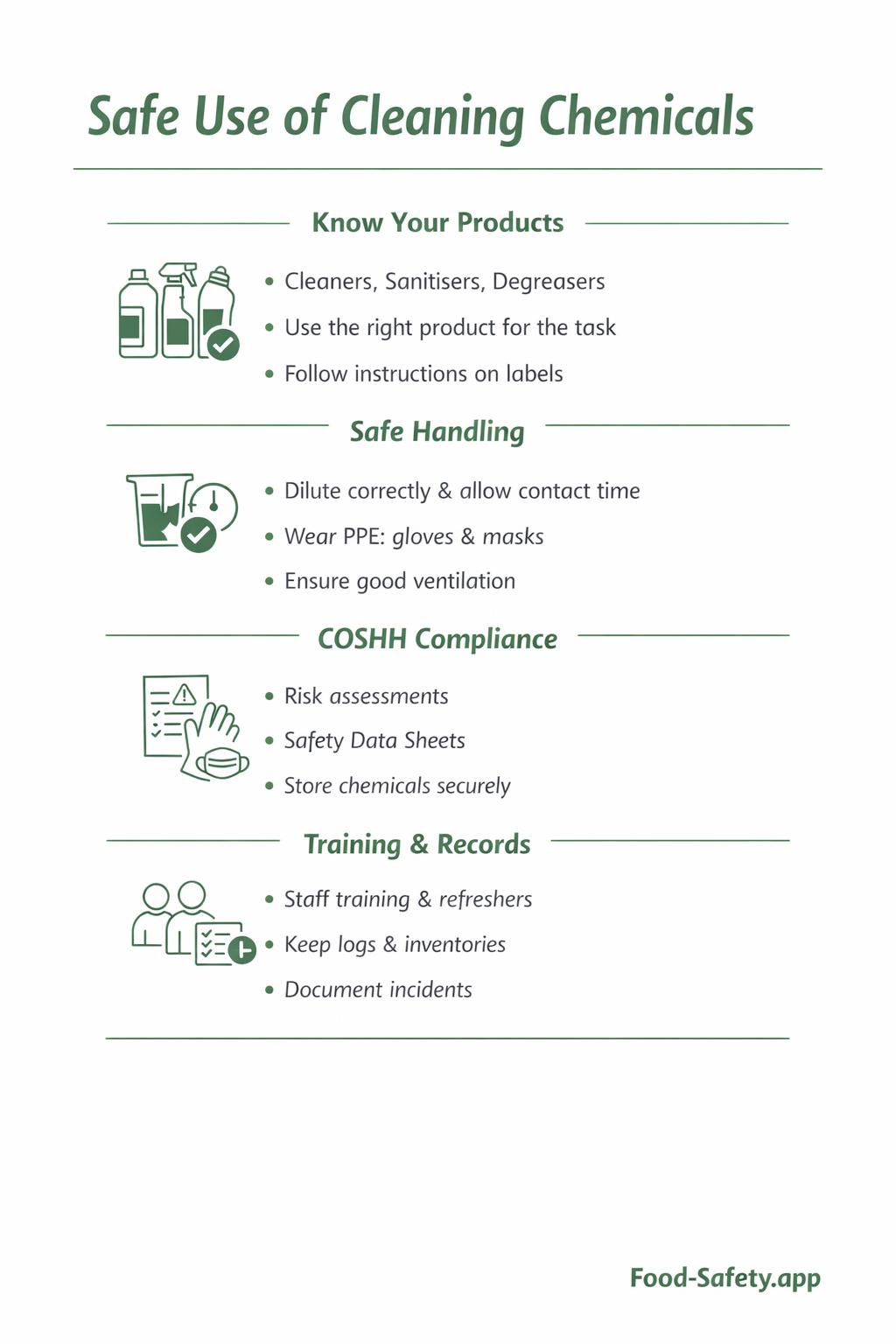
- Stage one (Preparation and cleaning): Remove loose debris. Apply detergent or sanitiser and wipe with a clean cloth to remove grease and food residue. Rinse with clean water if required.
- Stage two (Disinfection): Apply disinfectant or sanitiser to the visibly clean surface. Ensure the surface remains wet for the full manufacturer-recommended contact time.
- Final rinse and dry: If the product is not “no-rinse,” use clean water to remove chemical residues. Allow to air dry or use disposable blue roll.
This process is essential for HACCP compliance, particularly on prep benches used for raw meat and ready-to-eat foods.
Dosing, contact time, and verification
Chemicals only work if used at the correct concentration. Guesswork leads to chemical taint in food or survival of bacteria.
Dilution control
- Use automatic dosing systems or calibrated pumps to ensure consistency.
- Never “glug” concentrates into a bottle; use a measuring jug.
- Check that the water temperature matches the manufacturer’s instructions, as some chemicals lose efficacy in very hot or very cold water.
The importance of contact time
Contact time is the duration a chemical must stay wet on a surface to kill pathogens. If a label specifies a 30-second or 5-minute contact time, wiping it off early renders the disinfection stage useless. Use a kitchen timer or “clean-as-you-go” rotation where one bench is left to sit while another is pre-cleaned.
Preventing chemical cross-contamination
Chemicals are a physical and toxicological hazard if they reach the food chain. Follow these storage and handling rules:
- Storage: Keep all chemicals in a dedicated, locked cupboard or area away from food prep and storage. Store liquids on bottom shelves to prevent leaks from contaminating items below.
- Labelling: Every spray bottle must have a durable, waterproof label. If you decant from a 5L drum, the spray bottle must state the product name, dilution ratio, and any hazard symbols (e.g., corrosive or irritant).
- Aerosol management: Never spray chemicals near open food. Spray directly into a cloth at waist height, then wipe the surface to prevent “chemical mist” from settling on ingredients.
- Colour-coding: Use red cloths for washrooms, blue for general areas, and green or white for food prep surfaces. This prevents moving chemicals and bacteria between high-risk and low-risk zones.
Staff safety and COSHH compliance
Under COSHH (Control of Substances Hazardous to Health) regulations, employers must protect staff from chemical exposure. This is a key part of maintaining personal hygiene standards and workplace safety.
- Personal Protective Equipment (PPE): Provide heavy-duty gloves, aprons, and eye protection for handling concentrates.
- Safety Data Sheets (SDS): Keep a folder containing the SDS for every chemical on-site. This is the first thing a paramedic or doctor will need if an accident occurs.
- Ventilation: Ensure extraction is running when using strong chemicals like oven cleaners or descalers to prevent respiratory irritation.
Emergency spill response procedure
In a busy service, a chemical spill can shut down a kitchen. Follow this checklist:
- Isolate: Keep staff and food away from the area immediately.
- Identify: Check the label to see if the substance is flammable, corrosive, or toxic.
- Contain: Use a spill kit or non-combustible absorbent material (like sand or dedicated spill pads). Do not use towels that will be reused.
- Dispose: Place contaminated materials in a sealed bag and dispose of them according to local waste regulations.
- Decontaminate: Clean the floor or surface thoroughly with water and detergent to remove slippery residues.
Common mistakes and corrective actions
| Mistake | Risk | Corrective action |
|---|---|---|
| Mixing bleach with acid cleaners | Release of toxic chlorine gas | Evacuate area, ventilate, and retrain staff on chemical compatibility. |
| Using unlabelled spray bottles | Accidental use as a food ingredient | Discard contents immediately. Clean, dry, and relabel the bottle before reuse. |
| Applying chemicals to hot surfaces | Fumes and reduced chemical efficacy | Allow equipment (e.g., griddles) to cool to the recommended temperature before cleaning. |
| Storing chemicals above prep benches | Drip contamination into food | Move storage to a low-level, dedicated chemical area. Discard any exposed food. |
Frequently asked questions
Can I use the same sanitiser for everything?
You can use a high-quality sanitiser for most tasks, but you must use it twice: once to clean and once to disinfect. For heavy grease (like extraction hoods), a dedicated degreaser/detergent is more effective for the first stage.
How often should I change my cleaning solution?
If using a bucket and cloth, change the solution as soon as it becomes visibly soiled or cold. Using dirty water just spreads grease and neutralises the disinfectant. For spray bottles, follow the manufacturer’s “shelf life” for diluted products—some lose power after 24 hours.
Do I need to keep training logs for cleaning?
Yes. Providing chemicals without training is a breach of safety law. Maintain updated staff training logs showing that every team member understands dosing, PPE, and contact times for the specific products you use. Ensure this is reflected in your daily food safety cleaning schedule.