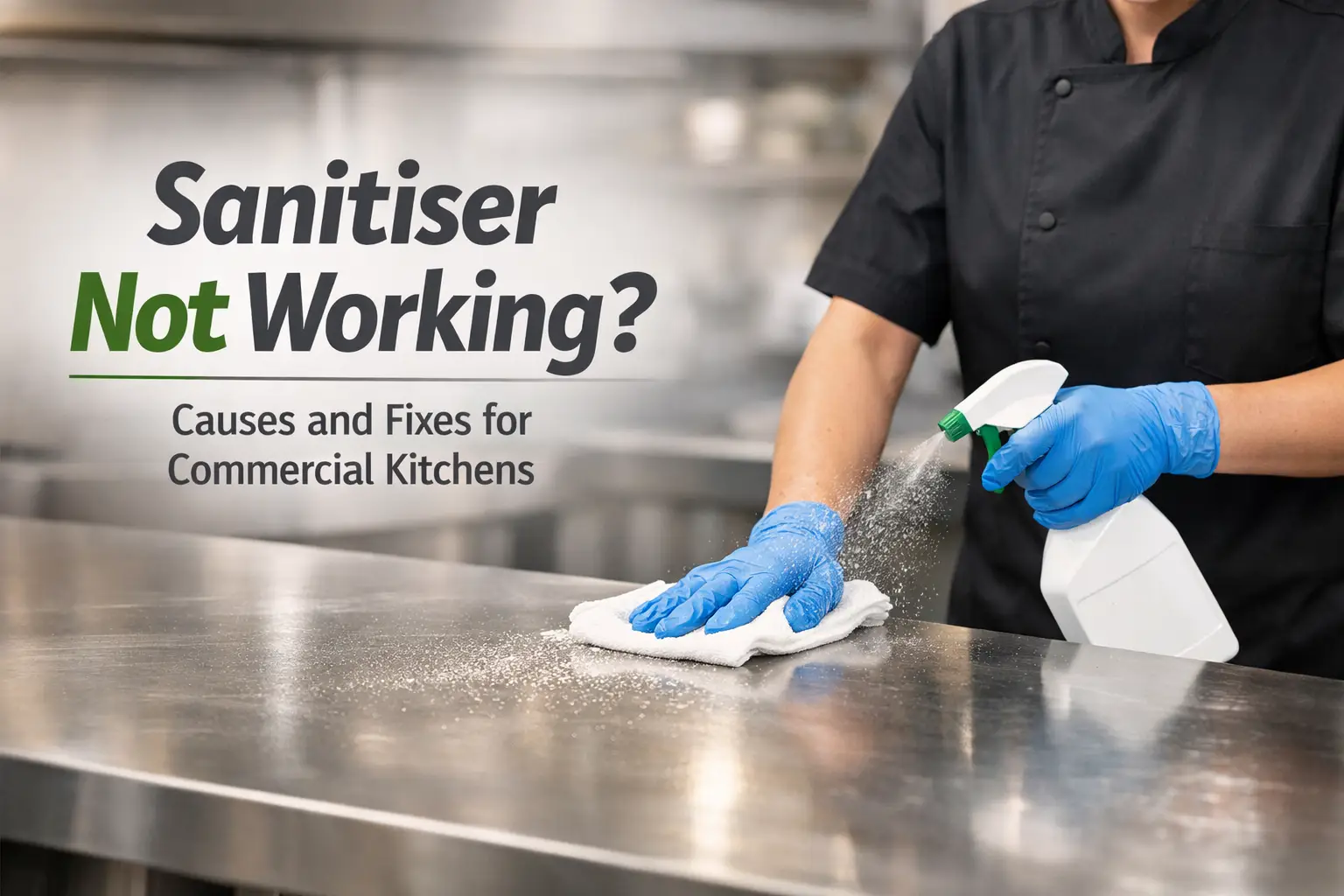
If you’re seeing surfaces that look clean but still risk contamination, this guide helps pinpoint why sanitising may fail in real kitchens. You’ll learn common mistakes, practical checks, and how better training and record-keeping can improve inspector confidence. From soil removal to correct dilution and logging, these fixes keep sanitiser routines effective during service.
Cleaner vs disinfectant: when a spray will not remove grease, dirt, or food residue first
Important: Sanitiser efficacy hinges on soil-free surfaces. If you can see grease or food residue, the product cannot work properly.
Sanitising only works if the surface is free of visible soil. A cleaner is designed to remove grease, dirt and food residue; a disinfectant then works on reducing microorganisms. If you apply a sanitiser to a greasy prep bench, you’re mainly spreading soil rather than sanitising the surface. Start with a proper cleaner, rinse or wipe as required, dry the surface, then apply the sanitiser following the product label.
In practice:
- Confirm whether the product you’re using is a cleaner, a disinfectant, or a combined product.
- Use the cleaner first, then the disinfectant in the recommended order if both are required.
- Ensure surfaces are visually clean before moving to disinfection.
If in doubt, perform a quick soil check before sanitising and re-clean if needed.
High-traffic areas often accumulate hidden soils; neglecting initial cleaning is the most common cause of perceived “failed” sanitising.
Practical checks you can implement
- Establish a simple soil check checklist at each station.
- Train staff to recognise visible soil, not just a shininess that looks clean.
- Keep a dedicated cleaning cloth for soil removal at each area.
Contact time errors
The surface must stay wet for the recommended contact time; wiping off early shortens efficacy and increases risk.
Even if you spray correctly, sanitiser only works while it stays in contact with the surface for the time stated on the label. Wiping off too soon or drying the area with towels interrupts the dwell time, leaving pathogens more likely to survive. In busy kitchens during service, it’s easy to rush this step, but compromising dwell time defeats disinfection.
A practical scenario: a line cook finishes a station, sprays a sanitiser, and immediately dries the surface to “save time.” That single action shortens contact time and defeats disinfection.
How to tighten up contact time:
- Use a visible timer or stopwatch to track dwell time between application and wiping.
- Apply product to one small area at a time during service to avoid rushing.
- If you re-treat, ensure the surface remains wet for the full dwell time each time.
Wrong dilution
Excessive concentration can leave residues or create safety issues; under-dilution may be ineffective.
Using too much or too little sanitiser—or the wrong product for the job—undermines effectiveness. Concentrates that aren’t mixed correctly can leave residues or fail to kill microbes, while over-diluted solutions will fall short of the intended potency. Ready-to-use products reduce dilution errors, but even these require periodical checks and adherence to the label.
Key checks to prevent dilution errors:
- Read and follow the label precisely; use the supplied measuring tools.
- Use colour-coded or clearly labeled dilution containers to reduce mix-ups.
- Calibrate spray bottles or dispensing systems at set intervals.
- Do not top up a bottle by eye; re-check the concentration after each refill.
A scenario to avoid: a cleaning bottle is topped up without rechecking the dilution, leaving the solution ineffective for sanitising tasks.
Staff shortcuts
Rushed cleaning leads to inconsistent results; dedicated cloths and deliberate routines improve outcomes.
What to reinforce with teams:
- Use colour-coded cloths and separate soil and surface cloths.
- Avoid reusing dirty cloths across stations; establish clear cloth handling rules.
- Implement a short, repeatable end-of-shift cleaning routine that includes re-checks of soil, dilution, and dwell time.
- Schedule periodic refreshers on label reading and product compatibility.
A practical example: during a lunch rush, the team shares a single cloth between prep tables. This spreads contamination and undermines sanitation.
Product checks
Always check expiry dates and ensure the product is compatible with the surface and method of use.
Product knowledge is foundational. Staff should read labels, confirm that the product is appropriate for the surface, and verify expiry dates and dispensing methods. Poor product checks lead to missed incompatibilities (e.g., using a disinfectant on a non-food-contact surface without considering residue) or expired formulations that are no longer effective.
How to embed product checks into routine:
- Train staff on label sections: active ingredients, contact time, safe usage, and surface compatibility.
- Use a simple daily quick-check sheet for expiry, dispensing system status, and whether the correct product is at each station.
- Keep a short, timestamped record of when products are dispensed and refiled.
In addition, ensure the cloths used with particular products match the intended type and colour coding.
High-risk areas
Food contact surfaces require careful re-cleaning when soils are present; a single quick spray won’t suffice.
Some surfaces pose greater risk for cross-contamination: food contact surfaces (prep tables, chopping boards), door handles, sinks, fridge and freezer seals, and other contact points. These areas demand stricter cleaning discipline, as microbes can transfer quickly from dirty surfaces to food or hands.
Operational focus to protect high-risk zones:
- Clean and sanitise these surfaces more frequently, not just during a general clean.
- Establish specific procedures for handles, boards, and seals that require higher attention.
- Use validated routines for areas that see heavy use, such as service counters and line prep stations.
- Keep a clean record of tasks performed, including any corrective actions, so inspectors see a clear trail.
Operational improvements you can implement today:
- Make “clean first, sanitise second” a formal step in the routine.
- Add simple visual checks for soil, dilution, and contact time at each station.
- Train staff on product labels, colour coding and correct use.
- Record scheduled cleaning and any custom tasks clearly.
- Use defect reporting if poor results, equipment issues, or product problems are found.
- Keep cleaning records and corrective actions ready for inspection.
Food-Safety.app can help you manage all of these. It enables you to set cleaning tasks, log completion, record corrective actions, and keep a clear digital trail. Features like custom cleaning schedules, offline use, automatic timestamps, and exportable records make audits smoother and inspections less stressful. If you’re aiming for consistent, verifiable hygiene, this is the kind of tool that keeps you ahead of the questions inspectors ask.