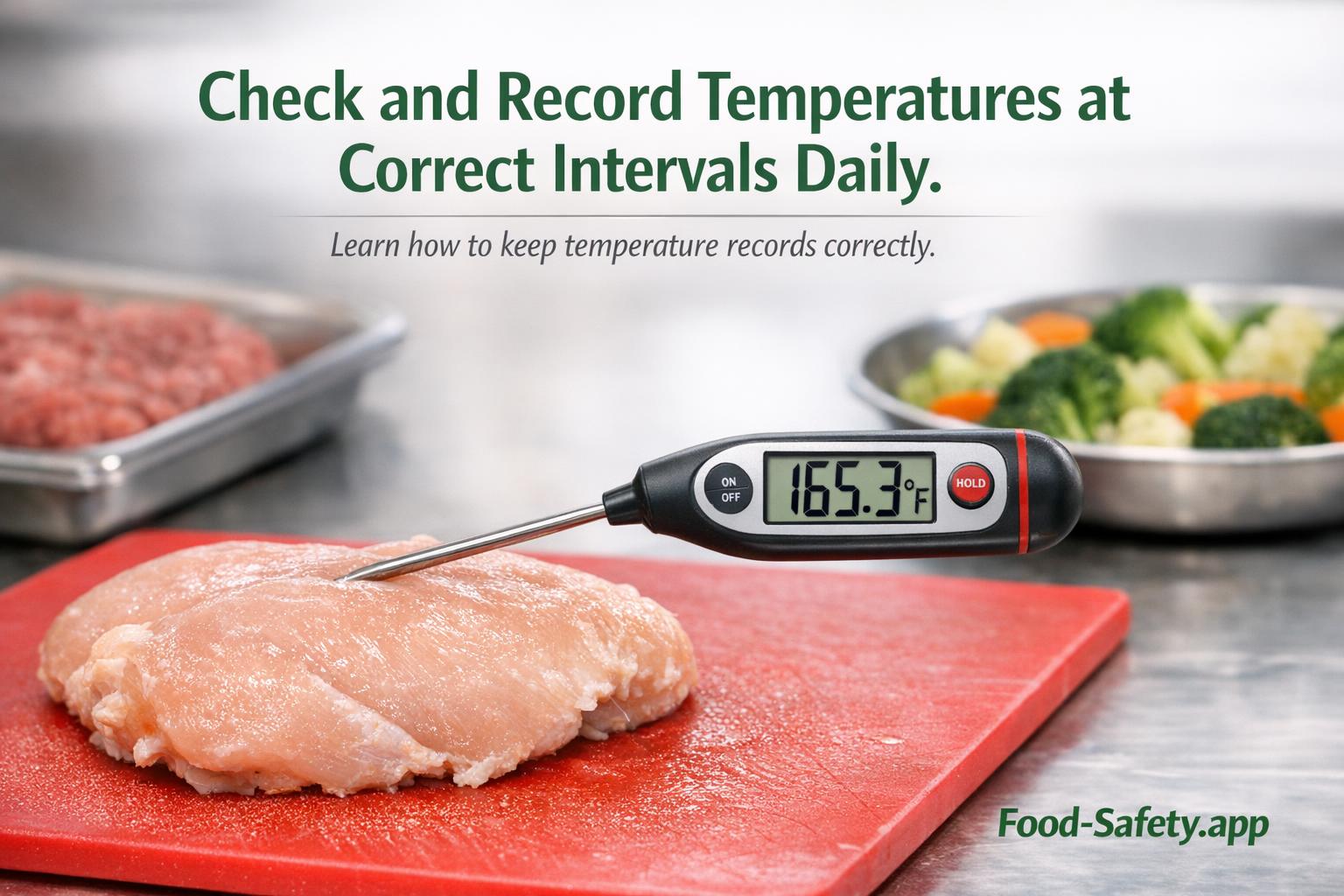
Temperature records are not just paperwork. They are part of your food safety controls, showing that chilled storage, cooking, hot holding, cooling, and delivery checks are being done at the right time and in the right way. In a catering or hospitality business, this matters because conditions change quickly: a fridge can warm up overnight, a bain marie can drift during a busy lunch rush, and a delivery vehicle can be delayed at the worst possible moment. They are foundational to HACCP-based record-keeping, see HACCP principles explained for more context.
Why temperature records matter
Temperature records are not just paperwork. They are part of your food safety controls, showing that chilled storage, cooking, hot holding, cooling, and delivery checks are being done at the right time and in the right way. In a catering or hospitality business, this matters because conditions change quickly: a fridge can warm up overnight, a bain marie can drift during a busy lunch rush, and a delivery vehicle can be delayed at the worst possible moment. They are foundational to HACCP-based record-keeping, see HACCP principles explained for more context.
What often goes wrong is that teams collect numbers without using them. A fridge sheet may be completed every day, but no one notices repeated high readings in one unit, or no one follows up when a delivery arrives warm. Good temperature records should help you make decisions, not just fill a folder.
The focus keyword here is simple: temperature records must be accurate, timely, and easy to review. That is what makes them useful during normal operations and during an inspection.
What good temperature records look like
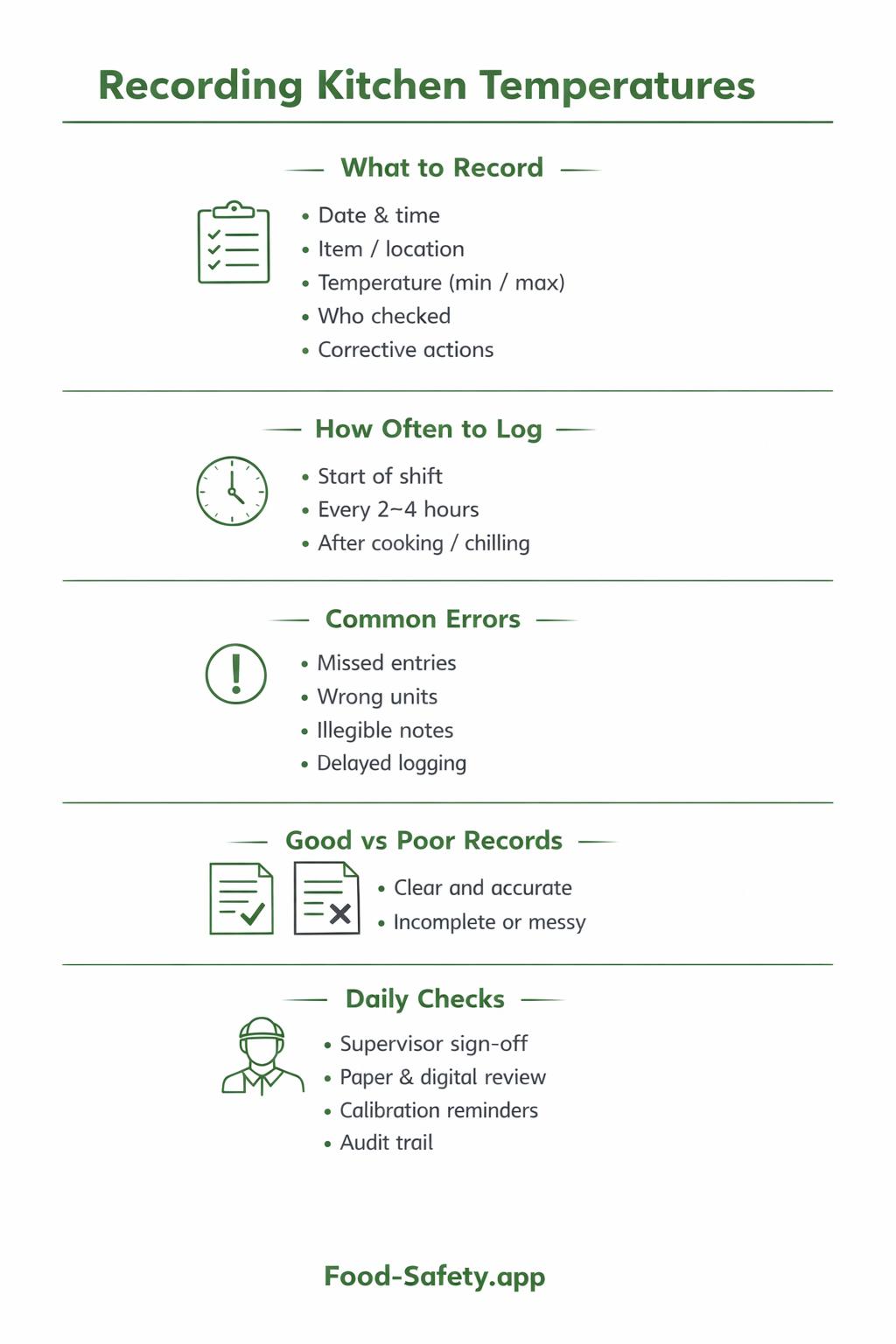
Good temperature records are clear enough that a manager can understand them at a glance. They should show what was checked, when it was checked, who checked it, what the reading was, and what action was taken if the result was not satisfactory. They should also help identify patterns and trigger follow-up actions as needed. For context on cross-contamination risks in kitchens, see cross-contamination and food safety management.
In a professional kitchen, good records are practical rather than perfect. They are completed at the point of check, not filled in from memory at the end of a shift. They also use a consistent format so the team does not waste time guessing which box to tick or where to write a note.
What commonly goes wrong is that forms are too complicated, so staff skip fields or copy the same number each day. That creates false confidence. A better system is one that takes less than a minute per check, uses clear prompts, and makes any unusual reading stand out immediately.
Good temperature records usually include:
- Date and time of the check
- Location or equipment name
- Food item or storage area checked
- Actual temperature reading
- Name or initials of the person checking
- Corrective action if required
- Follow-up check once the issue has been dealt with
What should be recorded
Different food businesses need to record different checks, but the principle is the same: record the temperatures that matter to the food safety controls in your operation. For many businesses this includes fridge and freezer checks, cooking temperatures, hot holding, cooling checks, and any temperatures linked to deliveries or transport.
What often goes wrong is recording the wrong thing at the wrong time. For example, some teams only record the fridge air temperature but never check whether the unit is actually holding food safely. Others check a cooked item once, but do not record rechecks after the food has been held or reheated. Allergen management should be considered in records as well; see managing allergens safely in a busy kitchen.
Record checks that reflect your operation:
- Fridges and chilled displays
- Freezers where stock control depends on stable storage
- Cooking temperatures for high-risk foods
- Hot holding equipment during service
- Cooling stages for leftovers or batch-cooked food
- Incoming deliveries where temperature is critical
How to keep temperature records properly
To keep temperature records properly, build the routine into the working day rather than treating it as an admin job. The best systems are attached to natural pause points: opening checks, pre-service prep, mid-service spot checks, end-of-shift review, and handover.
The biggest operational mistake is making one person responsible for everything. In a busy kitchen, that often means checks are missed when that person is pulled into service. A better approach is to assign the record to the role, not just the individual. For example, the breakfast lead checks chilled storage before prep; the duty manager checks hot holding at the start of lunch; the closing chef verifies cooling logs before the end of shift. Training records help ensure the right people are trained; see Training records.
Another insight many businesses miss is that temperature checks should be linked to equipment risk. A brand-new fridge may need less attention than an older unit that warms up when the door is opened repeatedly. A record that flags repeated issues with the same appliance is far more useful than a perfect-looking sheet with no pattern.
A practical routine for temperature records
- Check the right item at the right time, not all checks at once
- Use a calibrated probe or reliable built-in system as appropriate
- Record the result immediately while the item is still in front of you
- Write clearly enough that another manager can understand the entry later
- Take action straight away if a reading is outside your normal control limits
- Repeat the check after corrective action and note the outcome
Make records usable during service
During service, staff need speed, not extra admin. Keep log sheets on a clipboard near the check point, use a mounted tablet if your digital system is reliable, and keep pens, wipes, and probe sanitiser together so there is no barrier to completing the check properly. If staff have to hunt for the form, the record will probably be late or incomplete.
Common mistakes and how to avoid them
Some temperature records look complete but still fail the test because they do not reflect what actually happened in the kitchen. The most common problems are missing times, copied readings, unreadable handwriting, and no follow-up action after a problem is found.
Another common issue is completing every check at the end of the shift. That can make the records look neat, but it removes their value as a control measure. Temperature records should help you act early, not just show that someone remembered paperwork later.
Training and induction play a role here as well; see Training records for more on how to structure effective staff induction and ongoing checks.
Common mistakes to watch for
- Recording the same numbers day after day without checking the equipment
- Leaving blank spaces that are later filled in by someone else
- Using vague notes such as “ok” without giving the actual reading
- Failing to record who carried out the check
- Not documenting what happened after a temperature issue was found
- Keeping logs where staff cannot access them quickly during service
The fix is usually straightforward: simplify the sheet, train staff on what “good” looks like, and review records daily so errors are caught while they can still be corrected.
Paper or digital records?
Both paper and digital temperature records can work well if they are used properly. Paper is simple, familiar, and easy to pull out during a power or Wi-Fi issue. Digital records can save time, reduce lost sheets, and make it easier to spot trends across multiple sites. The right choice depends on the pressure your team works under and how consistently the system will be used. For allergen management in records, see managing allergens safely in a busy kitchen.
What commonly goes wrong is choosing a system that looks impressive but slows staff down. In a takeaway or café with fast turnover, a complicated digital workflow can be ignored if it takes too many taps. In a hotel kitchen with multiple departments, a paper-only system can make it harder to compare results across teams.
If you use digital records, make sure alerts are set up so repeated failures do not get buried. If you use paper, make sure completed sheets are reviewed, signed off, and stored securely. In both cases, the system must be accessible during service and reliable at the end of the day. For training and induction, see Training records.
What to do when temperatures are out of range
A temperature record is only as good as the action that follows it. If a fridge is running warm, a hot holding unit is drifting, or a cooked item has not reached the expected standard, staff need a clear next step. That may mean moving food, adjusting equipment, discarding unsafe food, calling maintenance, or escalating to a manager.
One of the most useful habits in a busy kitchen is to write the corrective action in the same place every time. This stops issues being treated as isolated events and helps managers spot patterns quickly. For example, if a fridge in the prep area repeatedly needs adjustment after the lunch rush, the problem may be airflow, loading, or door discipline rather than a one-off fault.
Always record the follow-up check too. That shows the issue was not just noticed, but actually resolved. For practical guidance on audits and inspections, see Understanding food hygiene ratings.
Useful corrective action notes include:
- Moved food to a working fridge
- Adjusted thermostat and rechecked after 15 minutes
- Discarded food that could not be kept safe
- Reported fault to maintenance
- Reduced the load in the unit to improve circulation
- Escalated to the duty manager
Staff training and sign-off
Even the best temperature records system will fail if staff do not understand what they are checking. Training should cover where the check is made, which probe or device to use, what the normal range is for that process, and what to do if the reading is not acceptable. See Training records for related guidance on training documentation.
What often goes wrong is training people on the form rather than the reason behind it. Staff then complete the log without understanding why the check matters. In a pressured kitchen, that leads to habits such as guessing readings or copying the previous line. Good training should include brief practical demonstrations and supervised checks during real service periods.
Sign-off is important too. A signature or initial can show who completed the check, but only if managers actually review the entries. If no one looks at them until an inspection, the system is not doing its job. A short daily review at handover is often enough to catch most problems early. For more on training and induction, see food-safety-induction-training-for-new-staff or training-records.
Using records for audits and customer confidence
Well-kept temperature records do more than satisfy an inspection. They help managers see trends, support complaint investigations, and show customers or clients that food safety is being handled seriously. That is especially useful in schools, hotels, contract catering, and multi-site operations where confidence in the system matters as much as the food itself.
If your records are tidy, complete, and reviewed regularly, you can spot recurring issues before they become service failures. For example, repeated overnight fridge fluctuations may point to a door left ajar, overloading, or a failing seal. A record system that highlights patterns gives you a chance to fix the cause rather than reacting to symptoms. For practical guidance on audits and inspections, see Understanding food hygiene ratings.
Businesses using Food-Safety.app, a food safety management system for catering businesses, can often make this review process easier by keeping checks organised and visible across the team.
For further practical guidance, the Food Standards Agency provides useful food hygiene advice for businesses.
Final checks
To keep temperature records properly, make them timely, clear, and linked to action. The best systems are easy for staff to use during a busy service, specific enough to be meaningful, and consistent enough for managers to spot problems quickly. Focus on the checks that matter to your operation, train staff to record them at the point of action, and review the entries before small issues turn into food safety failures.
If your records are practical, well maintained, and actually used, they become a working control rather than a paperwork burden. That protects customers, supports your team, and gives your business a stronger food safety culture every day.