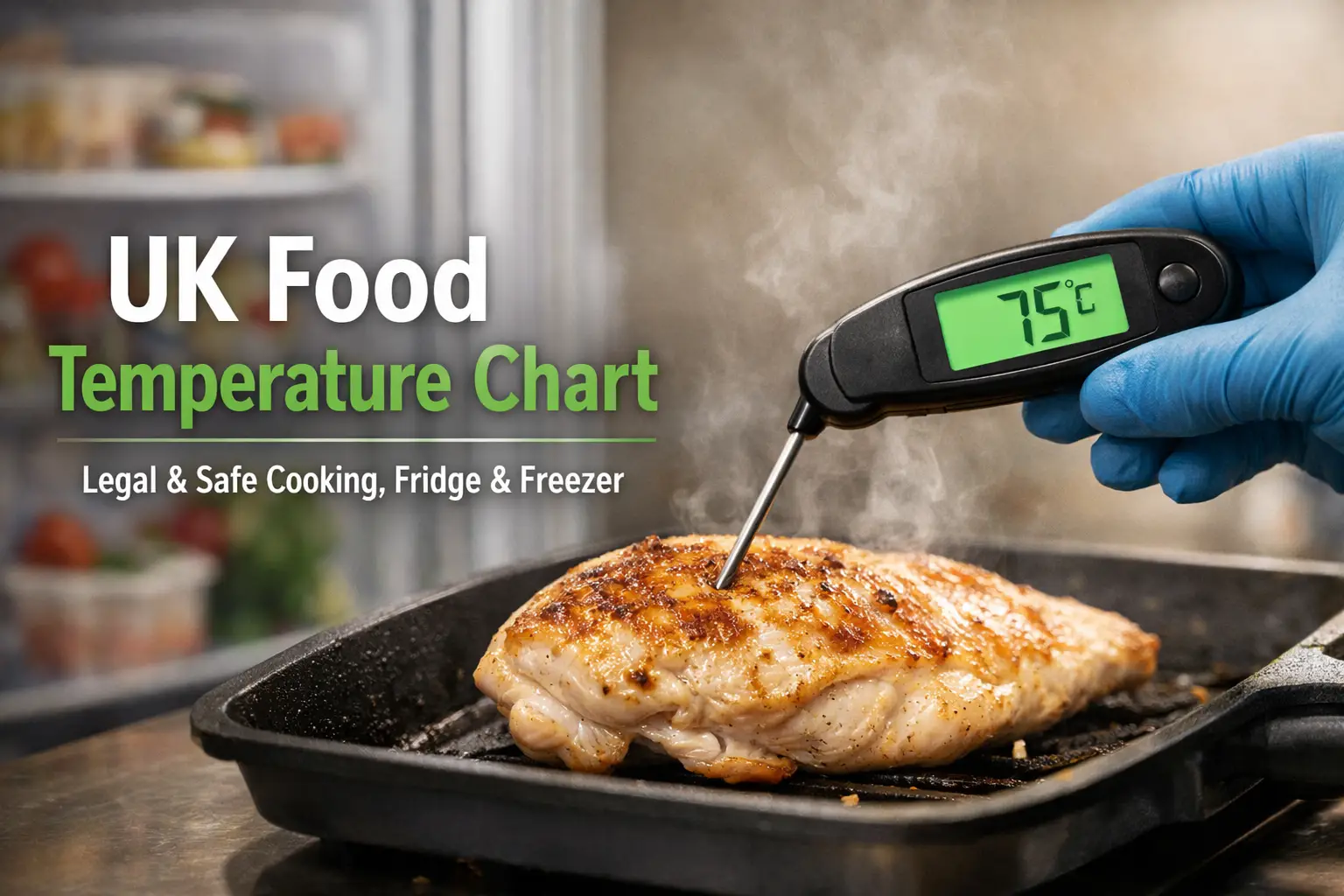
Maintaining clear temperature controls is essential in UK catering. This guide translates practical targets for chilling, freezing, cooking, reheating, cooling and hot holding into everyday actions, with straightforward records to support inspections and staff handovers.
Chilled storage temperatures and limits
Keep chilled storage at 0–5°C. If a fridge reads above 5°C for any sustained period, take corrective action and log it.
Chilled storage should be kept between 0°C and 5°C in most catering settings. 0°C helps preserve quality and prevents accidental freezing, while 5°C is a practical upper limit that keeps microbial growth slow enough for safe handling. Regular, accurate checks with calibrated thermometers are essential to spot hot spots and verify door seals.
- Track temperatures in each fridge, not just the main unit.
- Don’t overfill shelves; ensure air can circulate.
- Position high-risk items at the back and away from the door.
- Label deliveries with clear use-by dates and keep a simple daily log.
Frozen storage and deliveries
Frozen storage must be kept at -18°C or colder; verify delivery temps and check the freezer readings on arrival.
Frozen food should be stored at -18°C or colder. On delivery, confirm the product is frozen solid and that the delivery temperature is recorded. If items arrive warmer than -18°C, log the issue and act per your corrective-action plan, which may include separating affected stock and returning or redirecting items.
- Check the freezer temperature upon delivery and again after loading.
- Ensure freezer doors close fully and gaskets seal properly.
- Do not refreeze foods that have thawed; plan thawing in the fridge or controlled environment.
Cooking temperatures and probe use
Use a calibrated probe and check the core temperature in the thickest part away from bone; record the reading before serving.
Use a calibrated food thermometer to check core temperatures, inserting the probe into the thickest part of the food and away from bones or gristle. Allow a reading to stabilise before logging.
Typical targets (illustrative guidance for common pastry and meat preparations in UK kitchens):
- Poultry: 75°C core
- Ground meats (e.g., mince): 70°C
- Roasts of pork, beef or lamb: 63°C with a rest period
- Fish and seafood: 60°C
- Ready meals and reheat dishes: 75°C
Calibrate your thermometer regularly. If a probe cannot be trusted, replace it or retire the utensil from service.
- Check readings in multiple locations within a batch to avoid hot spots.
- Clean probes between checks to avoid cross-contamination.
- Record the core temperature and the time of reading.
Reheating and hot holding
Reheating must achieve the target core temperature, and hot holding should stay above 63°C to prevent growth.
Reheat foods so the core reaches 75°C and maintain that temperature during service, with the aim to reach the target temperature within 2 hours. After reheating, keep hot foods at 63°C or above to inhibit microbial growth.
- Reheat large volumes promptly using appropriate equipment; avoid slow, uneven heating.
- For hot-held items, check temperatures at regular intervals (at least every 2 hours during service).
- If a dish cannot achieve the target temp quickly, pause service and take corrective action.
Practical checks during service
- Sauces and soups should be measured at the thickest part after reheating.
- Stir during reheating to promote even heat distribution.
Reheat quickly to a core of 75°C and hold above 63°C; if you can’t reach these temps promptly, reassess service flow.
Cooling guidance and the danger zone
The danger zone is the temperature range where pathogens multiply rapidly. In UK practice this is roughly 8°C to 63°C. The aim is to move foods through this zone quickly.
Cooling should start immediately after cooking and continue until the product is cold enough for refrigeration. A common cooling guideline is to reduce temperature from 63°C to 21°C within 2 hours, then from 21°C to 5°C (or lower) within the next 2 hours. Large or dense foods require extra momentum to meet these targets; shallow pans, rapid chilling and spreading into smaller portions help.
- Divide large pots into shallow, wide containers for faster cooling.
- Use a blast chiller or ice-water bath to accelerate cooling when possible.
- Stir liquid foods and spread solids in thin layers to maximise surface area.
- Move cooling foods to a fridge promptly and log start and finish times.
Be mindful of holding on a hot pass; maintain above 63°C while service continues, if necessary.
The danger zone between 8°C and 63°C is where bacteria multiply fastest; limit any time food spends there and cool promptly.
Record-keeping and calibration
Regular calibration and complete temperature records build traceability and support inspections.
Reliable records are a fundamental part of kitchen hygiene and a key aid during inspections. Keep it simple but complete.
- Calibration and probe accuracy: test thermometers with ice water (0°C) and boiling water (100°C at sea level) to verify accuracy; adjust readings within a small tolerance, and replace faulty tools.
- Recording temperatures: maintain logs that show date, time, area (fridge, freezer, hot hold, cook station), actual temp, and any corrective actions taken.
- Use consistent log formats, including automatic timestamps if available. Keep a full history for audits and staff handover.
- For hands-on practicality, use a digital log system to export PDFs and store records offline when needed.
The safest procedure is the one you can follow consistently during a busy service.
Practical example scenarios
- A chilled delivery arrives at 8°C: reject or log corrective action and record the issue with the supplier or route, and move items to temperature-controlled storage.
- Cooked rice cooling in a deep gastro tray: split into smaller containers and chill fast to meet the time-based cooling targets.
- Soup on a hot pass: verify it stays above 63°C throughout service and adjust if readings drop.
- A fridge runs warm after a busy lunch: log the defect, move stock if needed, and follow corrective action steps.
The safest procedure is the one you can follow consistently during a busy service.