Running a food business in Australia means more than serving good food. You need records that show checks were done, issues were followed up, and staff know what safe handling looks like during a normal working day. For many cafés, caterers, takeaways and small restaurant teams, paper forms are where that breaks down. Sheets go missing, handwriting is unclear, and nobody wants to dig through a folder when records are requested.
This guide explains how to use a food safety app in a practical Australian setting. It is written for food business owners and managers who want a simpler way to handle temperature checks, cleaning records, delivery checks, corrective actions and staff routines without creating more admin. Used properly, a digital system helps you keep clearer records, spot gaps earlier and stay better prepared for Standard 3.2.2A requirements and day-to-day inspections.
Using a food safety app in Australia: what it helps you prove
For Australian food businesses, record keeping matters because it helps show that food safety controls are being carried out in real life, not just written down in a policy folder. Standard 3.2.2A increased the focus on food safety management tools for many businesses handling unpackaged, ready-to-eat, potentially hazardous food. In practice, that means owners and managers need a reliable way to show what was checked, when it was checked, and what happened when something went wrong.
A food safety app does not replace supervision, training or sensible kitchen management. What it does is make those things easier to document consistently. Instead of relying on clipped paper sheets, separate notebooks and memory, you can keep key records in one place with timestamps, named tasks and follow-up actions. That is especially useful for businesses trying to stay organised across split shifts, weekend trade and casual staff turnover.
If you want broader context on daily compliance, these guides on running a food business safely and HACCP food safety systems help explain how digital records fit into a wider food safety system.
Why paper records break down in busy Australian kitchens
Paper can work, but it often fails at exactly the point a business is busiest. A lunch rush starts, a delivery arrives at the back door, a team member calls in sick, and the opening checks are suddenly completed late or not at all. The problem is not that staff do not care. The problem is that paper systems are easy to delay, duplicate, lose or fill in after the fact.
That creates weak spots in the places that matter most: cold storage, hot holding, cleaning, allergen communication, staff training and corrective actions. One missing fridge check may be an isolated mistake. Repeated gaps across several shifts suggest the process itself is failing. Digital systems help by making daily checks quicker to complete, easier to review, and harder to ignore when a task is overdue.
This becomes even more important when you are reviewing areas such as deliveries and receipt of food, reducing cross-contamination and staff training records, where small failures can build into bigger food safety risks.
How to use a food safety app step by step
The best way to use a food safety app is to build it around the tasks your team already needs to complete. Keep it simple first. Start with the records that are most likely to be missed, hardest to read on paper, or most useful during a review.
1. Set up the checks that matter every day
Begin with your routine checks: fridge and freezer temperatures, hot holding, cooling, cleaning schedules, opening checks, closing checks and delivery inspections. These are the records that usually create the most friction on paper because they happen repeatedly and often during busy periods.
For example, a suburban takeaway shop in Brisbane might set up three opening checks before service starts: fridge temperatures, sanitiser readiness and a review of allergen information for any menu changes. Instead of relying on a clipboard in the prep area, each task is completed on a phone or tablet and saved immediately.
2. Assign tasks clearly to staff and shifts
One of the biggest reasons records fail is that everyone assumes someone else has done them. A digital system works better when each task is tied to a role, shift or named team member. That makes accountability clearer without turning the kitchen into an office.
Imagine a café in Melbourne with separate breakfast and lunch teams. The breakfast supervisor handles opening checks and cold storage logs. The lunch shift lead confirms hot holding and cleaning sign-off before handover. When each task sits in the right part of the day, there is less guesswork and fewer missed steps.
3. Record problems when they happen, not at the end of the shift
This is where digital systems usually outperform paper. If a fridge is reading too warm, a delivery arrives outside expected temperature, or a cleaning task is missed, the issue can be logged immediately with a note about what was done next. That creates a more believable record and gives managers something useful to review later.
For example, a Sydney sandwich bar receives a delivery of cooked chicken and notices the product feels warmer than expected. The goods-in check is logged at the back door, the affected items are rejected, and the note explains why. That is a stronger record than a vague paper note written an hour later.
4. Use records to spot repeat issues
The value of a food safety app is not just that it stores information. It also helps you see patterns. If one fridge keeps running warm, if the same cleaning task is repeatedly missed on Sunday evenings, or if one site has more delivery rejections than another, you have something practical to act on.
A catering business working across corporate functions, for example, may notice through its logs that cold-holding checks are often late during bump-in periods at off-site venues. That insight can lead to a better setup routine, an equipment review or a clearer pre-service checklist.
5. Make inspection day easier
When records are organised and consistent, inspections are less stressful. Instead of pulling forms from folders and trying to explain gaps, you can show a clear sequence of checks, missed items and corrective actions. That does not guarantee a perfect outcome, but it puts your business in a stronger position because your records match the reality of day-to-day operations.
If your business wants to strengthen these controls further, the Australia-focused overview at Food-Safety.app Australia shows how digital records can support small food businesses without adding a complicated system.
Real-world examples from Australian food businesses
Café example: A busy café in Newcastle opens at 6:30am and has three staff on before the morning rush. One person checks the display fridge and milk fridge, one confirms the dishwasher and sanitiser are ready, and the supervisor signs off the opening checklist. At 11:15am, a fridge reading is above the normal range. The team re-checks the unit, moves high-risk food to another fridge, logs the corrective action, and calls for service. That is the sort of day-to-day record that shows follow-through, not just box-ticking.
Caterer example: A small Adelaide catering company prepares sandwich platters and hot food for office events. During packing, the team records final cold storage checks, confirms allergen information for labelled items and logs dispatch times before delivery. When one delivery arrives later than planned because of traffic, the team records the delay and checks product condition before service. The benefit here is not just storage. It is having a usable timeline when someone asks what happened.
Takeaway example: A regional NSW takeaway shop has strong trade on Friday evenings but weak paperwork by closing time. The owner switches the end-of-day cleaning and closing checks to a phone-based routine. Instead of staff rushing through a paper sheet at the till, they complete each cleaning and closing task as they finish it. Within a few weeks, the owner can see exactly where jobs are being skipped and which tasks need retraining.
Multi-site example: A two-site food business on the Gold Coast wants the same standards at both locations. By using one digital setup for temperature logs, cleaning tasks and corrective actions, the owner can compare records across both sites. One location is consistently stronger on opening checks, while the other is better on delivery records. That makes coaching more specific and more useful than simply telling both teams to “be more careful”.
Why digital records are easier to trust
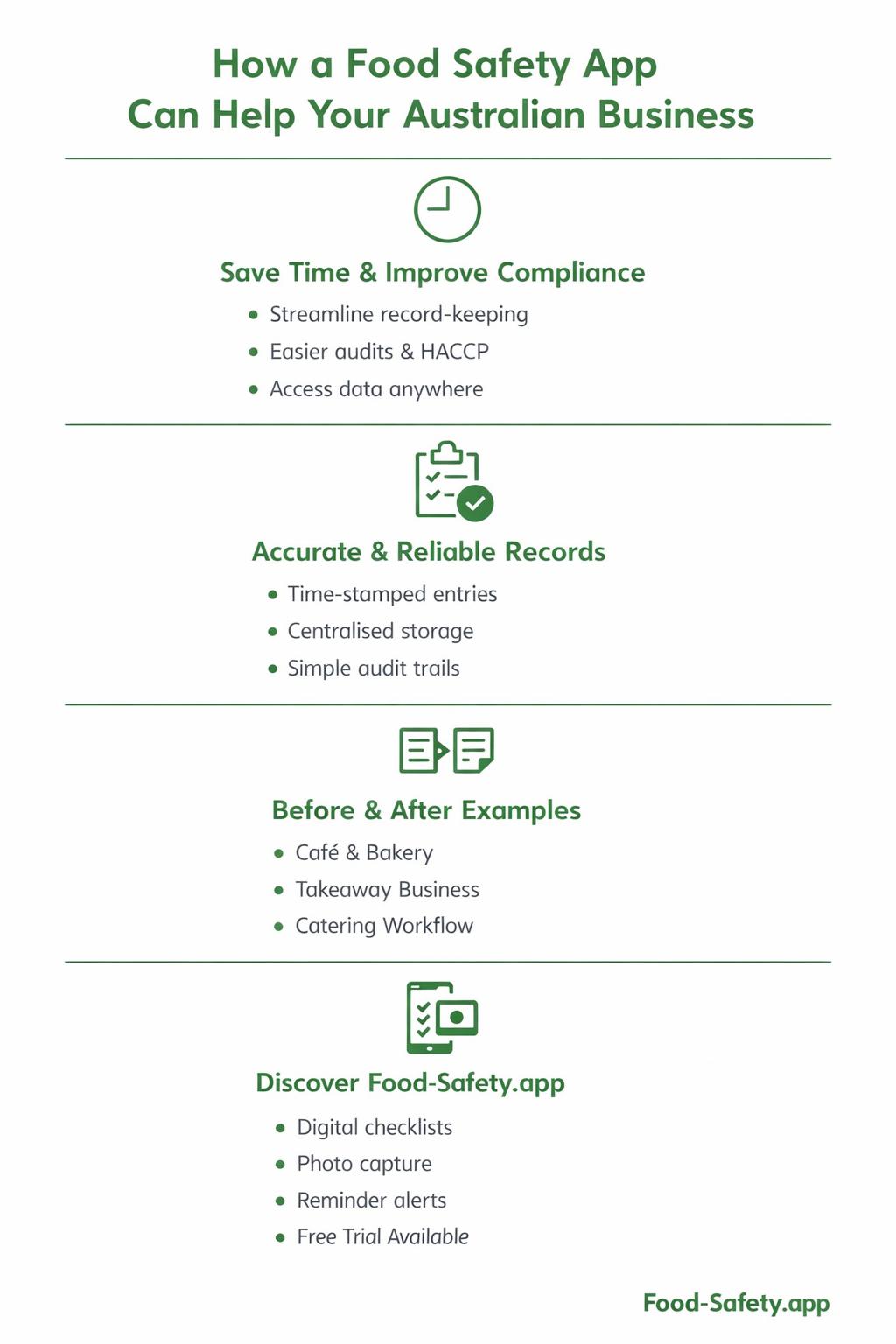
Good records do two jobs at once. They help a team manage food safety today, and they help the business explain its actions later. Paper often struggles with both. Entries are rushed, handwriting is unclear, pages go missing, and corrective actions are either too vague or never written down at all.
Digital records are usually easier to trust because they are faster to complete, consistent in format and tied to the actual task being performed. A temperature log saved at the point of check carries more weight than a number written at the end of the shift from memory. A cleaning task with a named sign-off is more useful than an empty box on a laminated sheet. A corrective action with a short explanation is stronger than a tick with no context.
That is also why digital records work well alongside guidance on delivery checks, cross-contamination control and staff training. The point is not just storing more information. It is making core food safety tasks easier to complete properly and easier to defend later.
Where Food-Safety.app fits naturally into this process
Food-Safety.app fits best once the business is clear on the problems it wants to solve. It is useful for teams that are tired of chasing paper records, want clearer evidence of checks being done, or need a simpler way to log corrective actions during normal service. Instead of treating compliance as a separate admin job, it helps turn routine tasks into clear digital records that are easier to review and easier to retrieve.
For an Australian food business, that might mean keeping temperature logs, delivery checks, allergen information, cleaning schedules, pest control notes and staff training records in one place. It can also make onboarding simpler because new staff follow the same structure each time rather than inheriting whatever paperwork system the last manager created.
The strongest use case is practical, not theoretical: fewer missing records, faster sign-off, better visibility, and a clearer story when records are requested. That is the real benefit of using a food safety app well.
What a practical food safety app should help you do
A useful system should make the right task easy to complete at the right moment. It should not bury staff in menus or force managers to clean up messy data afterwards. In practical terms, it should help you:
- complete routine checks quickly during service
- log issues immediately and record corrective actions clearly
- keep records consistent across different staff and shifts
- review repeat failures before they become bigger problems
- find records quickly when they are requested
That is where a digital system adds value. Not because it sounds modern, but because it removes friction from work your team already has to do.
Try it in a real working week
If you are deciding whether a digital system is worth it, test it during a normal week rather than a quiet one. Use it across opening checks, temperature records, delivery checks and cleaning sign-off. That will show you very quickly whether it genuinely fits the pace of your kitchen or just gives you another system to manage.
Try Food-Safety.app for FREE and judge it on practical outcomes: are records easier to complete, are gaps easier to spot, and are corrective actions clearer than they were on paper? That is the standard that matters.
For Australian food business owners, the goal is not to look more digital. The goal is to run a safer, more consistent business with records that stand up when you need them. If your current paperwork is slow, patchy or only gets attention when someone asks for it, moving to a food safety app can be a sensible next step.