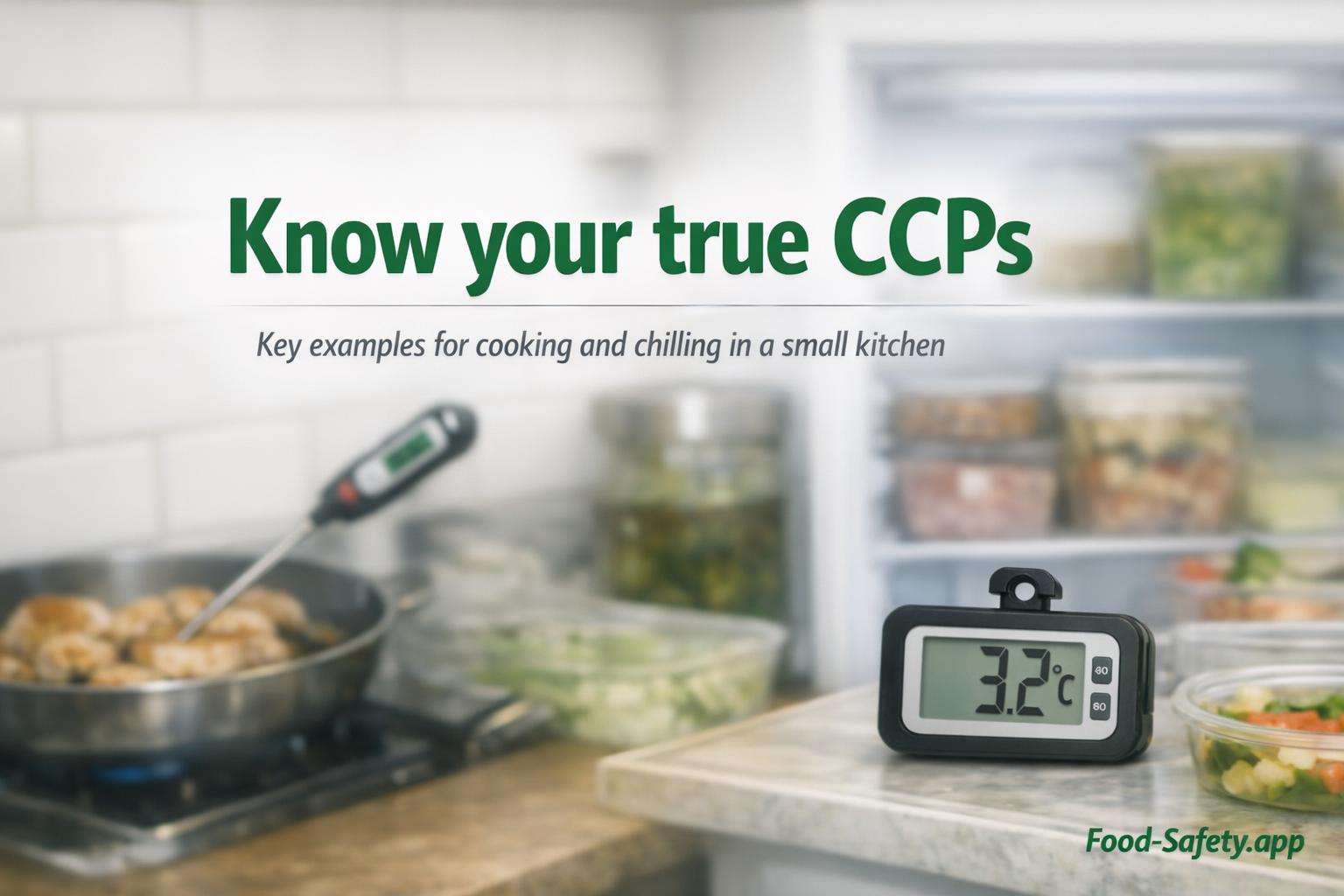
What Counts as a CCP in a Small Kitchen?
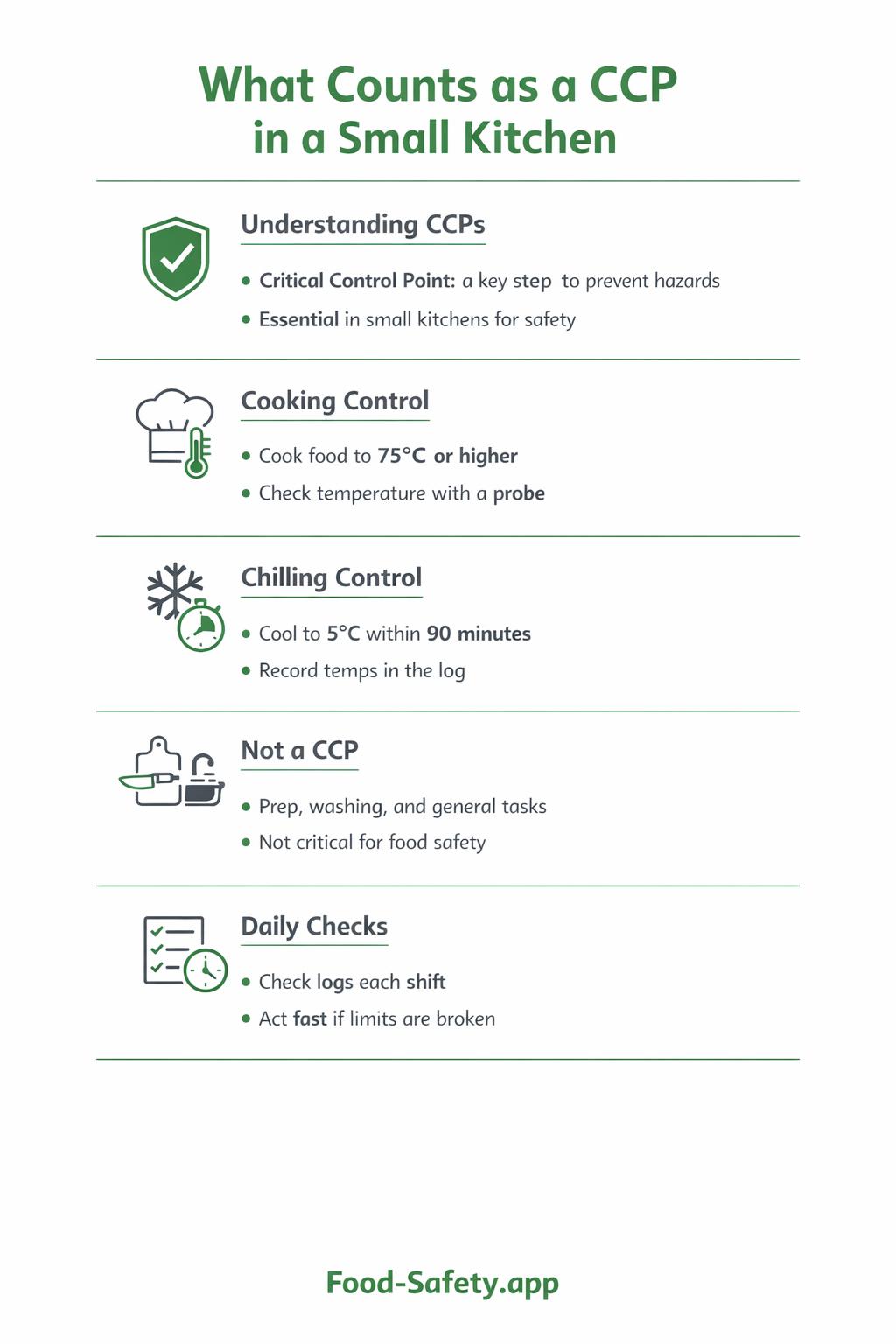
A critical control point (CCP) is a stage in food handling where control is essential to stop unsafe food reaching customers.
In small kitchens, identifying genuine CCPs helps staff focus on the checks that matter most during preparation, cooking, storage, and service.
Most CCPs relate to situations where bacteria could survive, multiply, or spread if controls fail.
Examples include undercooking poultry, improper reheating, slow cooling, and unsafe hot or cold holding.
For a broader overview of HACCP systems, see HACCP principles explained.
Typical CCPs in Small Kitchens
Cooking High-Risk Foods
Cooking is one of the most common CCPs because it is often the final opportunity to destroy harmful bacteria.
This commonly applies to poultry, minced meat products, reheated meals, and foods containing high-risk ingredients.
Cooling and Chilling
Cooling becomes critical when cooked food remains in the temperature danger zone long enough for bacteria to multiply.
Soups, curries, sauces, rice dishes, stews, and cooked meats all require careful cooling and refrigeration controls.
Hot and Cold Holding
Hot holding can become a CCP during buffet or service operations where food remains out for extended periods.
Cold holding is especially important for ready-to-eat foods that receive no further cooking before service.
- Buffets and carveries
- Bain maries and soup stations
- Prepared salads and sandwiches
- Cold desserts and plated dishes
If a control fails and there is no later opportunity to make the food safe, the step is likely a CCP.
What Is Not a CCP?
Not every food safety task is classified as a critical control point.
Many important procedures support hygiene and food safety without being formal CCPs.
- Handwashing procedures
- Cleaning schedules
- Stock rotation systems
- Pest monitoring
Allergen management also remains essential, even though it is usually handled as part of prerequisite controls rather than a CCP.
Understanding the Difference
For example, checking that a fridge is clean supports food safety, but the actual CCP is often the temperature keeping food chilled safely.
Similarly, delivery inspections matter, but the true control may be whether chilled products arrive within safe temperature limits.
Keeping this distinction clear helps small kitchens avoid overcomplicated systems and unnecessary paperwork.
How to Identify a CCP
A practical way to identify CCPs is to review the entire food process from delivery through to service.
Look for points where hazards could enter the process, survive cooking, or multiply during handling and storage.
Questions That Help Identify CCPs
- Does this step remove or reduce a hazard?
- If this step fails, can the problem be corrected later?
- Does the process require measurable limits?
- Must the step be routinely monitored?
If there is no safe recovery after failure, the process is often treated as a CCP.
Keeping Controls Practical
Small kitchens perform best with monitoring systems that fit naturally into daily operations.
Clear routines for opening checks, preparation, service, and close-down procedures help staff maintain consistent standards.
Useful records may include fridge temperature logs, cooking checks, and cooling monitoring sheets.
Practical CCP Examples
Cooking Poultry Safely
Cooking poultry thoroughly is one of the clearest examples of a CCP.
Thermometers should be used where appropriate, checking the thickest part of the food rather than relying on colour alone.
Related guidance: Temperature control in kitchens.
Reheating Cooked Food
Reheating previously cooked and stored food can also become a CCP.
Whether using pans, ovens, or microwaves, food must become piping hot all the way through.
Cooling Batch-Cooked Food
Slow cooling creates ideal conditions for bacterial growth.
Using shallow containers, dividing large batches, and refrigerating promptly all help reduce risk.
For related guidance, see Cross-contamination and food safety management.
Corrective Actions for CCP Failures
Every CCP should have a clear corrective action so staff know exactly how to respond if controls fail.
Quick action helps prevent unsafe food from reaching customers.
- Continue cooking until safe temperatures are achieved
- Discard food that cannot be made safe
- Transfer food to functioning equipment
- Record the issue and action taken
If cooked food cools too slowly and remains in the danger zone too long, disposal may be the safest option.
Further support is available through food safety induction training and official guidance from the Food Standards Agency.
Strengthen Daily Kitchen Controls
Manage CCP checks and food safety records with Food-Safety.app.