When food safety paperwork falls behind it creates risk fast. Learn how to recover properly without guessing entries or weakening your due diligence.
Table of contents
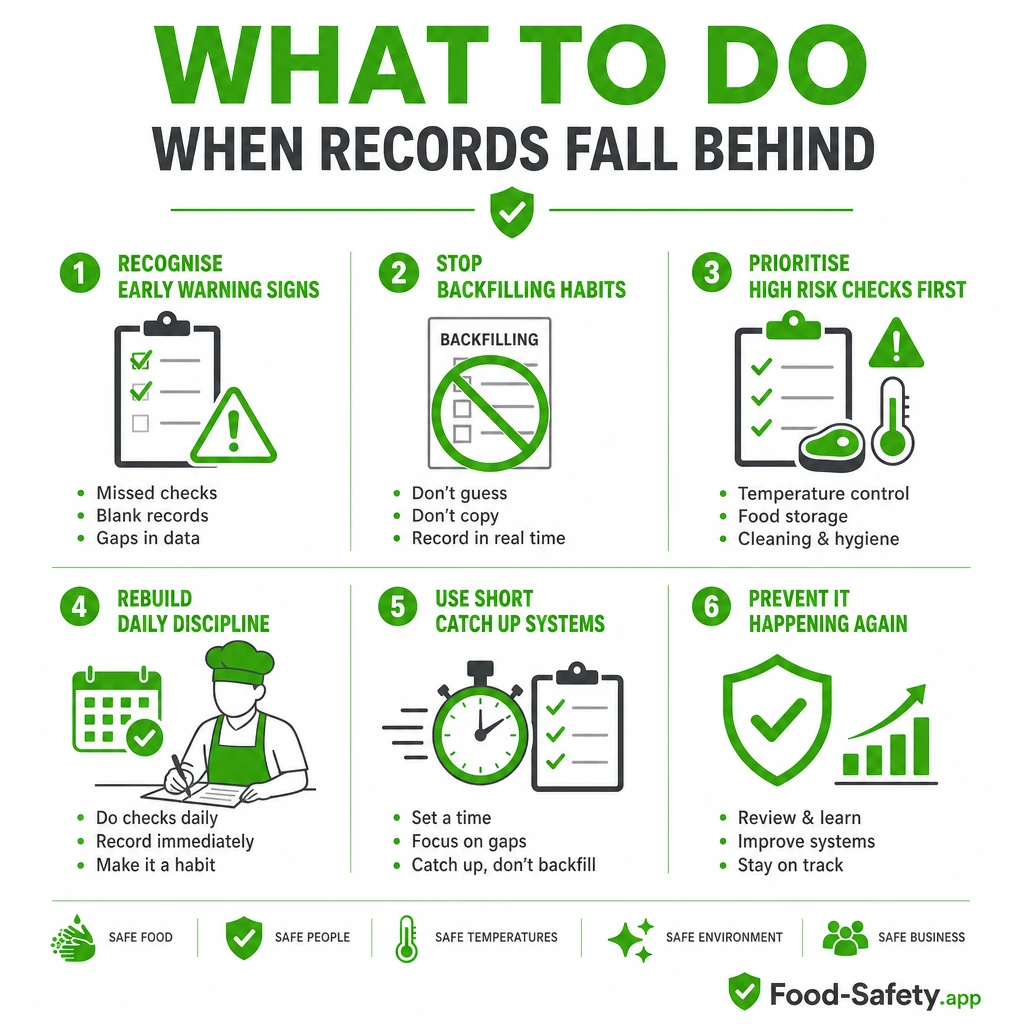
Recognising early warning signs
Missed temperature logs
Regular temperature monitoring protects the safety of prepared food. If logs are skipped or completed from memory, you lose traceability and confidence in your control measures. Small omissions add up to bigger risks during service when temps swing or there are delivery fluctuations. For guidance on what records you should keep, see what-food-safety-records-should-a-small-business-keep.
Incomplete cleaning records
Cleaning and sanitation checks reassure staff and customers. When tasks are omitted or notes are incomplete, pathogens may persist in hard-to-reach areas. Busy periods can hide gaps, but repeated omissions signal a workflow problem rather than a one-off event.
Delayed delivery checks
Delivery checks verify supplier compliance, correct temperatures, and correct items. Delays in logging deliveries create a blind spot about what arrived and when. This weakens your ability to trace issues back to suppliers or specific batches. For cross-contamination guidance, see cross-contamination in food safety explained causes examples and prevention.
Unsigned opening and closing checks
Opening and closing checks set the day’s baseline and record end-of-shift actions. When these are not signed, accountability becomes unclear and corrective actions may be missed or misattributed.
Gaps in corrective actions
When a temperature or hygiene deviation is identified, a documented corrective action should follow. If actions aren’t recorded, the issue can reappear and inspections will look for a complete, closed loop rather than a quick patch. See how-HACCP-records-support-due-diligence.
Why backfilling records is risky
Weak traceability
Backfilled entries blur the timeline of events. If you cannot prove when a check was done, you cannot prove who was responsible or why a decision was made.
Poor audit trail
Auditors expect a clear narrative from logbooks and digital records. Backfilling creates a false chronology, undermining trust and potentially delaying approvals or increasing scrutiny.
Unclear accountability
Without a precise record of who performed each check, accountability erodes. Frontline staff must own their tasks to maintain consistent safety practices.
Loss of confidence during inspections
Inspectors rely on timely, authentic records. Massaged or missing data raises questions about daily discipline and the reliability of your food safety systems.
Prioritising high-risk checks
Cooking and cooling
Prioritise logs that prove hot foods reach safe temperatures and that rapid cooling targets are met. Inadequate cooling is a common route to bacterial growth, especially after service surges.
Cold storage and goods-in checks
Regular checks of fridge/freezer temperatures and incoming goods help prevent storage faults and bad stock from entering service. Any deviation should trigger immediate corrective action and documentation.
Reheating and hot holding
Reheating must hit safe temperatures, and hot holding should maintain them. Logs that miss these steps leave you with a fragile safety net during busy periods.
Probe calibration and allergen controls
Regular probe calibration ensures temperature readings are accurate. Allergen controls require up-to-date records to prevent cross-contact and mislabelling, which can cause serious safety incidents.
Catch-up systems that work in a busy kitchen
10-minute end-of-shift reset
Agree a brief, structured wind-down where staff complete the most critical logs first, then finish any remaining items within a short window. This prevents a backlog growing across shifts. For practical templates, see our free HACCP plans for your food business.
Shift handover checklist
Use a concise handover that flags records not yet completed, what remains to be done, and deadlines for each item. Clear ownership reduces duplication and gaps.
Top three critical records approach
Each shift should identify the three most essential records to complete before service. Focusing on high-risk areas ensures a safe baseline even when time is tight.
Rebuilding daily discipline
Assign ownership
Designate a named person responsible for each critical area (temperature, cleaning, deliveries, corrective actions). Accountability accelerates completion and accuracy. For staff training guidance, see how-to-train-new-staff-without-missing-food-safety.
Set fixed recording times
Tie recording to routine tasks (opening checks at start of shift, cooling logs after batches, end-of-shift closures). Predictable timing improves consistency.
Use simple routines
Keep forms short and straightforward. Overly complex logs discourage completion; simple prompts help staff capture the right data without delays.
Link checks to real kitchen tasks
Integrate logging with daily activities such as line checks, prep lists, and delivery unpacking. When records arise from real work, they’re less likely to be skipped.
Preventing repeat problems
Reduce unnecessary admin
Strip non-essential fields from records. Focus on the data that proves safety and supports quick decision-making during audits.
Review staffing pressures
Peak periods, staff turnover, or understaffing can drive backlogs. Proactively adjust expectations, provide quick training refreshers, and adjust checklists to fit the shift load.
Make records easier to complete
Standardise formats, use simple language, and ensure handwriting or digital input is user-friendly. If the task is quick and obvious, compliance rises.
Reminders or digital prompts
Automatic prompts can help. If you choose digital prompts, ensure data is time-stamped and accessible for audits. For guidance on safe practices, see the Food Standards Agency guidance on records and traceability.
Food Standards Agency guidance
Practical scenarios
- A breakfast shift misses opening checks after a late delivery and needs to recover the morning safely.
- A catering team finds fridge logs missing for two days and must check temperatures before service.
- A head chef discovers cleaning tasks were skipped during a busy weekend and needs a catch-up plan without guessing.
- A supervisor notices allergen and delivery records are out of date before an external visit.
Closing thoughts
Maintaining timely, accurate records is a core operational discipline in a busy catering environment. When you design practical routines, clarify ownership, and keep the focus on high-risk checks, you can recover quickly from lapses and stay audit-ready without creating extra admin burden. For a quick overview, see what-food-safety-do-small-food-businesses-need.
Improve your food safety records today
Discover practical routines and clear ownership to keep records accurate, demonstrate due diligence, and stay audit ready without adding unnecessary admin burden.