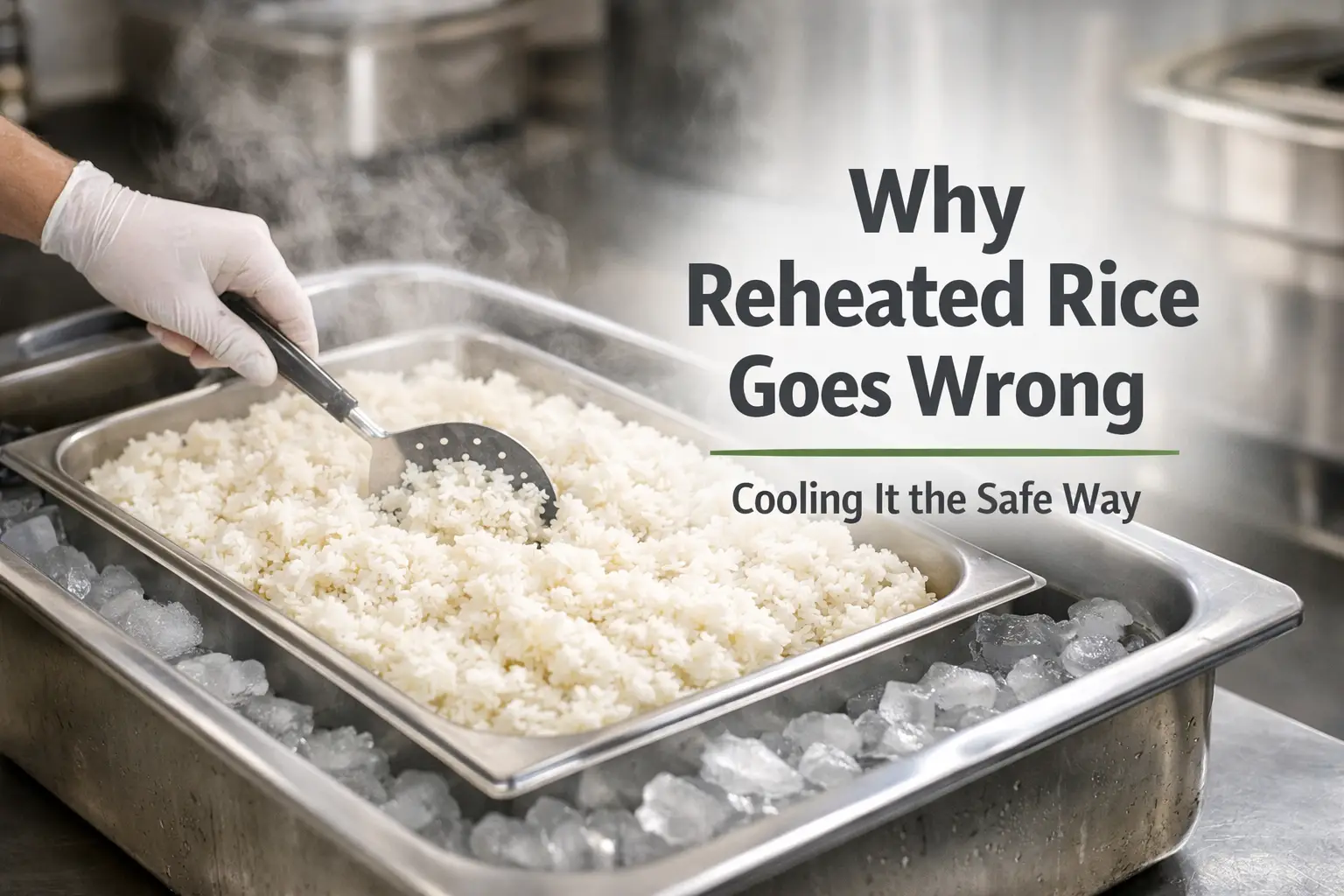
Learn why reheated rice often goes wrong and how to avoid it. Clear steps for cooling storage reheating and staff training in busy kitchens. For broader guidance on safe food handling, see our food safety blog.
Table of contents
Why rice is a special risk
Bacillus cereus and the danger zone
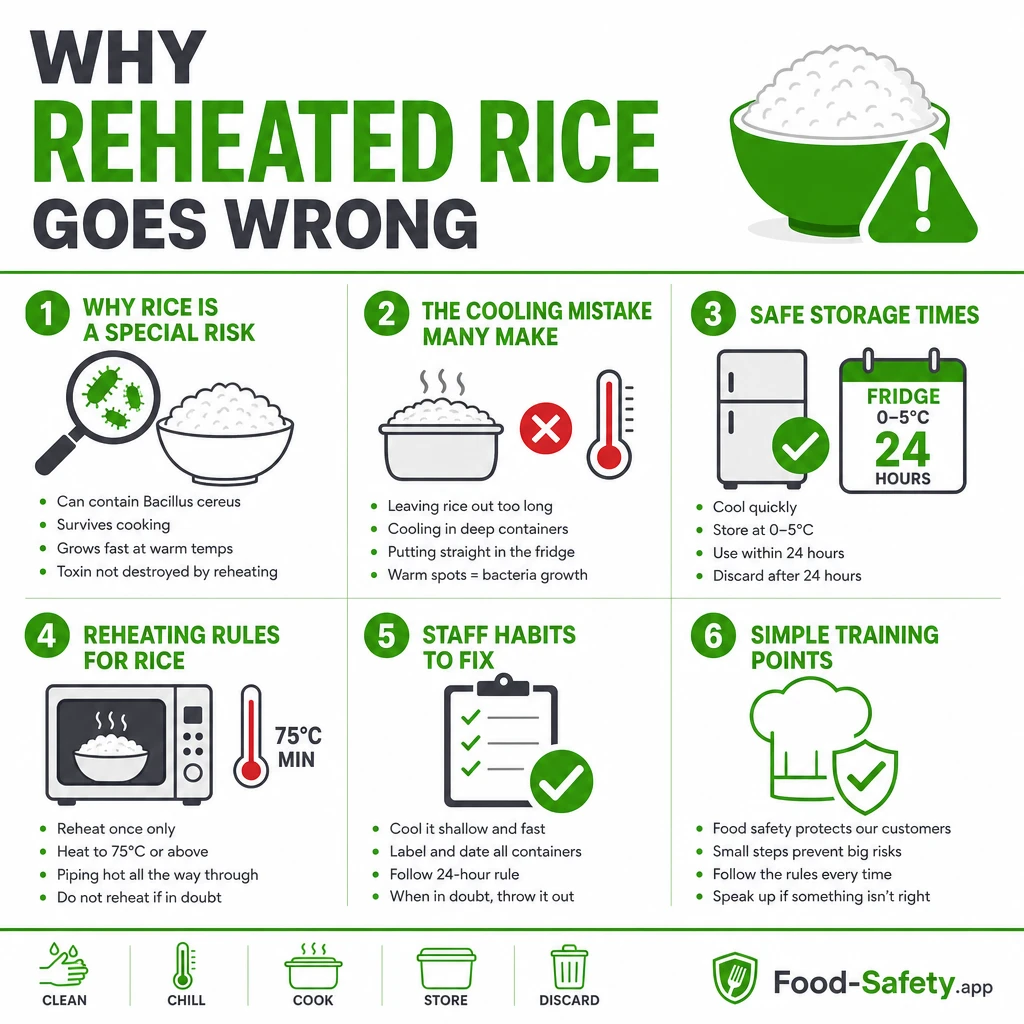
Rice is unique because the spores of Bacillus cereus can survive normal cooking. If cooked rice is left to cool slowly or held at ambient temperature for too long, these spores may germinate and multiply, producing toxins. Some toxins are heat-stable, meaning reheating will not always neutralise the danger. In practical terms, a busy kitchen must prevent rice from sitting in the warm range for extended periods and must reheat rice only when it will be served promptly.
In a catering environment, the biggest risk occurs when rice is transferred to large containers or deep pans and left on a pass or counter while service finishes. The outer layers may cool slowly while the inner core remains warm, providing an ongoing environment for bacterial growth. The result can be rapid toxin formation and a service that looks normal but carries a hidden risk for guests.
What good practice looks like
Good practice means controlling the rice from the moment it comes off the cooker to the moment it is reheated and served. Operators should:
- Use shallow containers to maximise surface area for rapid cooling
- Spread rice evenly and avoid piling into deep tubs
- Cool rice promptly and refrigerate quickly
- Label portions with date and time and follow site shelf-life rules
The cooling mistake many make
Deep pans and room temperature traps
The most common error is leaving rice in deep gastro pans or large tubs at room temperature after cooking. Heat gets trapped inside, and the outer surface may fall into the “danger zone” while the core remains warm. This creates an extended window for spores to germinate and toxins to form. In busy kitchens, it’s tempting to finish plating and use the rice later, but this shortcut introduces avoidable risk.
Safer cooling habits are simple and practical. Transfer cooked rice to shallow, wide containers no more than a few centimetres deep. Spreading evenly helps the rice cool quickly from the surface inward. If possible, move containers into a verified cooling area or a blast chiller to accelerate the process. Never leave rice uncovered in a hot kitchen for extended periods. Learn more about kitchen controls in our food safety management system.
Practical cooling steps
- Immediately separate rice into shallow, flat containers.
- Spread evenly; do not pack or stack thick layers.
- Cool in a monitored area or blast chiller until surface temperatures drop to safe levels.
- Cover loosely once cool to minimise contamination while still allowing airflow.
Safe storage times
Cool quickly, refrigerate promptly
Once rice has cooled to a safe temperature, it must be refrigerated promptly and stored in clearly labelled portions. Use-by times should be defined in your site’s food safety plan and aligned with overall shelf-life policies. Label each container with the date and time of cooking to enable traceability during audits or inspections.
Key storage practice includes placing rice in the refrigerator below 5°C and avoiding long stacking in deep tubs that hamper cooling. If a site uses a freezer for excess supply, portion rice into freezer-safe packaging and clearly label with the date. Frozen rice must be thawed safely, but the general rule remains to keep cooked rice out of the danger zone as much as possible.
In addition, ensure you have robust documentation to support audits. Digital records can simplify compliance and support HACCP management.
| Phase | What to do | Notes |
|---|---|---|
| Post-cook | Transfer to shallow containers | Aids rapid cooling |
| Cooling | Cool quickly in refrigeration or blast chiller | Avoid stacking; use date/time |
| Storage | Refrigerate promptly, store in approved shelf-life | Keep below 5°C |
| Reheating | Heat thoroughly and serve immediately | One reheat only |
Reheating rules for rice
One reheating pass, and done
The core rule is straightforward: reheat rice only once, and serve it immediately after reheating. Do not reheat leftovers again. Reheating should be thorough and rapid, ensuring the entire portion reaches a safe hot core before serving. Use a probe thermometer to verify that the core temperature is safe throughout the serving batch and avoid reheating rice that has been cooled for longer than your site policy allows.
Operationally, reheating should be done in small, even portions to promote even heating. Reheat on the shortest route to service, keeping the rice moving through the danger zone as little as possible. If a batch cannot be served promptly, discard it according to your waste policies rather than risking safety.
Staff habits to fix
Batch cooking, portioning and checks
Habits in the kitchen drive safety just as much as written procedures. The most impactful changes come from practical routines that staff can adopt consistently:
- Batch cook rice in controlled portions to avoid large leftovers
- Always use shallow containers for cooling; avoid deep tubs
- Portion rice into meal-sized servings before refrigerating
- Regularly check fridge temperatures and log readings
- Use a calibrated probe to verify core temperatures during reheating
- Log actions with the time and date to provide an audit trail
For common hygiene pitfalls, see 10 food hygiene mistakes small kitchens still make.
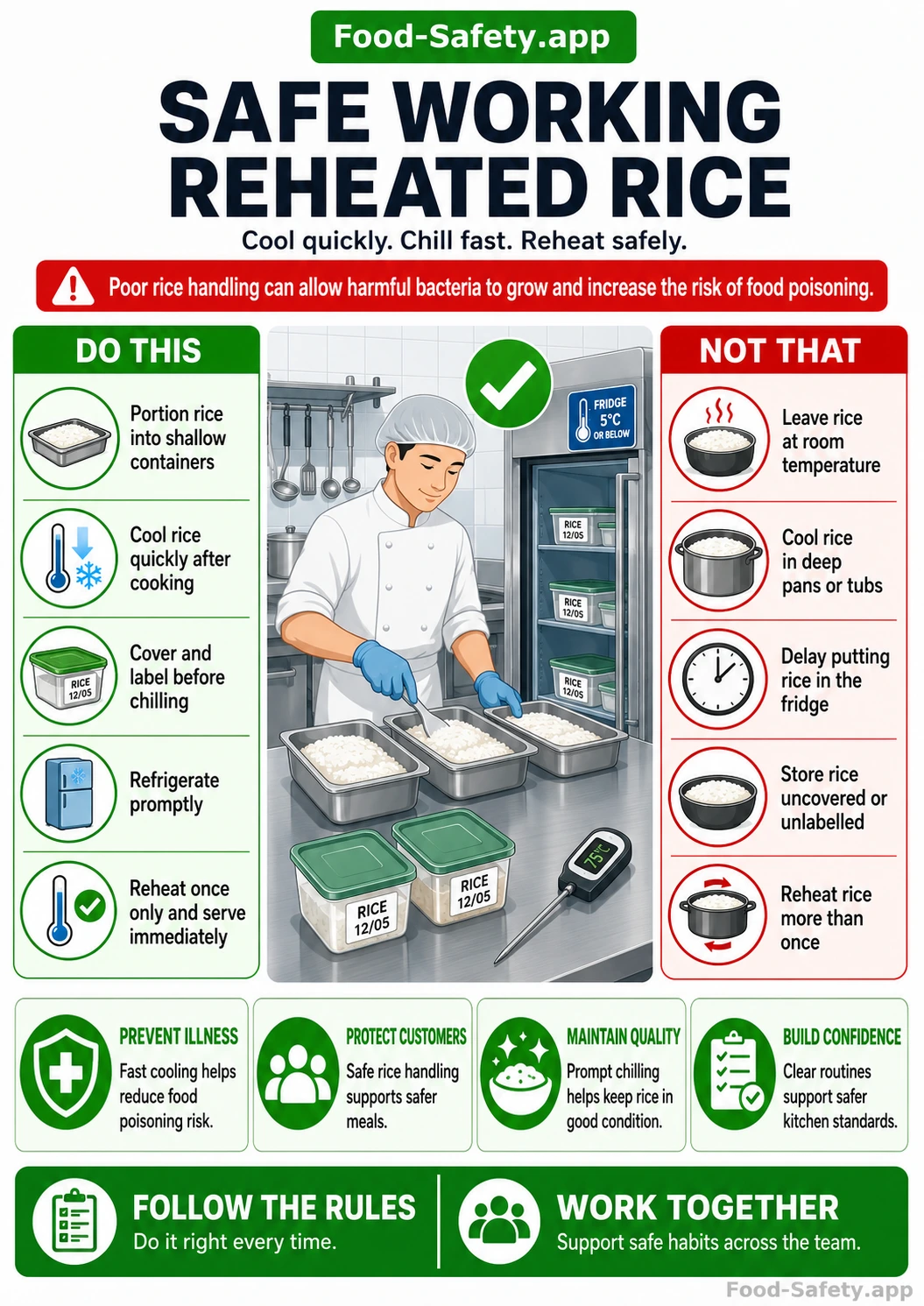
Closing note: This card also contains additional training and risk scenarios to follow up on in team training sessions.
Simple training points for teams
What to cover after cooking and before service
Training should be concise and action-oriented. Focus on practical, repeatable steps that staff can perform without hesitation:
- After cooking, transfer rice to shallow trays and cool promptly
- Store with clear date/time labels; discard if shelf-life is exceeded
- During service, reheat only once, checking the core temperature throughout
- Label and separate reheated portions to avoid cross-contamination
- Record fridge temperatures and rice checks in daily logs
Practical examples or scenarios
Shift scenarios to illustrate risk and response
Real-world scenes help teams recognise unsafe practices before they cause problems:
- Cooked rice left on the pass while the team finishes service
- Rice cooled in a deep gastro pan and put in the fridge too late
- Next-day fried rice made from rice that was not chilled quickly enough
- Reheating rice for a lunch rush without checking core temperature
Each scenario should trigger a corrective action: move to shallow containers, initiate rapid cooling, or discard rice that cannot be reheated safely. Use these prompts to train new staff and reinforce safe routines with experienced teams. You can also support teams using the food safety training resources.
Compliance or operational focus
What good records and checks look like
Strong compliance relies on clear records and routine checks. Build simple, repeatable habits into daily operations:
- Record cooking, cooling, cold storage and reheating temperatures
- Use automatic timestamps for traceable rice checks
- Add rice handling to opening and closing checks and staff training
- Keep corrective actions for any unsafe cooling or reheating incident
- Export records for audits, inspections and manager review
Conclusion and how to act now
Rice safety is about discipline, not complexity. By reducing time in the danger zone, using shallow cooling, and enforcing a strict reheating rule, catering teams can dramatically cut the risk of Bacillus cereus-related illness. Implement a straightforward routine, train staff to follow it, and maintain clear records so service runs smoothly and safely. For teams looking to formalise and automate these checks, a practical tool can help you log rice temperatures, cooling times and reheating checks, providing an audit-ready trail. Food-Safety.app, a food safety management system for catering businesses.
Improve rice safety in your kitchen today
Put in place simple cooling storage and reheating checks with clear records to protect guests, reduce waste, and simplify audits in busy kitchens.