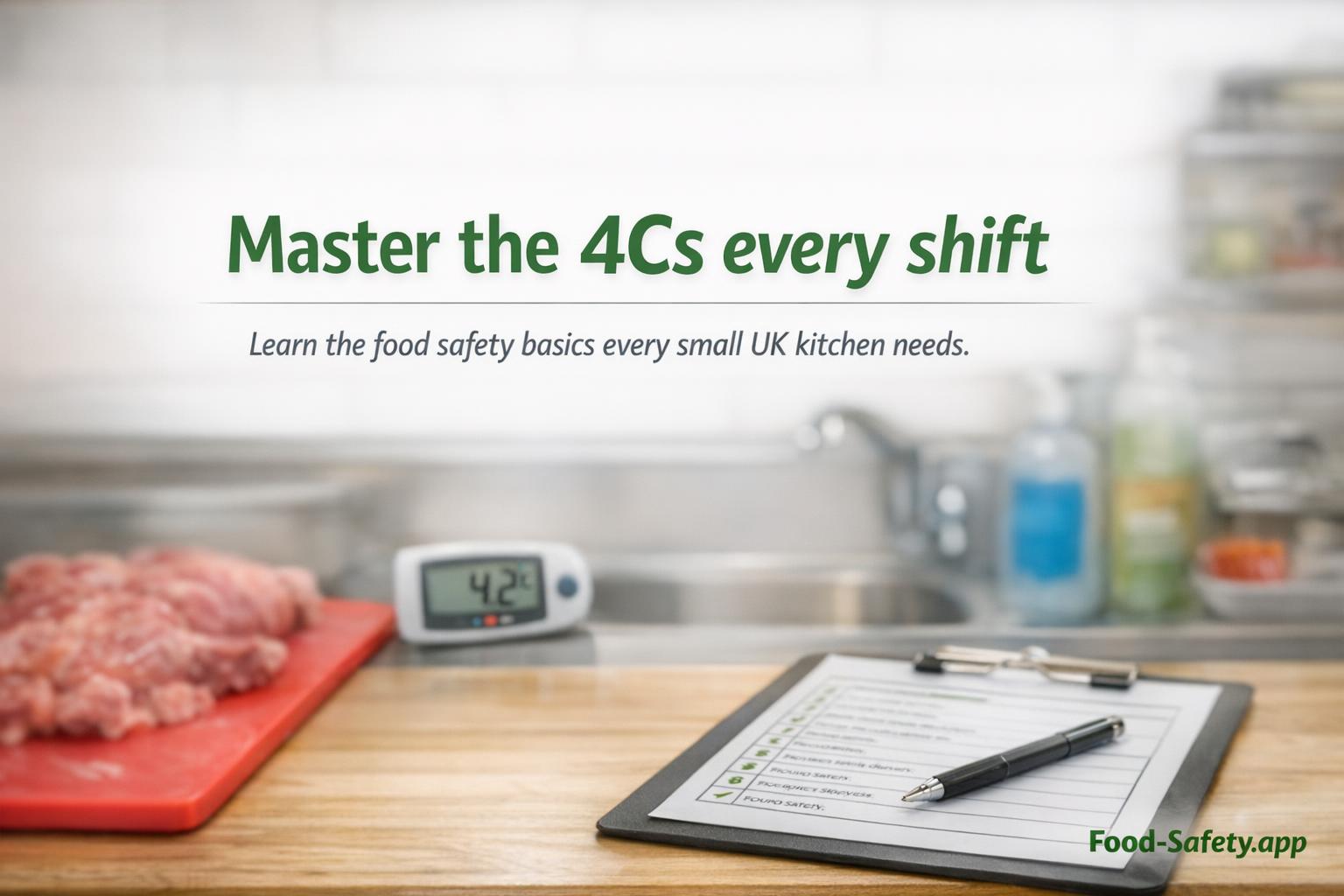
Keeping on top of food safety basics for small UK kitchens does not have to be complicated. In a café, takeaway, school canteen or hotel kitchen, the same core habits matter every day: clean hands, safe temperatures, sensible stock control, clear labelling, and good records. If those basics are consistent, food safety becomes much easier to manage during busy service, staff changes, and delivery rushes. The HACCP principles explained provide a simple framework for identifying critical control points.
This guide sets out practical food safety basics for small UK kitchens in a way that fits the reality of catering work. It is written for businesses in the UK, and practices may differ in other countries, so always check local rules if you operate elsewhere.
Why the basics matter in small kitchens
Small kitchens often run with limited space, a tight team, shared equipment and no room for sloppy habits. That is exactly why food safety basics for small UK kitchens need to be simple, repeatable and easy to check. A good system does not rely on memory alone. It relies on routines that work even when the lunch rush is building, a delivery arrives early, or one member of staff is covering two sections.
The biggest risks in small catering businesses usually come from everyday pressures rather than rare incidents. Food is left out too long, a probe is not cleaned between checks, raw and ready-to-eat food are handled on the same board, or cleaning tasks are squeezed in at the end of a shift when the team is tired. The best prevention is to build food safety into the flow of work, not treat it as an extra job.
Food safety basics for small UK kitchens: daily routine
A strong daily routine makes food safety more manageable and less dependent on one experienced person. Start each shift with a quick review of the most important checks.
Start-of-shift checklist
- Wash hands and check handwashing stations are stocked with soap, hot water and paper towels.
- Confirm fridges and freezers are operating correctly.
- Check that raw and ready-to-eat foods are stored separately.
- Review deliveries for temperature, packaging damage, date codes and signs of contamination.
- Make sure probes, cleaning cloths and sanitising products are available and in good order.
- Check that waste bins are empty, lined and lidded where needed.
In a small café kitchen, that might take only a few minutes, but it can prevent hours of trouble later. If a fridge is warm at the start of service, you can move high-risk foods immediately and get it checked before the day gets busier. If a delivery has damaged packaging, you can reject it before it enters stock.
During service
During service, keep high-risk food out of the danger zone as much as possible, use separate utensils and boards for raw and ready-to-eat food, change gloves when they become contaminated, but do not rely on gloves instead of handwashing, keep lids on containers and cover food where practical, clear spills and debris quickly to reduce slip and contamination risks, and use colour-coded chopping boards in use to help prevent cross-contamination.
Busy service is where standards often slip. The key is to make the safe action the easy action. For example, keep colour-coded boards in the same place every day, store sanitiser wipes within reach of prep areas, and label fridge shelves clearly so staff do not waste time deciding where things belong.
Temperature control that actually works in service
Temperature control is one of the most important food safety basics for small UK kitchens because it affects both food quality and food safety. The aim is to keep food out of conditions where harmful bacteria can grow quickly.
Practical temperature control means more than just checking fridges now and then. It means knowing which foods need close control, using equipment properly and acting fast when something is not right.
Fridges and freezers
Do not overload fridges, because blocked airflow makes them work less efficiently. Keep fridge doors shut as much as possible during service. Store cooked and ready-to-eat items above raw foods to reduce drip contamination. Label all opened and prepared food with a clear date and use-by control system. Fridge temperature monitoring should be done regularly to catch drifting temperatures early. Defrost and clean equipment before ice build-up becomes a problem.
If a fridge reading seems off, check it again with a clean, properly used probe and review whether the door has been left open or the unit has been overloaded. If food has been held at an unsafe temperature for too long, the safest decision is usually to discard it. Small kitchens cannot afford to guess.
Cooking, reheating and hot holding
Use approved cooking and reheating procedures for the foods you serve, and make sure staff know the difference between “hot enough to eat” and “safe to serve in volume”. In a takeaway, for example, rice, curry, sauces and cooked meats may sit in hot holding while orders are packed. If the holding method is not effective, food may cool too much before service is complete.
Keep probe thermometers clean and calibrated according to your own kitchen policy. Sanitation between checks matters, especially when moving between raw and cooked food. If a reading is outside your expected range, investigate the cause rather than just rechecking once and hoping for the best.
Cleaning and sanitising without missing key touchpoints
Cleaning is not just about a tidy kitchen. In small food businesses, it is one of the main barriers against cross-contamination. Food safety basics for small UK kitchens should always include a cleaning schedule that fits the actual working pattern, not a generic list that nobody follows.
Focus on high-touch and high-risk areas
- Prep tables and chopping boards.
- Knife handles, taps, fridge handles and touch screens.
- Probe thermometers and their cases.
- Sink areas and handwashing stations.
- Seal edges, lids, shelves and drawer handles.
In a school canteen or hotel kitchen, there may be multiple shifts using the same prep area. If each team leaves the space “as found”, the day builds up risk. A better routine is to assign end-of-task cleaning points, so each section is reset before the next task starts.
Cleaning routine that works
Remove visible dirt before applying sanitiser or detergent. Use the right cloth for the right task. Do not top up old cloth buckets without cleaning them properly first. Replace dirty cloths and mop heads often. Store chemicals away from food, packaging and utensils.
One common problem in small kitchens is “cleaning by appearance”. A surface may look clean but still carry risk if it has not been properly washed and sanitised. Clear instructions help staff understand when a quick wipe is not enough and when a full clean is needed.
Allergen control in a small kitchen
Allergen safety is a major part of food safety basics for small UK kitchens because many businesses handle loose ingredients, changing menus and custom orders. A small team can manage allergens well, but only if the process is organised and communication is clear.
Simple allergen controls
- Keep allergen information up to date for every menu item.
- Store allergen ingredients separately where practical.
- Use clean utensils, boards and prep areas for allergen-free requests.
- Brief front-of-house staff so they do not guess or promise what the kitchen cannot guarantee.
- Check every special order before it leaves the pass.
- Clear allergen labelling on packaged food
Cross-contact is often the bigger issue than the ingredient itself. For example, a gluten-free sandwich can become unsafe if made on a flour-dusted surface with shared tongs. In a takeaway or café, that can happen very quickly during a rushed breakfast shift. A short allergen check list at the point of prep is usually more effective than relying on memory.
Training, records and checks
Good records help a small kitchen stay consistent, especially when different people cover the same duties. They also make it easier to spot patterns, such as a fridge that keeps drifting warm or a cleaning task that keeps getting missed.
Useful records for small catering businesses
Useful records for small catering businesses include daily fridge and freezer temperature checks, cooking, cooling or hot-holding checks where relevant, cleaning schedules with sign-off, delivery checks and rejection notes, staff training and refresher dates, and allergen information review dates.
Keep records simple enough that staff will actually complete them. A short, clear log is far more useful than a long form nobody has time to fill in properly. If a check is missed, write down what happened and what you did next. That matters more than pretending nothing went wrong.
For a practical guide to keeping training records, see the Training records page.
If you want a trusted starting point for core food safety guidance in the UK, the Food Standards Agency is a useful place to check current advice and official guidance.
Common mistakes and quick fixes
Even well-run kitchens can drift into habits that create avoidable risk. The good news is that the fixes are usually straightforward. For a quick reference, see Common mistakes in kitchens.
Mistake: “We are too small for formal checks”
Small does not mean simple enough to skip checks. A two-person prep kitchen still needs temperature monitoring, cleaning controls and allergen awareness. The fix is to keep the system lean, not absent.
Mistake: “Everyone knows what to do”
Staff turnover, agency cover and seasonal recruitment make assumptions risky. Use short written instructions for the tasks that matter most, especially at opening, delivery receipt and close-down.
Mistake: “If it looks fine, it is fine”
Food safety is not always visible. Build in checks for temperatures, dates, separation and contamination risks rather than relying on sight and smell alone.
Mistake: “We will sort it at the end of service”
By then, the day is already busy and staff are tired. Break cleaning, labelling and stock rotation into smaller tasks through the shift.
Final takeaways for busy teams
The best food safety basics for small UK kitchens are the ones that staff can follow every day without slowing service to a standstill. Keep the routine simple: check temperatures, store food correctly, clean high-risk touchpoints, manage allergens carefully, and write down the important checks. When something goes wrong, act quickly, record it and correct the cause rather than patching over it.
For small restaurants, cafés, takeaways, school canteens and hotel kitchens, consistency is what protects both customers and reputation. If you want better control across daily checks, training and reminders, a food safety management system for catering businesses such as Food-Safety.app can help keep the process organised without making it harder to run the kitchen.
With a practical routine in place, food safety stops feeling like an extra burden and becomes part of the normal flow of a well-run commercial kitchen.
Keep daily food safety checks organised
Food-Safety.app helps catering teams manage checks, reminders, training records and routine food safety tasks in one simple system. It is built for busy kitchens that need clear processes without adding more paperwork or slowing down service during the day.