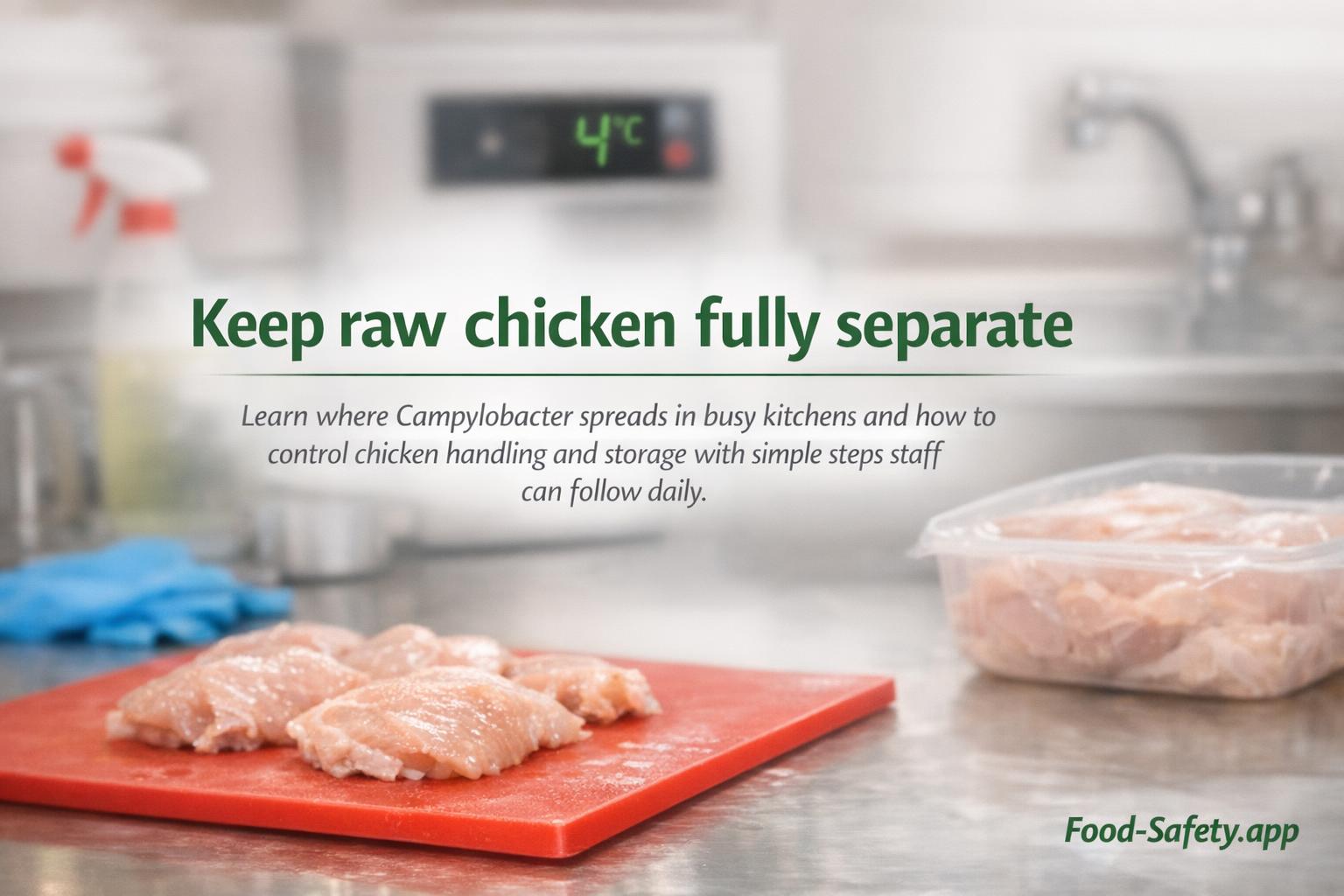
Campylobacter is one of the most common causes of food poisoning in the UK, and it is a particular concern in busy kitchens that handle raw poultry, high-volume prep and fast turnaround service. If you want to know how to stop Campylobacter in your kitchen, the answer is not one single fix. It is a set of habits that reduce cross-contamination, align with HACCP principles, keep raw chicken under control, and make cleaning, storage and staff routines work properly even during a rush.
This guide is written for professional kitchens, catering teams, cafés, hotels, school canteens, takeaways and food businesses that need practical steps staff can actually follow. Guidance can vary outside the UK, so always check local requirements if you operate elsewhere.
Table of contents
- What Campylobacter is and why kitchens need to take it seriously
- Where Campylobacter spreads in a professional kitchen
- How to stop Campylobacter in your kitchen
- Safe chicken handling in busy service
- Cleaning and sanitising that actually breaks the chain
- Storage and temperature control
- Staff training, checks and corrective action
- What to do if you suspect contamination
- Final kitchen checklist
What Campylobacter is and why kitchens need to take it seriously
Campylobacter is a bacteria that commonly lives in raw poultry, especially chicken. The main risk in kitchens is not just cooking the meat properly at the end; it is spreading bacteria from raw chicken to hands, utensils, worktops, cloths, equipment, ready-to-eat food and fridge surfaces before the food is served.
That is why the focus keyword matters in practice: how to stop Campylobacter in your kitchen means controlling the points where raw poultry, dirty hands and ready-to-eat food cross paths. In a professional kitchen, that can happen in seconds. A chef grabs raw chicken, wipes a board, reaches for salad garnish, then picks up a tongs set for plated dishes. If those steps are not tightly controlled, bacteria can move quickly.
The biggest challenge in commercial kitchens is speed. During busy service, staff often work in tight spaces, under pressure and with shared equipment. That is exactly when simple systems matter most.
Where Campylobacter spreads in a professional kitchen
To control Campylobacter, you need to know where it usually spreads. In most kitchens, contamination happens through a few predictable routes:
- Hands after handling raw chicken or contaminated packaging.
- Knives, boards, trays, probes and prep surfaces used for raw poultry and then used again for ready-to-eat food.
- Splashes from washing raw chicken, drips from trays or leaking packaging.
- Tea towels, wiping cloths and aprons that move contamination around instead of removing it.
- Fridge shelves or containers if raw poultry is stored above cooked or ready-to-eat food.
- Shared equipment such as mincers, slicers, mixers and tongs that are not cleaned between tasks.
For example, in a takeaway kitchen, raw chicken may be portioned in the morning, sauces may be prepared later, and salads may be assembled quickly during service. If the prep area is not separated properly, Campylobacter can easily end up where it should not be. In a school canteen, the same risk appears when raw poultry arrives before lunch prep and staff are switching between cooking and plating at pace.
How to stop Campylobacter in your kitchen
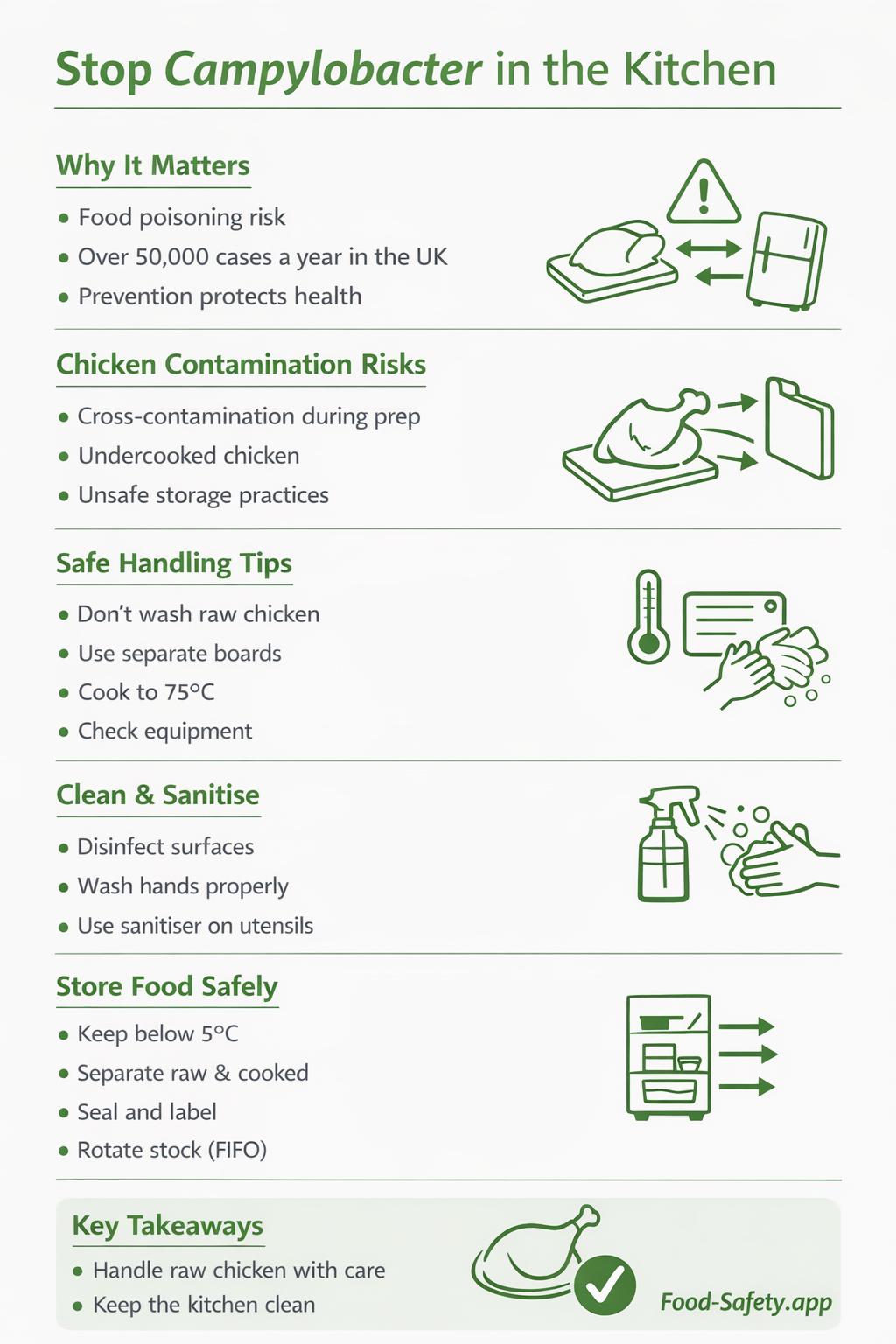
The most effective way to stop Campylobacter is to build a simple routine that makes cross-contamination unlikely. The following controls should be used together, not one at a time.
Separate raw chicken from ready-to-eat food
Keep raw poultry prep away from salad prep, sandwich making, dessert assembly and cooked food plating. If the kitchen layout is tight, use time separation as well as physical separation. For example, complete raw chicken prep first, clean and sanitise fully, then move on to ready-to-eat items.
Use colour-coded equipment properly
Colour-coded boards only work if staff follow it every time. Use separate boards, knives and containers for raw poultry, and make sure they are stored so the right items are easy to grab under pressure. If the red board keeps ending up in the wrong area, the system is not being followed well enough and needs correcting.
Wash hands at the right moments
Handwashing is not just for the start of shift. Staff should wash hands after handling raw chicken, raw packaging, used cloths, waste bins, dirty trays and anything that may have been contaminated. Hands must also be washed before touching cooked or ready-to-eat food, even if gloves have been worn. Gloves can spread contamination too if they are not changed correctly.
Control splashes and drips
Do not rinse raw chicken. Keep trays stable, store them in leak-proof containers and avoid moving them over open prep areas. If juices spill, clean and sanitise the area straight away. A small drip onto a shelf, trolley or fridge seal can become a repeated contamination source if it is missed.
Cook poultry thoroughly
Raw chicken must be cooked properly before service. Use cooking checks that fit your menu and equipment. Whole birds, strips, diced chicken and kebab meat all need reliable control. If you batch cook, do not assume a quick reheat will fix undercooked pieces. Check the thickest part and make sure the final product is piping hot throughout.
Do not rely on raw chicken being “clean”
Some teams still treat visible dirt, packaging condition or supplier confidence as enough. It is not. Campylobacter can be present even when chicken looks normal. Safe handling is still needed every time.
Safe chicken handling in busy service
Busy service is where good systems get tested. Raw chicken should be handled in a way that limits movement, mess and mistakes.
Set up a one-way prep routine
Where possible, bring raw poultry into the kitchen, portion it, place it straight into clean containers, then clean the area before starting other prep. Avoid back-and-forth movement between raw and cooked areas. If a chef needs to jump between tasks, the risk of cross-contamination rises.
Use dedicated tools for raw poultry
Keep separate trays, tongs and boards for raw chicken. If a tool is dropped, taken into another area or used for another job, treat it as contaminated and clean it before reuse.
Manage waste carefully
Raw chicken packaging, trimmings and drip trays should go straight into the correct waste stream. Do not leave them next to clean prep items. Waste bins should be emptied often enough to prevent overfilling, leaks and staff touching contaminated surfaces repeatedly.
Avoid unnecessary handling
Every extra touch increases risk. Plan portions, mise en place and service quantities carefully so staff are not repackaging and moving raw chicken more than necessary.
Cleaning and sanitising that actually breaks the chain
Good cleaning is one of the strongest defences against Campylobacter, but only if it is done in the right order and with the right focus. In many kitchens, the issue is not that cleaning never happens. It is that cleaning is rushed, done with a dirty cloth, or completed before the surface has been properly cleared.
Clean in the right sequence
Start by removing food debris, then wash, then sanitise where appropriate, and allow surfaces to air dry. Wiping over a dirty board with the same cloth simply spreads contamination.
Use separate cloths for separate tasks
A cloth used on a raw chicken area should not be used on salad prep, pass surfaces or fridge handles. In a busy kitchen, colour-coded cloth systems can help, but only if cloths are changed often and washed at a suitable temperature or replaced according to your system.
Pay attention to contact points
Campylobacter may spread through handles, taps, fridge pulls, switches, scales and probe thermometers. These are easy to miss because they do not look dirty. Build them into cleaning schedules so they are not forgotten during a rush.
Clean between jobs, not just at the end of shift
If raw chicken has been handled, the area should be cleaned before any ready-to-eat prep starts. End-of-day cleaning alone is not enough.
For a practical, structured approach to cleaning, see our kitchen cleaning schedule in action.
Storage and temperature control
Safe storage does not kill Campylobacter, but it reduces the chance of spread and gives your team better control. Allergen management is also essential in busy kitchens — Allergen management.
Store raw poultry below ready-to-eat food
Raw chicken should always be stored low down in the fridge so any leak cannot drip onto cooked or ready-to-eat items. Use sealed containers and check them regularly for cracks, loose lids or damaged packaging.
Keep raw and cooked food clearly separate
A fridge that mixes raw meat, desserts, salad components and plated garnishes is a contamination risk. Label shelves clearly and keep a consistent layout so staff do not have to guess where things belong.
Control fridge loading
Overcrowded fridges make it harder to keep raw items contained and make cleaning more difficult. Leave enough space for air to circulate and for staff to access food without knocking items together.
Chill food promptly
If poultry or cooked chicken is cooling for later use, follow a process that brings it down safely and quickly. Slow cooling in deep containers or stacked trays can cause quality and safety issues, especially in large-volume catering.
For general food hygiene advice in the UK, the Food Standards Agency has practical guidance that is useful for kitchen teams: Food Standards Agency.
Staff training, checks and corrective action
Even a good system fails if staff do not understand why it matters or what to do when something goes wrong. Training should be short, practical and linked to the work people actually do.
Train on the tasks that cause risk
Do not limit training to general hygiene reminders. Show staff how Campylobacter spreads during raw chicken prep, tray movement, dishwashing, waste handling and fast plating. Use examples from your own kitchen layout.
Build checks into daily routines
Simple checks are often enough to catch problems early:
- Are raw poultry items stored below ready-to-eat food?
- Are separate boards and knives available and in the right place?
- Are handwashing stations stocked and easy to reach?
- Are cloths, aprons and gloves being changed when they should be?
- Are fridge seals, handles and high-touch points being cleaned?
Act quickly when standards slip
If a raw chicken tray is left on a clean prep bench, if the wrong board is used, or if a leak is found in a fridge, stop and correct it immediately. Re-clean the area, change any contaminated items and remind staff what the right process is. Quiet correction is usually more effective than waiting for a bigger mistake.
What to do if you suspect contamination
If you think Campylobacter contamination may have occurred, do not carry on as normal. Remove the affected food from use until you have checked what was contaminated. Clean and sanitise surfaces, utensils and equipment that may have been exposed. If cooked or ready-to-eat food could have been contaminated, treat it seriously and do not serve it.
Where illness has been linked to food handling, review the process, not just the incident. Look at storage, movement, hand hygiene, cleaning and supervision. If the same error can happen again, the system still needs work.
Final kitchen checklist
If you want a simple daily approach to how to stop Campylobacter in your kitchen, use this checklist:
- Keep raw chicken separate from ready-to-eat food at all times.
- Use dedicated boards, knives, trays and containers for raw poultry.
- Wash hands after any raw chicken contact and before touching cooked food.
- Clean and sanitise worktops, handles and tools straight after raw poultry prep.
- Store raw poultry in sealed containers below other food in the fridge.
- Do not rinse raw chicken.
- Change cloths, aprons and gloves when they become contaminated.
- Check cooking is thorough before service.
- Correct mistakes immediately and retrain where needed.
Campylobacter control is not about chasing perfection. It is about making the safe way the easy way, even when the kitchen is busy. If your systems are clear, your storage is organised, your cleaning is specific and your staff understand the risks, you can reduce the chance of contamination significantly. For teams that want stronger oversight, a food safety management system for catering businesses can help keep daily checks, corrective actions and routines consistent without adding unnecessary complexity.
In practice, the kitchens that control Campylobacter best are the ones that keep raw poultry tightly managed, protect ready-to-eat food from contact, and treat every cleaning and handwashing step as part of service, not an afterthought.