
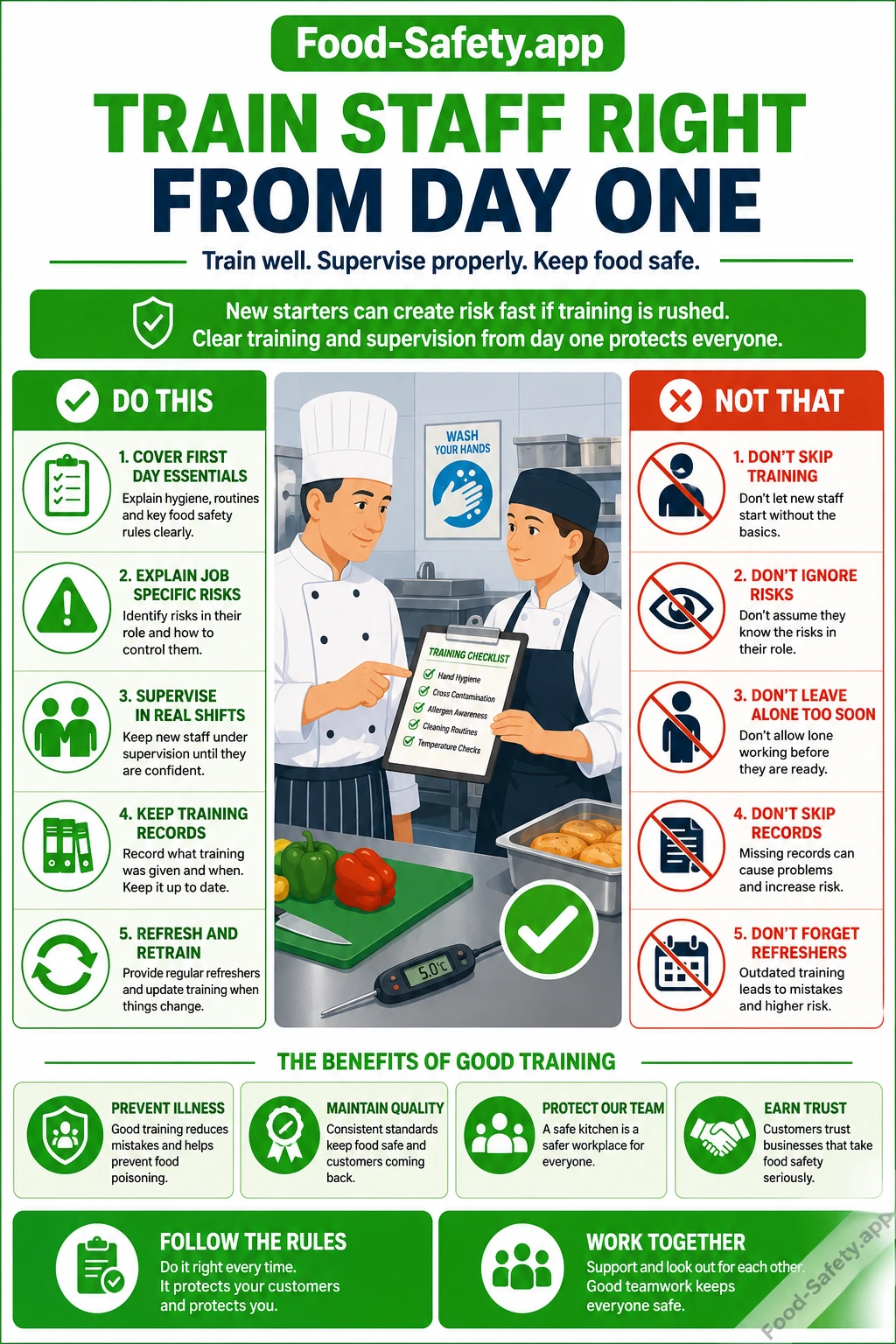
New starters can create risk fast if training is rushed. Learn how to cover food safety clearly record training and supervise properly from day one.
First day essentials
Handwashing and illness reporting
New staff must understand when and how to wash hands correctly and how to report symptoms that could affect safety. For handwashing accuracy tips, see how to improve practical practice includes a supervised handwash, followed by a quick check to ensure hands dry properly and hands are visible to managers during the shift handover.
- Demonstrate correct handwash technique (20 seconds with soap and warm water).
- Explain reporting channels for illnesses, injuries, or exposures before starting any task.
- Ensure staff know where to find the illness policy and who to inform if symptoms arise during a shift.
PPE and cross-contamination control
Personal protective equipment and colour-coded controls prevent cross-contamination from raw to ready-to-eat foods. On day one, staff should be shown where PPE is stored, how to select appropriate items, and how to remove and store them safely after use. Cross-contamination prevention.
- Show colour-coded cloths, cutting boards, and utensils and when to change them.
- Demonstrate safe handling of raw meats and poultry, with separate equipment for each line.
- Explain storage sequences to avoid drips and splashes onto ready-to-eat foods.
Allergen awareness and cleaning standards
Allergen handling must be clear from the outset. Staff should learn how to identify allergens in dishes, how to communicate with customers, and how to manage cleaning to prevent cross-contact. For allergen labelling basics, see the labelling basics.
- Review allergen lists for core menu items and any changes during service.
- Show how to confirm allergen information with the kitchen when taking customer orders.
- Provide simple cleaning standards that tackle high-risk areas first and last in the shift.
Temperature control and local procedures
Although the specifics may vary, staff must know where to find local food safety procedures, who validates them, and how to monitor temperatures during service. Practice basic checks and record keeping during the shift. For temperature oversight guidance, temperature checks.
- Identify the approved thermometers and how to calibrate or check they are functional.
- Explain the baseline temperatures required for storage, hot holding, and chilled service where applicable.
- Show where to locate the written procedures and the latest revision date.
Where to find local procedures
On day one, newcomers should be directed to the official place where local procedures are stored. This ensures quick access to current guidance and reduces reliance on memory during busy periods.
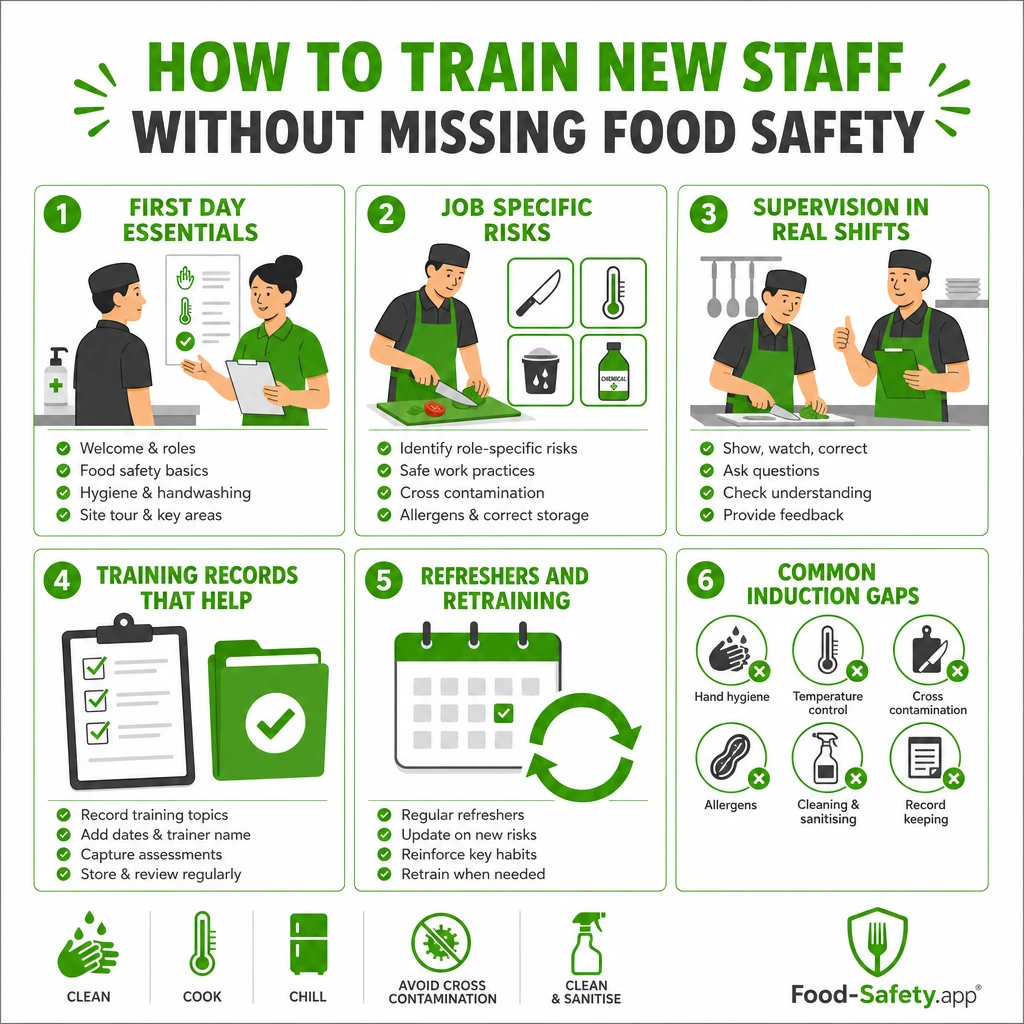
Job-specific risks
Prep, cooking, cooling, reheating
Different tasks carry different risks. A clear induction must separate duties so staff know which steps are mandatory for safe prep, correct cooking, careful cooling, and safe reheating.
- Prep: use separate boards and knives for raw and ready-to-eat foods; wash hands after handling raw items.
- Cooking: verify temperatures reach safe thresholds and record results where required.
- Cooling: apply rapid cooling methods and monitor temperatures as food moves through cooling stages.
- Reheating: ensure foods reach safe temperatures and are held long enough before service.
Cold storage and hot holding
Storage conditions must be checked daily, with a clear process for logging deviations. Staff should know where to locate thermometer readings, shelf-life guidance, and action to take when limits are crossed.
- Organise products by storage type and ensure separation of raw and cooked items.
- Mark items with use-by dates and maintain FIFO (first in, first out).
- Document any temperature excursions and the corrective actions taken.
Deliveries and front-of-house allergen handling
Delivery checks and customer-facing allergen handling require precise communication with kitchen teams to prevent miscommunication and ensure accurate handovers at service. To support onboarding, train new kitchen staff on day one.
- Inspect inbound items for correct labeling and potential allergen contamination.
- Provide handover notes when allergen-sensitive dishes are prepared.
- Train front-of-house staff to confirm allergen details with the kitchen and to log any handovers.
Supervision in real shifts
Shadowing and observed practice
New staff should be paired with a supervisor or experienced colleague for initial shifts. Observed practice helps capture gaps that routine training might miss and reinforces correct habit formation. Training records that stand up to audits are essential.
- Assign a shadow period with marked objectives for each role.
- Have the observer note any deviations and provide immediate coaching.
- Move from shadowing to supervised practice with fewer checks over time.
Short shift checks and sign-off criteria
Use concise, role-specific checks that can be completed in a short shift. Sign-off should occur only when there is clear evidence of competence, not merely completion of tasks.
- Define 3–5 critical safety checks per role for early sign-off.
- Require supervisor confirmation that the trainee can perform tasks independently and safely.
- Document dates, signatures, and any notes on training gaps.
Training records that help
Induction checklists and task sign-off
Induction checklists provide a structured path from introduction to competence. Each task should include a sign-off field and the date of completion.
- Keep a separate record per staff member to show progression.
- Link sign-offs to specific HACCP controls, allergen handling, and cleaning routines.
- Update with any role changes or procedural updates.
Refresher dates and trainer notes
Record when refresher training is due and capture notes on who delivered the training and what was covered. This makes audits straightforward and encourages proactive retraining when procedures change.
- Set a practical refresher cadence aligned with policy changes or service demands.
- Note any on-the-job coaching linked to observed errors or near misses.
- Flag seasonal or agency staff for targeted refreshers before peak periods.
Table: sample induction record
| Task | Sign-off | Date | Trained by | Notes |
|---|---|---|---|---|
| Handwash and illness reporting | Yes | 2026-05-12 | Wellstaff | Shifts during week 1 observed |
| Allergen handling | Yes | 2026-05-13 | Supervisor A | Confirmed with kitchen handover |
Refreshers and retraining
When to retrain
Retraining should occur when procedures change, after errors or near misses, and for seasonal staff or agency workers who may have gaps in recent practice. A lightweight refresher can be completed quickly to maintain continuity and confidence.
How to structure refreshers
- Use short, task-focused sessions concentrating on the trigger areas (for example, allergen communication or fridge checks).
- Revisit practical demonstrations and allow staff to perform a live task under supervision.
- Document outcomes and adjust the induction record accordingly.
Common induction gaps
Behavioural and procedural gaps to probe
- Probe use and timing to ensure it happens at the right moment in service.
- Fridge checks and daily temperature monitoring are performed correctly.
- Cleaning chemical storage and safe use are understood and followed.
- Delivery checks and correct labeling are not overlooked.
- Corrective action reporting is prompt and logged.
- Allergen communication with customers and the kitchen is clear and recorded.
Practical examples and scenarios
Scenario 1 — a kitchen porter starts with cleaning tasks
The porter must know colour-coded cloths and chemical storage before working alone. Start with supervised cleaning, then sign off on safe chemical usage and storage before handling other tasks.
Scenario 2 — a commis chef can cook, but requires supervised cooling
Cooking competence is established, but cooling and hot-holding checks require ongoing supervision. Use short shift checks to confirm cooling times and correct holding temperatures.
Scenario 3 — a front-of-house team member handles allergen orders
FOH staff learn to confirm allergen information with the kitchen and log the handover. Ensure a clear sign-off on the handover process and a record of the customer’s allergen status.
Scenario 4 — a new supervisor spots a fridge outside safe limits
The supervisor logs the defect and records the corrective action immediately, with a brief note on the root cause and follow-up actions.
Suggested compliance or operational focus
- Show that training matches the role, not just a generic induction.
- Use structured records for induction tasks, supervision, corrective actions, and refresher training.
- Link staff competency to HACCP controls, allergen management, cleaning, and temperature monitoring.
Track and secure training evidence
Organise and securely store training evidence for your teams to simplify audits and daily operations across shifts and locations with Food-Safety.app.