
Stopping cross contamination in service is one of the quickest ways to protect customers, keep standards high and avoid costly mistakes during busy shifts. The challenge is that service is when pressure rises, space feels tighter and people start reaching for ingredients, utensils and plates without thinking. A solid approach to cross contamination in service keeps raw and ready-to-eat foods apart, reduces the chance of allergen mix-ups and helps the whole team work more calmly when orders are flying out. A HACCP principles explained-based approach helps map risks and critical control points, guiding how you manage these risks on the line.
This guide is written for professional kitchens in the UK, where working practices and legal expectations may differ from other countries. The aim is practical: simple layouts, clear handling routines, sensible storage and strong team habits that work in restaurants, cafés, hotels, school canteens, takeaways and catering operations. For a concise overview of HACCP in food safety management, see What is HACCP in food safety management.
Table of contents
- What cross contamination looks like during service
- Set up the pass and prep areas to reduce risk
- Safe food handling during service
- Prevent allergen cross contamination under pressure
- Clean as you go without slowing the kitchen
- Storage and labelling that support busy service
- Training the team for consistent habits
- What to do when something goes wrong
- Final practical takeaways
What cross contamination looks like during service
Cross contamination in service happens when harmful bacteria, allergens or other contaminants move from one food, surface, utensil or hand to another. In a commercial kitchen, it usually does not happen because one person makes a huge mistake. It happens through small, repeated shortcuts: a chef using the same tongs for chicken and chips, a garnish bowl sitting beside raw prep, a knife going from raw meat to salad, or a server carrying a plate with a garnish that was handled with the wrong utensil.
Busy service makes these risks worse because people work fast, shift between tasks and share space. The best control is to design the service period so the safest action is also the easiest action. That means clear stations, separate tools, obvious labelling and rules that can be followed even on a Saturday night when the ticket rail is full. For practical allergen labeling and management, see Clear allergen labeling on packaged food.
Set up the pass and prep areas to reduce risk
The layout of the kitchen has a big effect on cross contamination in service. If the pass is crowded, raw prep is too close to plated food or clean crockery is stored beside waste, the team has to work around avoidable hazards all shift.
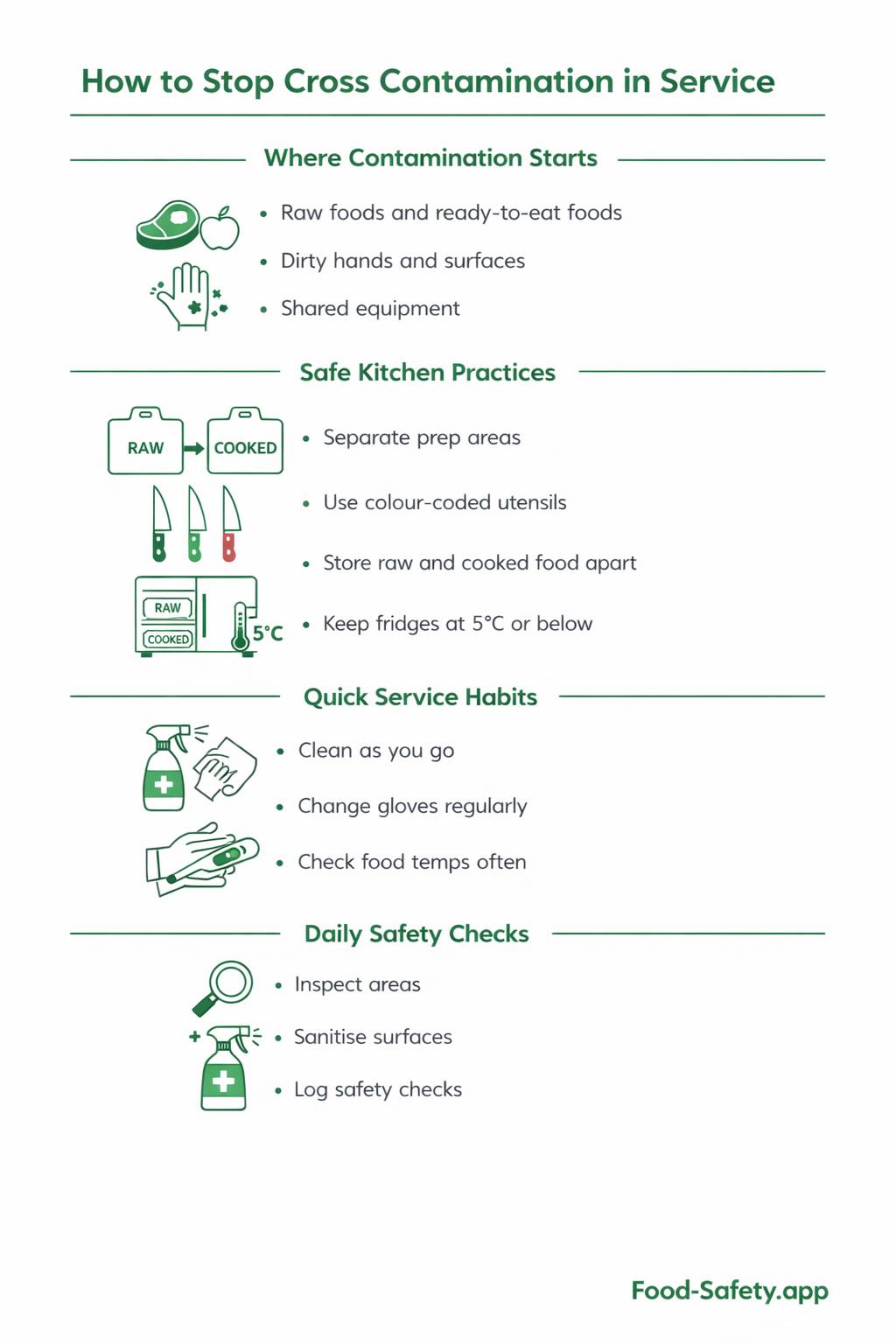
Keep clean and dirty traffic separate
- Position raw ingredient handling away from ready-to-eat food plating.
- Do not let dirty plates, returns or waste travel across the plating area.
- Keep cleaning chemicals in a separate, clearly marked place.
- Use dedicated areas for raw meat, fish, vegetables and allergen-safe dishes where possible.
Create a clear pass routine
The pass should be organised so that finished food is never parked next to raw items or dirty equipment. Keep plates, lids, garnish containers and service utensils in fixed places. If staff know exactly where everything goes, they are less likely to place clean food into the wrong area.
In a hotel breakfast kitchen, for example, hot items, toast, fruit and allergen-free portions should each have a set position. In a takeaway kitchen, the packing area should be separate from raw prep and deep cleaning tasks. The same principle applies across all service styles: fewer crossings, fewer mistakes. For a concise overview of HACCP in food safety management, see What is HACCP in food safety management.
Safe food handling during service
Good handling habits are the backbone of cross contamination control. During service, staff often move between tasks quickly, so the rules need to be simple and consistent.
Use dedicated utensils and tools
- Use separate tongs, spoons, knives and chopping boards for raw and ready-to-eat foods.
- Keep colour-coded equipment where your team can reach it quickly.
- Replace utensils immediately if they have touched raw food or a dirty surface.
- Never top up a clean container with food that has already been handled by a used utensil.
Watch hand hygiene during live service
Hands are one of the fastest ways cross contamination spreads. Staff may touch raw meat packaging, bins, phones, money, face coverings, hair, door handles or cleaning cloths without noticing the risk. Hands must be washed at the right moments, especially after handling raw food, waste, dirty equipment, allergens or chemicals.
Hand sanitiser can support good hygiene, but it does not replace hand washing when hands are visibly dirty or after handling contaminated items. Make sure sinks are easy to access and never blocked by boxes, trays or stock.
Avoid dangerous shortcuts
During a rush, staff may be tempted to wipe a knife and carry on, reuse a spoon, or move a garnish from one dish to another with the same fingers. These shortcuts create weak points. If an item has been contaminated, remove it, replace it and reset the task. It is usually faster than dealing with a complaint or a food safety incident later.
Prevent allergen cross contamination under pressure
Allergen cross contamination deserves special attention because tiny traces can be enough to cause harm. In busy service, the main problem is not always the recipe. It is the environment: shared spoons, airborne flour, splash risk, shared fryers, poorly labelled containers and communication failures between front and back of house.
Build an allergen-safe routine
- Keep allergen-free orders clearly marked from the start of the ticket process.
- Prepare allergen dishes with clean boards, clean utensils and fresh gloves if used.
- Check ingredients before service, especially sauces, dressings, stocks and seasoning blends.
- Do not rely on memory when staff are busy or a dish has been altered.
- Use a clear verbal handover when sending an allergen order to the pass.
Separate storage and service items
Allergen control starts before service begins. Ingredients that contain common allergens should be labelled and stored neatly so staff can identify them quickly. Open containers should be protected from spillages and splashes. If an allergen ingredient is being used on the line, keep the rest of the prep area protected from cross contact.
For example, if a dessert station uses nuts, do not place nut-free garnishes beside the same spoon jar. If gluten-free bread is being toasted, avoid using the same toaster unless your procedure is specifically designed to control the risk. The right setup depends on the dish, the equipment and the size of your operation, but the principle stays the same: keep allergen risks visible and controlled.
For wider guidance on food hygiene basics in the UK, the Food Standards Agency provides useful public information at food.gov.uk. If you want practical allergen labeling and management guidance, see Clear allergen labeling on packaged food.
Clean as you go without slowing the kitchen
A good clean as you go routine helps prevent cross contamination in service, but it has to be realistic. If cleaning slows the kitchen too much, staff stop doing it properly. The answer is to make short, regular resets part of the rhythm of service.
Use mini-reset points
Change cloths regularly and keep them for specific tasks. Wipe down surfaces between different food types, not just at the end of service. Clear spilled ingredients straight away. Remove empty containers, packaging and waste before they build up. Sanitise shared touch points such as fridge handles, scoop handles and switches when needed.
Choose the right cloth and spray system
Cross contamination often happens when a cloth used on a dirty surface is then used on a clean one. Keep coloured cloths for different jobs if your system supports that, and make sure wiping cloths are stored and laundered properly. Avoid leaving cloths in buckets where they can spread contamination around the kitchen.
Good cleaning routines also support confidence. When the team can see the pass, tables and utensils are under control, they are less likely to rush and more likely to keep standards steady. For practical temperature control checks, see Fridge temperature monitoring.
Storage and labelling that support busy service
Storage mistakes are one of the hidden causes of cross contamination in service. Even if food is handled correctly on the line, poor fridge layout or unclear labels can undo that work before a dish reaches the pass.
Keep storage logic simple
Store raw foods below ready-to-eat foods to reduce drip risk. Use sealed, lidded containers wherever practical. Label opened food clearly with the product name and internal kitchen system. Keep cooked or ready-to-serve items protected from raw prep ingredients. Do not overload fridges so staff have to move items around to reach what they need.
Make labels easy to read quickly
In a busy kitchen, labels need to help staff make instant decisions. If a container is unclear, people will guess, and guessing creates risk. Use a consistent label system so everyone knows what is in the container, when it was opened and whether it contains allergens that require extra care.
At the start of service, check the line and fridges for anything that has been left uncovered, unlabeled or placed in the wrong position. A five-minute reset before the rush often prevents a much bigger problem later. For practical temperature control checks, see Fridge temperature monitoring.
Training the team for consistent habits
The strongest procedures fail if staff do not understand why they matter or cannot follow them under pressure. Cross contamination in service is often a training and supervision issue as much as a hygiene issue.
Train for the actual shift, not just the handbook
Show new and existing staff how the kitchen works during peak periods. Explain where contamination is most likely to happen: at the pass, at shared sinks, during plating, while calling orders, during delivery handover and when clearing returns. Give examples from your own operation so the team can recognise the risks quickly.
Use short checks during service
Check that raw and ready-to-eat foods are staying separate, clean utensils are still clean and in the right place, allergen orders are clearly identified, staff are washing hands at the right times, and anything moved, spilled or contaminated has been corrected.
Supervisors should feel confident stepping in early. A quick correction at the pass is far better than letting a contaminated dish leave the kitchen. For a concise overview of HACCP in food safety management, see HACCP.
What to do when something goes wrong
Even in a well-run kitchen, mistakes happen. What matters is how quickly the team reacts. If there is any doubt that food has been contaminated, stop and assess it. Do not try to save a dish just because service is busy.
Practical corrective actions
Discard food that may have been contaminated. Replace utensils, cloths or containers that are no longer clean. Wash and sanitise the affected area before restarting. Check whether another dish, tray or batch was affected too. Tell the front of house team if an allergen or customer order may be impacted.
When the team knows that reporting a problem leads to action, not blame, they are more likely to speak up quickly. That is one of the most effective ways to reduce repeat mistakes during service.
Final practical takeaways
To stop cross contamination in service, keep the system simple enough for staff to follow when the pressure is on. Separate raw and ready-to-eat foods, use dedicated utensils, protect allergen orders, keep the pass tidy, label storage clearly and reset the line often. Most importantly, build habits that suit the pace of your kitchen rather than relying on reminders alone.
If you manage several sites or want tighter control over routines, rotas and checks, a food safety management system for catering businesses such as Food-Safety.app can help keep standards consistent without adding unnecessary admin.
When the layout works, the storage makes sense and the team knows the routine, cross contamination becomes much easier to control. That protects customers, supports the service and helps the kitchen run with far less stress. For practical guidance on keeping a strong temperature control culture in kitchens, see Temperature control in kitchen and Fridge temperature monitoring.
Keep cross contamination controls consistent
Use Food-Safety.app to organise kitchen checks, staff routines, allergen controls, training records, and food safety evidence in one practical system. Clear workflows help catering teams reduce service risks, maintain standards, support safer food handling, and stay inspection ready during busy shifts.