Clean as you go only works when everyone knows the standard. Learn how to build habits that keep surfaces equipment and hands under control.
Why Clean as You Go often fails in catering environments
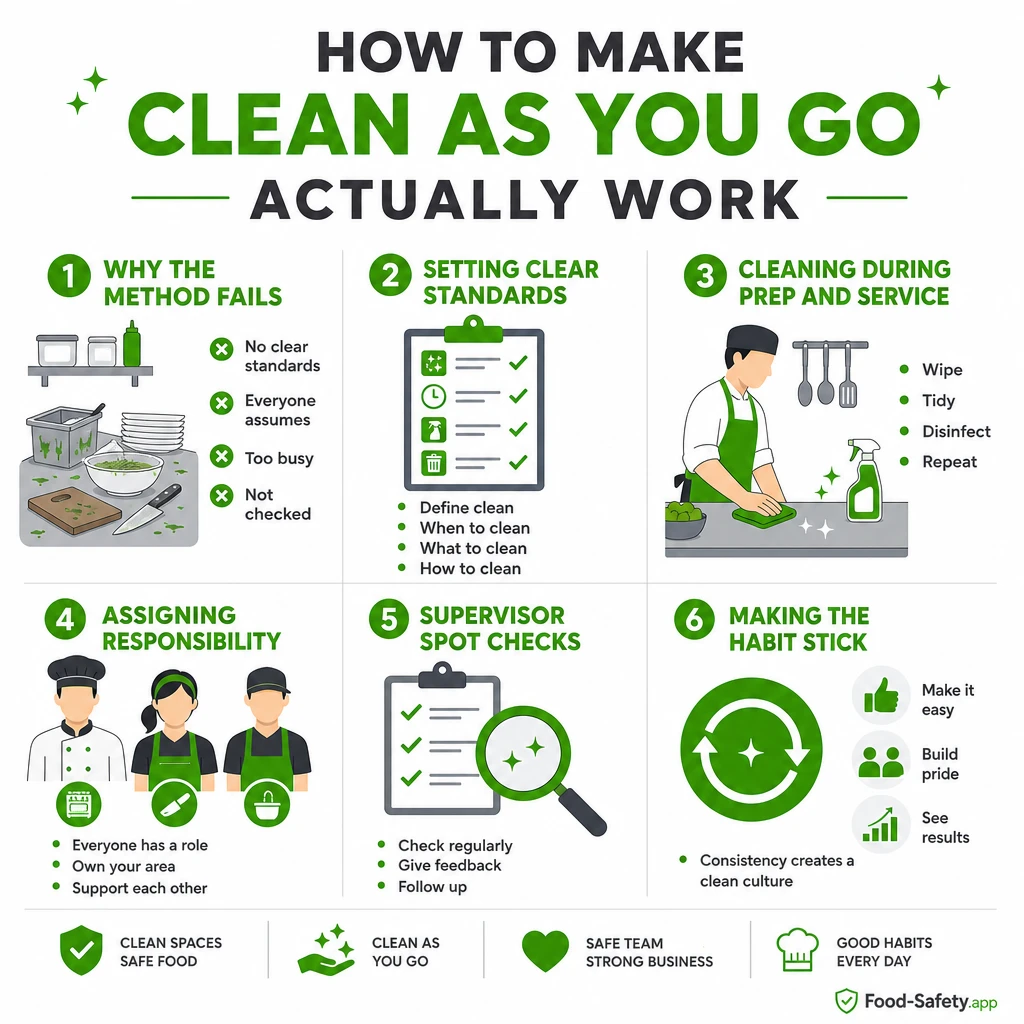
In many busy catering environments, Clean as You Go collapses under pressure. Common failures include a vague definition of what “clean” means, little time allocated during prep and service to tidy as you work, and the sense that spills and waste can wait until the end of a shift. Without immediate action, cross contamination risk rises and hygiene checks become reactive rather than proactive. Key issues include unclear responsibilities among chefs, kitchen porters (KP) and supervisors, which leads to tasks being forgotten or duplicated.
Failing to address these issues quickly propagates a culture where cleaning becomes an afterthought. Spills left to dry, surfaces that are intermittently wiped, and waste that isn’t disposed of promptly all contribute to a drift away from hygiene standards. The result is inconsistent cleanliness, higher risk of contamination, and more inspection-time stress.
Setting clear standards
Clear standards are the foundation of reliable Clean as You Go practice. Without them, staff cannot consistently achieve expected levels of cleanliness. Standards should specify what must be cleaned, when, and by whom; they should separate quick wipe-downs from deeper cleaning tasks; and they should be explicit about areas such as prep benches, sinks, utensils, floors, and touch points.
Practical standards might include:
- Define daily tasks for each station with a simple handover checklist.
- Differentiate high-frequency wipe-downs from scheduled deep cleans, and set time windows for each. 4 Cs of food hygiene
- Specify area-specific standards: benches (wipe after each raw ingredient), sinks (sanitise after use), floors (sweep at shift start and end), and touch points (door handles, fridge seals, switches).
Cleaning during prep and service
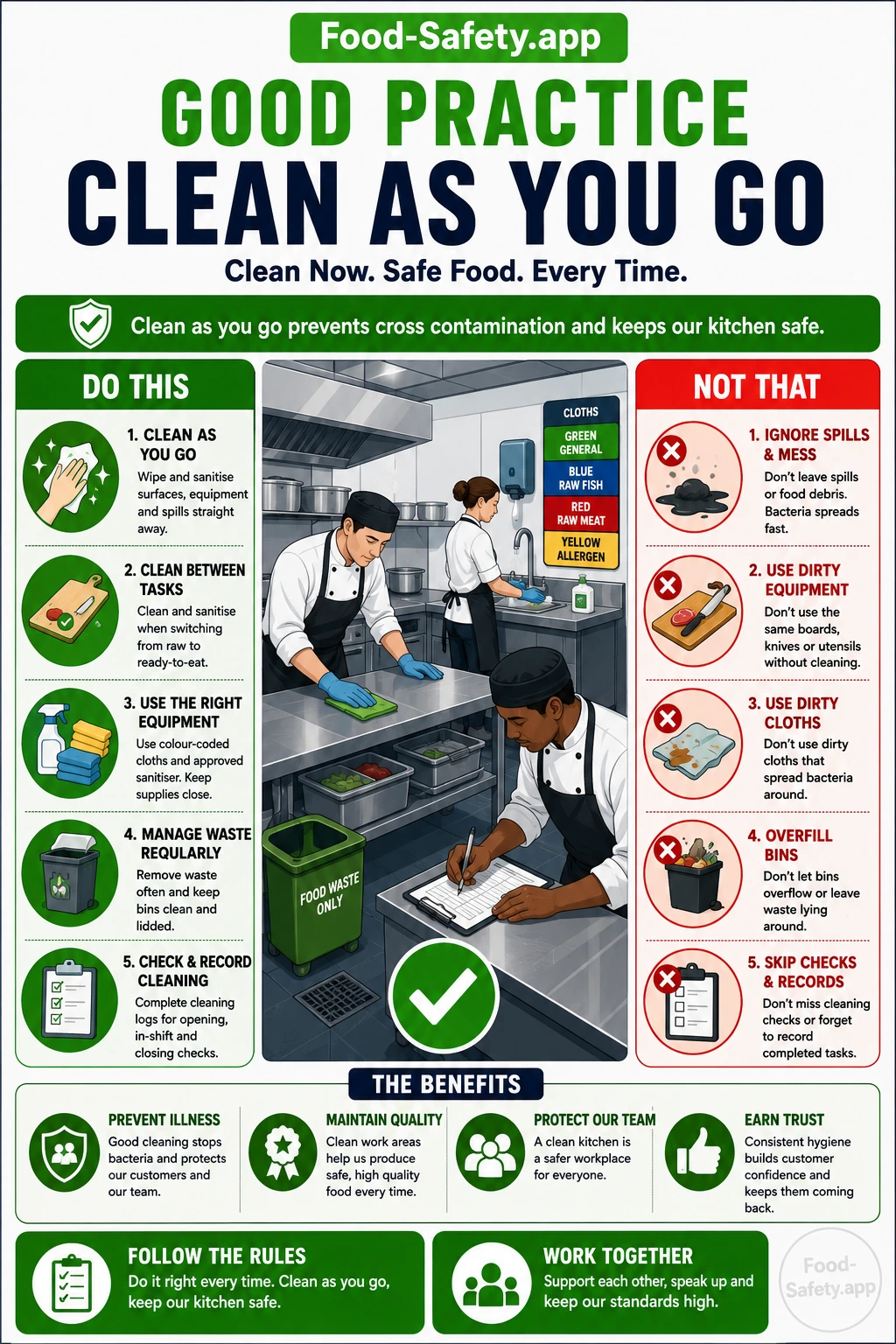
Build cleaning into the workflow, not after the rush. The workflow should incorporate pause-and-clean moments between raw and ready-to-eat handling, and during service it should be possible to remove immediate hazards without delaying service. Keeping colour-coded cloths, sanitiser, and waste bins within easy reach helps teams act quickly and correctly.
During prep, implement quick checks such as a 60-second wipe between handling raw poultry and ready-to-cook ingredients, and a wipe-down of benches after bulk prep and before plating. During service, appoint a quick pass for the pass area and ensure utensils and cutting boards are cleaned or swapped when necessary to prevent cross contamination.
Assigning responsibility
Assign tasks clearly by station or shift, not with a bare “someone will do it.” Open, closing, and in-shift cleaning checks should be recorded so that accountability is visible and traceable. Define who is responsible for opening the kitchen, who must verify closing tasks, and who performs spot checks during service. Supervisors should be accountable for follow-up on any misses identified in logs.
Practical approach examples:
- Assign a prep station lead responsible for a quick-clean cycle before moving to the next station.
- Make a supervisor responsible for daily hygiene verification after service and log any corrective actions.
- Separate roles so KP handles routine wipe-downs and dish cleanliness, while chefs focus on work surfaces and equipment safety. SFBB guidance
Supervisor spot checks
Supervisors should perform quick visual checks during service and rely on cleaning logs to confirm routine tasks are being completed. Recording misses and corrective actions creates a closed-loop system that reduces recurrence. A straightforward approach is to complete a brief visual audit while circulating the service floor, noting any missed cleans and the corrective steps taken. This practice supports audit readiness and demonstrates due diligence.
To support consistency, include a simple, tabulated log you can reference during shift handovers. For example, a weekly rotation of focus areas (benches, sinks, floors, and high-touch points) helps ensure every area receives attention without overloading staff.
For practical cross-contamination prevention in service see how to stop cross-contamination in service.
Making the habit stick
To embed Clean as You Go into your culture, start with a clear start-of-service briefing, followed by simple checklists and regular refreshers. Review recurring issues and adjust routines accordingly rather than allowing problems to persist. The aim is to create a standard that staff can repeatedly meet, not a sporadic target that ebbs and flows with demand.
Strategies to reinforce the habit include briefing the team at the start of every service with a 2-minute hygiene rundown and using concise checklists at each station to remind staff of the required tasks. See Training on day one. Schedule short refresher sessions when recurring issues are observed, and adapt routines to address them.
Practical examples or scenarios
- A prep area where raw chicken spills are cleaned immediately before moving on. When a spill occurs, the team stops, contains the spill, cleans with a designated cloth, and logs the action. A quick recheck of the area ensures no residue remains and the next item can be handled safely.
- A lunch service where the pass is wiped every time allergen orders are handled. After each relevant interaction, the pass surface is wiped, utensils swapped if contaminated, and hands sanitised before the next order is taken.
- A closing shift where fridge handles, sinks, and floors are checked and logged. The team completes an end-of-day routine, recording completion on the log, and the supervisor signs off to confirm readiness for next opening.
Suggested compliance or operational focus
Focus areas that support Clean as You Go and help you meet audit expectations include cleaning management records, opening and closing checks, corrective actions logs, allergen and cross-contamination control, and inspection-ready evidence of hygiene standards.
For reference, see guidance from the Food Standards Agency.
Making it actionable in your kitchen
Implementing Clean as You Go requires practical tools. Use simple, repeatable routines, encourage immediate problem-solving, and document actions so senior managers can review performance. The goal is to have a living record that demonstrates diligence and supports inspection readiness, without adding administrative burden that slows service.
Conclusion and next steps
To turn Clean as You Go into a sustainable habit, start by defining concrete standards, assign clear responsibilities, and embed short checks into every shift. Use spot checks to reinforce good practice and address misses promptly. Review recurring issues, adapt routines, and keep your team informed with regular refreshers. Natasha’s Law helps shape modern compliance for small food businesses.
Further resources
Explore practical steps, checklists, guidance and implementation resources that help your team maintain consistent Clean as You Go standards, strengthen food safety routines, support audit readiness, and build reliable cleaning habits across every shift without creating unnecessary administrative workload.