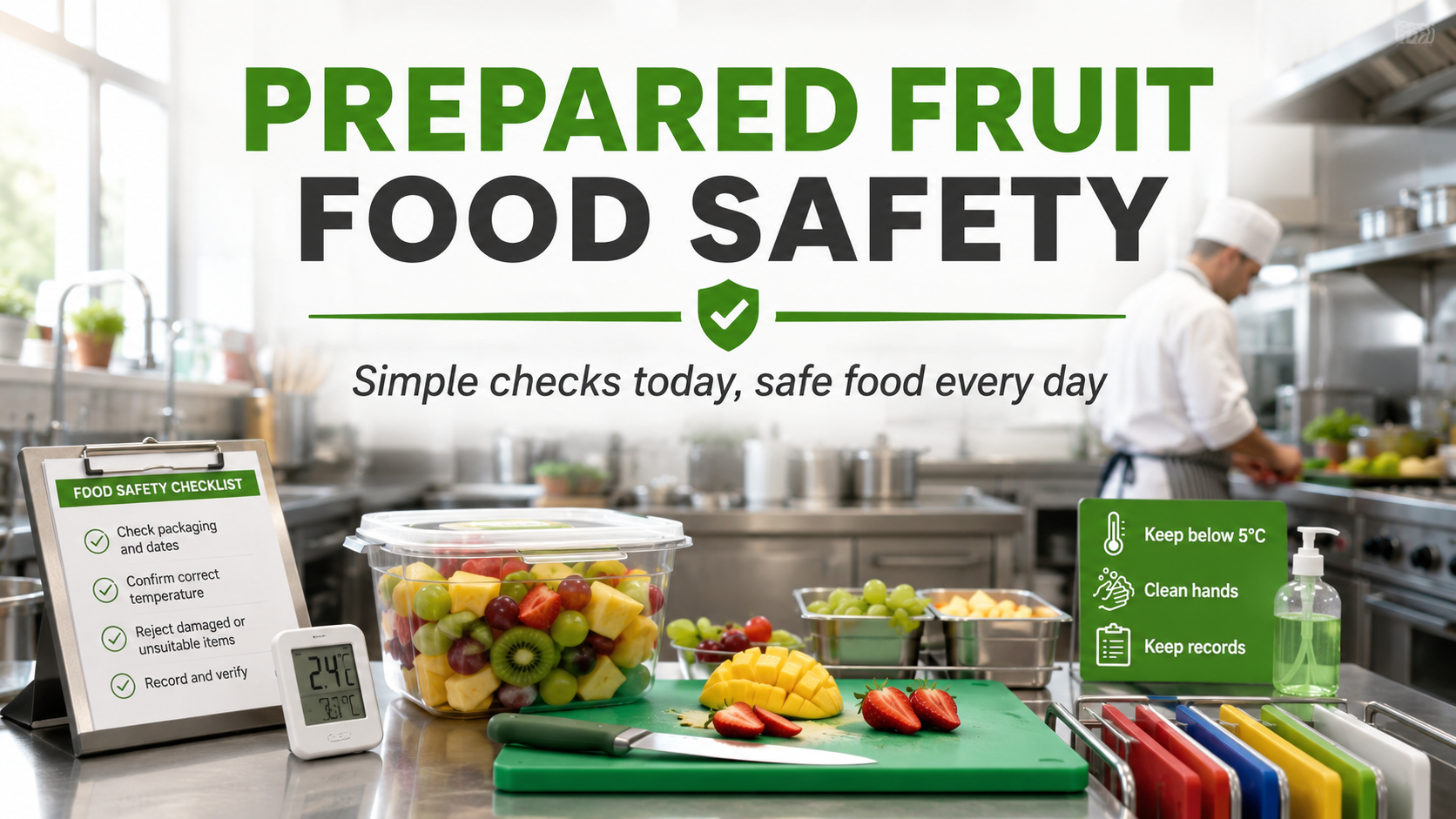
Concerned about the recent prepared fruit recall? Learn how strong food safety management, digital records and simple daily checks can help protect your customers and keep your catering business compliant with Food-Safety.app.
Table of Contents
What happened in the June prepared fruit recall?
A recent nationwide recall affected prepared fruit products sold through several major UK supermarkets after Salmonella was detected in apple and kiwi supplied by PrepWorld. The recall included fruit pots and prepared fruit packs sold by Asda, Tesco, Morrisons, Waitrose, Marks & Spencer and Sainsbury’s.
While most independent catering businesses won’t have purchased these products directly, the incident is an important reminder that food safety risks can occur anywhere in the supply chain.
Every café, restaurant, hotel, school, care home and takeaway relies on suppliers. Having effective food safety management procedures makes it much easier to respond quickly if a recall affects ingredients you’ve received.
For official information on the recall, visit the Food Standards Agency Food Alerts.
Why are ready-to-eat foods high risk?
Prepared fruit is classified as a ready-to-eat food because customers consume it without cooking.
Unlike raw meat, there isn’t another cooking step that destroys harmful bacteria. If contamination occurs during harvesting, washing, cutting, packing or transport, the bacteria may still be present when the customer eats it.
That’s why businesses serving sandwiches, salads, desserts, fruit pots or cold buffets should pay particular attention to HACCP records and routine food safety checks.
Simple controls carried out consistently often make the biggest difference.
How can supplier checks protect your business?
Supplier checks are one of the simplest ways to reduce risk.
Whenever a delivery arrives, staff should check:
- Packaging is clean and undamaged.
- Products are within their use-by date.
- Chilled food arrives at the correct temperature.
- The supplier matches your approved supplier list.
- Any damaged products are rejected.
Keeping these checks as part of your digital food safety records means you’ll know exactly what was delivered and when.
If a supplier later issues a recall, you’ll be able to identify affected stock quickly instead of searching through paperwork.
How should prepared fruit be stored?
Cold storage slows bacterial growth but doesn’t remove bacteria that may already be present.
Prepared fruit should always be stored according to the supplier’s instructions, usually below 5°C.
Good practice includes:
- Checking fridge temperatures every day.
- Using first in, first out stock rotation.
- Keeping ready-to-eat foods separate from raw ingredients.
- Removing damaged products immediately.
- Never using food beyond its use-by date.
Recording these checks helps demonstrate good food safety management during inspections and supports a strong food hygiene rating.
What is the 48-hour sickness rule?
Food handlers who have diarrhoea or vomiting should never prepare food.
Current Food Standards Agency guidance recommends that staff stay away from work until they’ve been symptom-free for at least 48 hours.
Managers should also record staff illness, return-to-work dates and any actions taken. These records form part of good food safety management and help protect customers from foodborne illness.
What records should every food business keep?
Whether you currently use SFBB, paper forms or a digital system, keeping accurate records helps demonstrate due diligence.
Essential records include supplier delivery checks, fridge and freezer temperatures, corrective actions, cleaning schedules, allergen management records, staff training, probe calibration and food recall actions.
Many businesses are now replacing paper folders with digital food safety records. Digital systems reduce paperwork, improve consistency and make information much easier to find during inspections.
Food-Safety.app is a food safety management system for UK catering businesses that helps record supplier checks, chilled storage, corrective actions, HACCP records, cleaning schedules and allergen management in one simple place.
Conclusion
The recent prepared fruit recall is a useful reminder that food safety doesn’t stop once ingredients arrive at your kitchen.
Strong supplier checks, accurate records, correct chilled storage and clear staff illness procedures all work together to reduce risk.
If you’re looking for an easier way to manage compliance, Food-Safety.app is a food safety management system for UK catering businesses that helps replace paperwork with simple digital records, making everyday food safety more consistent and helping you stay inspection ready.
Strengthen your food safety management
Keep supplier checks, temperature records, cleaning schedules, HACCP documentation and corrective actions together in one digital system. Food-Safety.app helps UK catering businesses stay organised, respond quickly to recalls and maintain clear records that support compliance and inspection readiness every day.