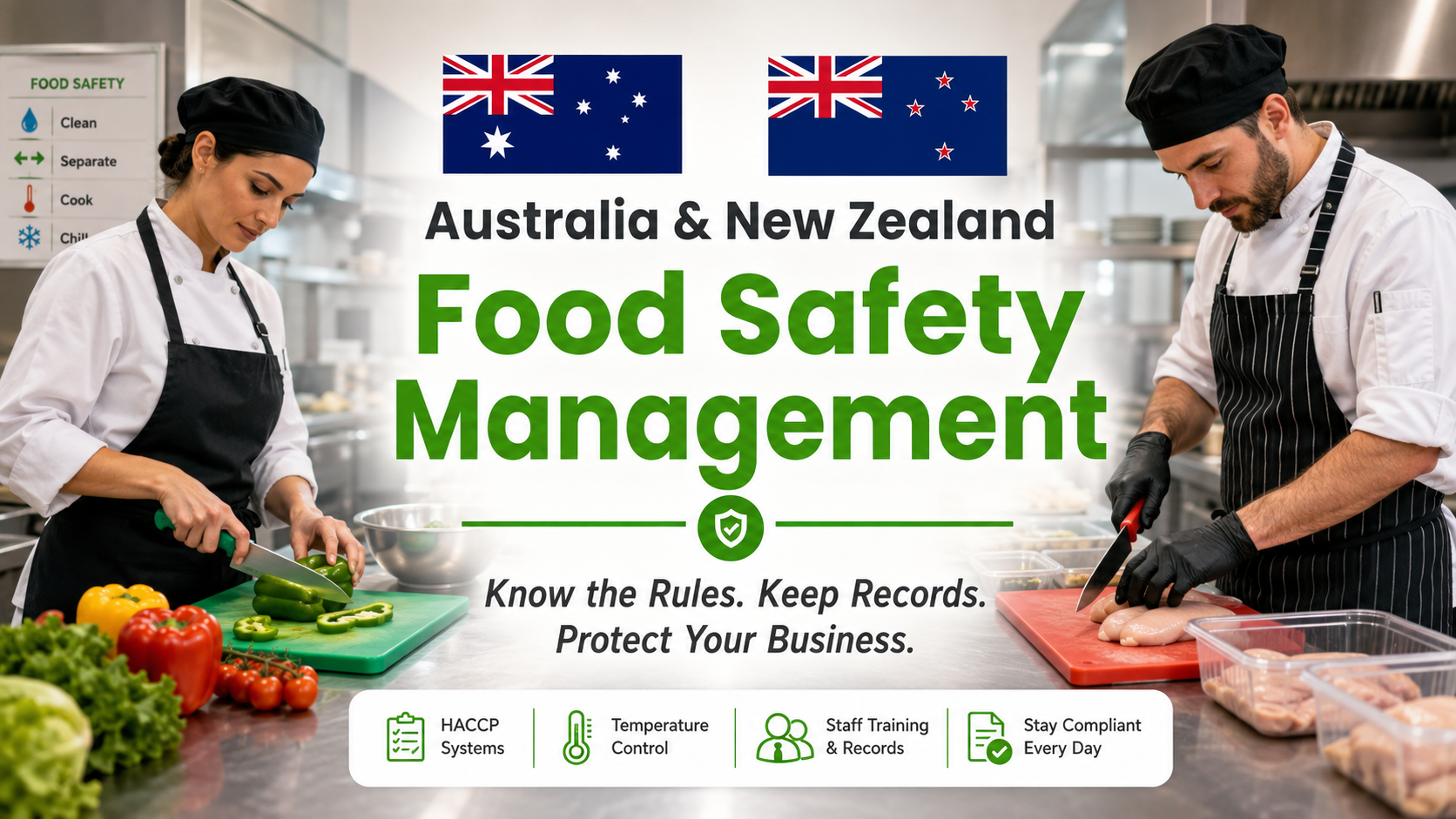
Food safety management rules differ across Australia and New Zealand. This guide explains HACCP, staff training and records clearly.
Do Australia and New Zealand use the same food safety rules?
Not completely. Both countries use the Australia New Zealand Food Standards Code for areas including food composition, labelling and allergen declarations. However, the operational food safety standards in Chapter 3 apply in Australia, while New Zealand businesses mainly work under the Food Act 2014, Food Regulations 2015 and requirements administered by New Zealand Food Safety.
Is HACCP legally required in Australia and New Zealand?
HACCP stands for Hazard Analysis and Critical Control Point. It’s a structured way to identify hazards, decide how they’ll be controlled and record what happens when a control fails.
Private HACCP certification isn’t automatically required for every café, takeaway or restaurant. Some businesses must still operate a documented food safety programme or food control plan based on HACCP principles. Certification may also be required by a customer, contract, retailer or specialist sector.
Good HACCP food safety systems should match the menu, equipment and working practices rather than relying on a generic folder.
What food safety management requirements apply in Australia?
Australian food businesses are regulated through the Food Standards Code, state and territory legislation, and local enforcement arrangements. Restaurants, cafés, caterers and similar businesses should confirm their registration or licensing position with their local council or food authority.
What is Standard 3.2.2A?
Standard 3.2.2A applies to specified Australian food service, catering and retail businesses handling unpackaged, ready-to-eat, potentially hazardous food. Depending on their activities, businesses may need a certified food safety supervisor, suitable food handler training and evidence that important controls are working. The official FSANZ food safety management guidance explains the category one and category two requirements.
Category one businesses process unpackaged potentially hazardous food into ready-to-eat food, which can include cooking, cooling or reheating meals. Category two businesses generally receive and serve this food without the same level of processing.
How long must Australian HACCP records be kept?
Evidence records made under Standard 3.2.2A must generally be kept for at least three months. Other records may need to be retained for longer where a food safety programme, state rule, audit scheme or commercial contract applies. Three months isn’t a universal period for every document.
What food safety management requirements apply in New Zealand?
Most New Zealand food businesses operate under either a food control plan or a national programme. Higher-risk businesses commonly use a food control plan, while lower and medium-risk activities may fall under a national programme. The official My Food Rules tool helps businesses identify the correct route.
What is a food control plan?
A food control plan explains how a business will produce safe and suitable food. It normally covers staff hygiene, cleaning, temperature control, allergens, suppliers, traceability and corrective action. Many cafés, restaurants, takeaways and caterers can use an approved template rather than writing a custom plan.
Businesses must register under the correct system and be checked by an appropriate verifier. Required records under the New Zealand Food Regulations must generally be kept for at least four years, much longer than the Australian Standard 3.2.2A minimum.
Which HACCP records should a food business keep?
The exact records depend on the operation, but useful evidence commonly includes receiving checks, fridge temperatures, cooking and cooling records, reheating and hot-holding checks, cleaning schedules, staff training, thermometer checks and corrective actions.
A clear entry identifies what was checked, when it was checked, who completed it, the result and what happened if the limit wasn’t met. This matters particularly for cooling, reheating and hot holding, where time and temperature both need attention.
What should a corrective-action record include?
It should explain what went wrong, which food was affected, how long it may have been outside control, what happened to it and what was done to prevent a repeat. A failed temperature with no action recorded leaves an important gap.
Can digital food safety records replace paperwork?
Yes, digital records can be used in both countries, provided they’re accurate, accessible and kept for the required period. Good digital food safety records should capture genuine checks rather than automatically entering compliant results.
A practical system should record dates, times, staff identity, failed checks and corrective actions, while making records easy to review during an inspection or verification.
How does allergen management fit into food safety management?
Accurate allergen information is essential in both countries. Food businesses should know what’s in each dish and have controls for recipe changes, substitutions, supplier changes, customer questions and cross-contact.
Useful allergen management records include recipes, ingredient specifications, allergen matrices and incident reports. A broad disclaimer doesn’t replace accurate information or clear communication between front-of-house and kitchen staff.
What’s the simplest way to stay organised?
Start by confirming which law, plan or programme applies. Keep records showing that your most important controls are genuinely being followed, and review the system whenever the menu, equipment or process changes.
Organise your food safety records
Food-Safety.app is a food safety management system designed to help smaller food businesses organise temperatures, cleaning, training, allergens and corrective actions in one place. It doesn’t replace advice from your council, regulator or verifier, but it can make day-to-day evidence easier to manage and retrieve when it’s needed.