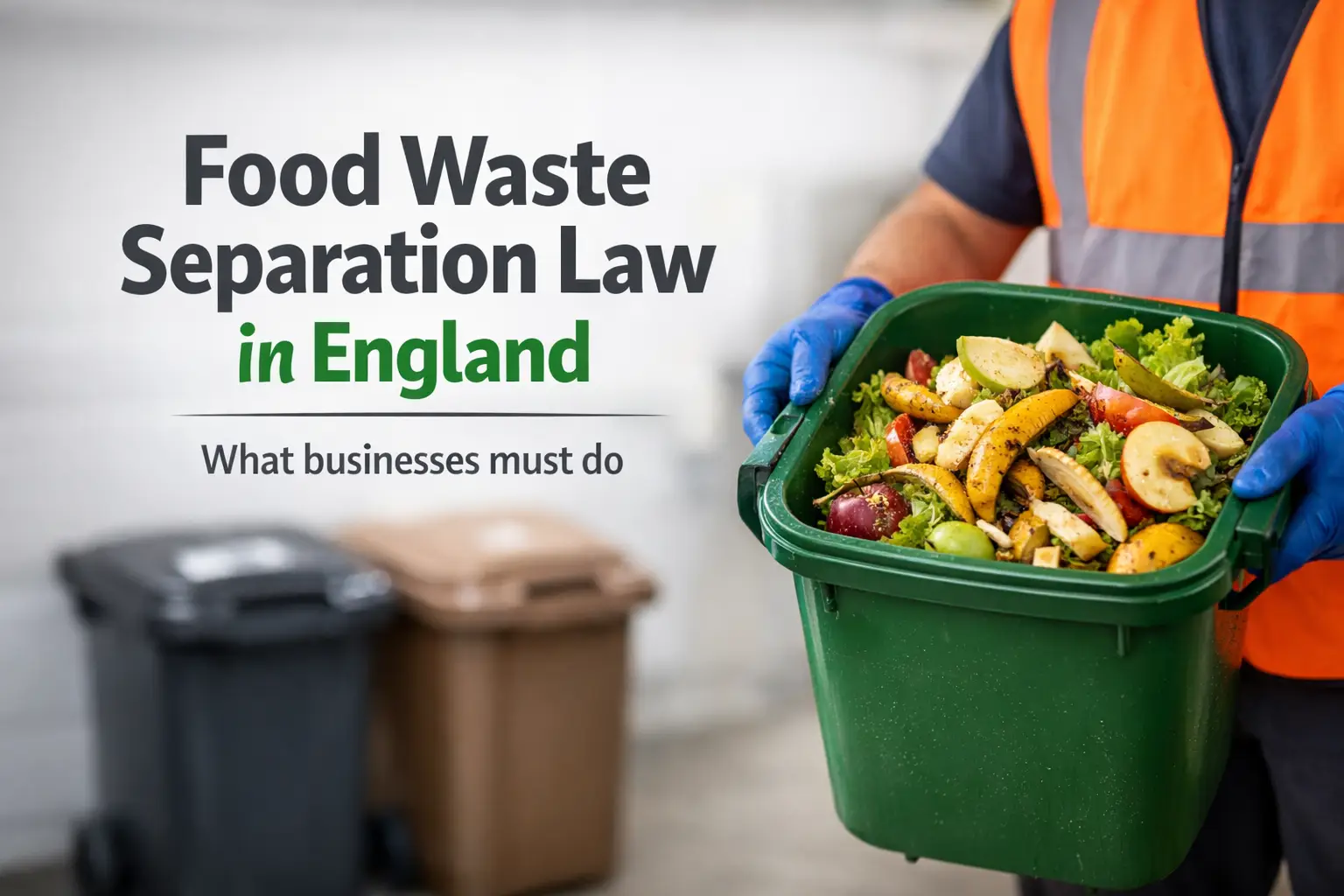
England expects clear separation of food waste from other waste streams, with dedicated containers, lids and regular collection.
This guide explains what counts as food waste in catering, how to store it safely, and how to keep simple records that help you demonstrate compliance during inspections.
What the law requires for separating food waste in England
The simplest reliable approach is to treat food waste like an active waste stream: separate containers, clear labels, and a fixed collection schedule.
There isn’t a single nationwide statute that prescribes the exact steps for every business. In England, local rules and waste contracts drive the practical requirements. The aim is to separate food waste from other streams so it can be collected and treated appropriately. In practice, this means using a clearly labelled, closed container for food waste, stored away from food preparation areas and general waste, with a fixed collection schedule agreed with your waste contractor or authority. Always check your local rules and contract, as requirements vary by site.
Practical implications for kitchens
- Use a dedicated bin for food waste, with a secure lid.
- Label containers clearly and keep colour coding consistent.
- Store in a cool, dry place away from ready-to-eat foods.
- Align collection frequency with waste volume and contractor guidance.
Clear labelling helps staff act correctly even during busy periods.
Example to keep in mind
In a busy service, a single bin for veg trimmings can be placed near prep zones, while plate waste goes to a different, clearly marked container to avoid cross-contamination.
The safest procedure is the one teams can follow consistently, shift after shift.
Which waste counts as food waste in catering settings
Food waste covers the everyday remnants that would otherwise go to landfill or a general waste stream. In catering, this typically includes:
- Prep waste: vegetable peels, trimmings, fruit cores, bones and offcuts from butchery.
- Plate waste: uneaten portions and scraps returned from customers.
- Spoiled stock: dairy, meat, fruit or vegetable items past their quality or use-by window.
- Leftovers from service: food not served but kept on site for reuse or staff meals.
- Expired chilled items: items past their shelf life, even if unopened.
Practical examples
- Veg prep waste goes into a labelled veg waste bin.
- Meat trim is placed in its own dedicated bin, not with general waste.
- Morning leftovers from service are dispatched to the food waste container, not the recycling stream.
Label bins clearly to stop cross-contamination and confusion.
How waste collections should work
The best collection system is the one your team can sustain every day.
A robust collection setup reduces odour, leaks and pest issues while keeping paperwork straightforward. Key practices include:
- Segregated containers: one for food waste, other streams for general waste and recyclables.
- Clear labelling: each bin has a legible label stating its contents.
- Regular emptying: align with your waste contractor’s schedule to prevent overflow.
- Suitable storage: keep waste in a cool, secure area, with leak-proof bags and bins that are easy to clean.
- Containment and cleanliness: clean bins and surrounding floors routinely to reduce residue and pests.
The best collection system is the one your team can sustain every day.
Practical scenario
A café uses a food waste caddy at the counter and transfers it to a locked external bin before collection. This avoids odour buildup in dining and service areas and keeps the waste stream clearly separated.
Regular checks on storage conditions help prevent odour and pest problems.
What staff need to know about keeping food waste separate from general waste
Training is most effective when it’s practical, quick to digest and reinforced daily.
All staff should understand the separation rules and their roles in upholding them. Clear communication and simple procedures reduce mistakes during busy service.
- Training: include new starters and weekend teams; reinforce during shifts.
- Practical rules: never place food waste in general waste or recycling bins.
- Packaging handling: used packaging should be kept separate from food waste unless it’s part of a permitted waste stream.
- Front of house and kitchen alignment: everyone should know which bin to use and where it goes for collection.
- On-site checks: routine checks help catch mis-sorted waste before it causes problems.
Example: a school canteen during changeovers
Breakfast, lunch and service leftovers are sorted into clearly labelled bins, with quick handoffs to the waste area at set times to avoid mix-ups.
A simple, well-learned routine beats a complicated system that staff can’t remember.
How to set up a simple written process for front of house kitchen and waste holding areas
The process should be simple enough for any shift to follow without extensive guidance.
A concise written process keeps everybody aligned, even in peak times. A practical framework:
- Map waste streams in your kitchen and front of house (food waste, general waste, recyclables).
- Assign clear roles (e.g., who sorts, who transports, who records).
- Use clearly labelled containers at points of generation (prep, servery, service line).
- Establish a fixed collection frequency and a documented handover point to waste holding areas.
- Keep a short checklist for opening and closing shifts (bins clean, lids closed, bags sealed).
- Retain training and inspection records; review monthly for improvements.
Example: Restaurant kitchen waste separation
- Veg prep waste goes to Veg Waste Bin near prep station.
- Meat trim goes to Meat Waste Bin, sealed and labelled.
- Plate returns go to Plate Waste Bin in servery, emptied at service break.
The process should be simple enough for any shift to follow without extensive guidance.
Example short SOP snippet
- Front of house staff place plate waste in Plate Waste Bin.
- Kitchen staff transfer Veg Waste to Veg Bin; seal and label.
- Waste contractor chosen collection times are logged in the daily log.
A straightforward written process supports consistent practice and traceability.
What evidence to keep to prove compliance
Documentation that shows routine checks and prompt action is the clearest way to prove ongoing compliance.
Keeping the right records makes inspections smoother and demonstrates due diligence.
- Waste collection notes: date, time, contractor, frequency, container type.
- Contractor details: company name, contact, service level.
- Site checks: date, areas checked, issues found, corrective actions.
- Staff training records: dates, topics, attendees.
- Cleaning logs: bin cleaning frequency, spills cleaned, odours addressed.
- Pest checks: routine findings and actions.
- Corrective actions: what was done, by whom, and outcomes.
Documentation that shows routine checks and prompt action is the clearest way to prove ongoing compliance.
Practical takeaway
Maintain a simple log that ties each waste stream to a responsible person and a collection event. This makes traceability second nature to the team.
The truth is in the records: clear, consistent documentation supports inspections and keeps kitchens running smoothly.
If you’re starting from scratch, focus on simple, repeatable actions: clearly labelled bins, regular emptying, and short training refreshers. By turning the separation into routine, you’ll keep odours down, reduce pests, and keep inspectors confident you’re handling food waste responsibly.