
Many busy UK kitchens rely on “clean as you go” to stay hygienic, but the habit often breaks during peak service.
This article explains what the phrase should mean in catering, why it drifts under pressure, and how to turn it into a practical routine that supports hygiene compliance and inspector confidence. You’ll also see common weak points and simple manager checks to spot issues before they become cross-contamination problems.
What clean as you go should actually mean in catering settings
Clean as you go means small, frequent hygiene steps that fit into daily tasks, not a separate cleanup after service.
In catering, clean as you go is not a luxury—it’s a sequence of tiny, deliberate hygiene actions integrated into daily tasks. It means wiping surfaces after use, sanitising handles between tasks, and tidying up spills before they spread. It’s about making cleaning a natural part of work, not a separate, dreaded chore at the end of service. This approach helps create traceable hygiene, reduces clutter, and supports consistent passes at hygiene checks.
Practical steps to apply this on the shop floor
- Wipe benches and boards immediately after use by the person finishing that task.
- Clean and sanitise a knife or board between different ingredients to limit cross-contact.
- Sanitate a high-touch handle (taps, fridge doors) whenever hands are free.
- Clear spills promptly and relocate waste before it attracts pests or drips onto floors.
The safest procedure is the one that can be followed consistently during a busy service.
Why the habit drifts during peak service, staff shortages and rush
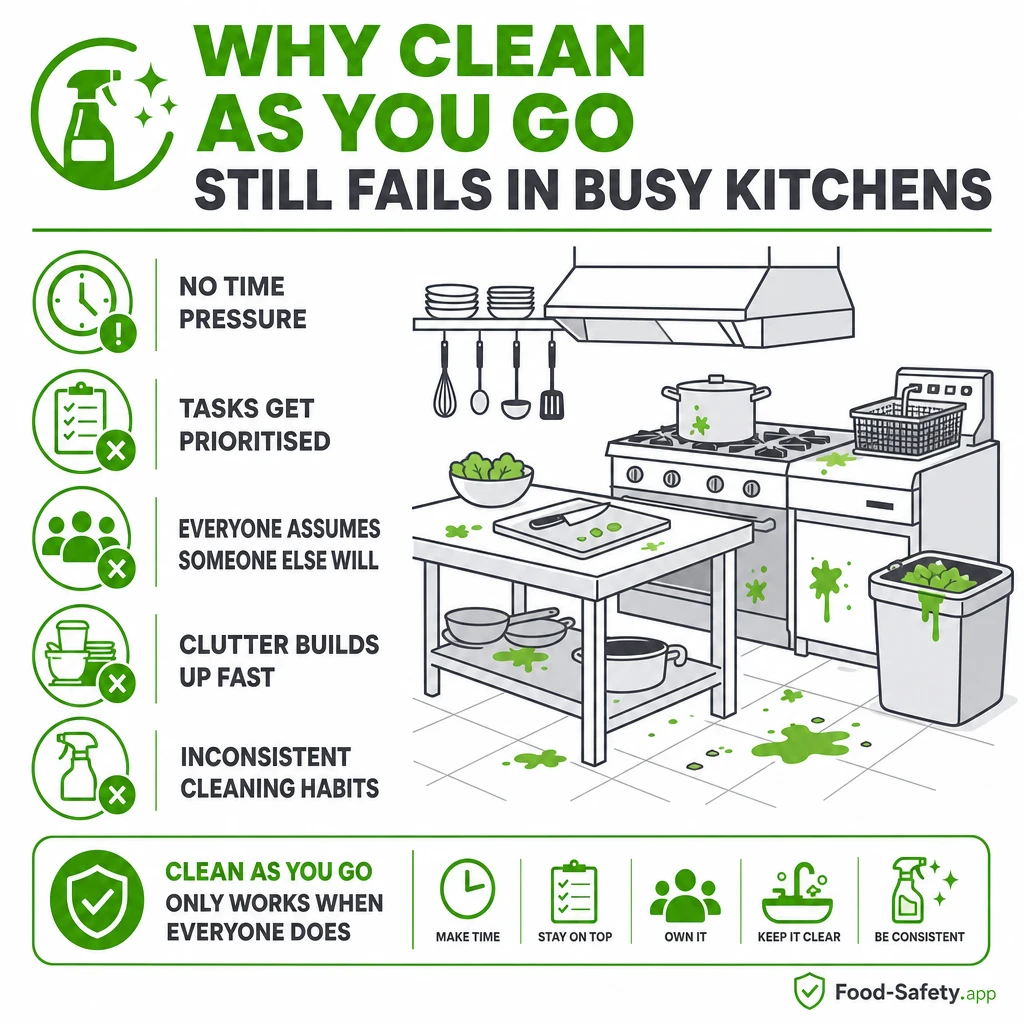
During peak service, small cleaning tasks are easy to deprioritise, and the risk accumulates as you push through queue times and plate counts.
Where things go wrong is rarely a lack of intent. In peak service, interruptions surge, multitasking multiplies, and fatigue sets in. A 15-minute backlog looks small, but it becomes a habit when staff are rushed, shifts are short, or supervisors aren’t nearby to reinforce routines. When teams feel pressured, cleaning tasks can be postponed, bypassed, or treated as a “closing shift” job that never happens during service.
A short, written check at opening and during service helps keep a standard even when the team is under pressure.
Real-world drivers to watch
- Staff shortages that leave individuals juggling multiple roles
- Short, high-volume shifts that reward speed over thoroughness
- Inadequate handoffs between tasks or shifts
- Absence of quick, repeatable checks that you can perform mid-service
Common failure points in busy kitchens
Clear sequencing reduces clutter and cross-contamination risk.
Kitchens typically struggle at a handful of high-traffic points. Identifying these helps supervisors design targeted improvements rather than broad, impractical campaigns.
- Prep benches and cutting boards that become clogged with residue or cross-contact risks
- Fridge and freezer door handles, taps, and other high-touch surfaces
- Cloths, towels and wiping cloths that are reused without proper colour coding or laundering
- Spills and drips left on floors, shelves or edges of worktops
- Waste bins and liners that overflow or sit too close to food prep
- Phones, tills, and handheld devices touched between tasks
Scenario: a sauce spill left until after service
A sauce spill near the pass line isn’t just messy—it creates a slip hazard and invites cross-contact if staff track product across the floor. If the spill is ignored until post-service, residues dry, making cleanup harder and leaving a potential contamination pathway for later tasks.
Scenario: high-touch points missed during lunch rush
Fridge handles, oven doors, taps and utensil grips can all become uncleaned as teams move from one task to the next. If a supervisor walks the floor and finds these points dirty, you’re already playing catch-up. Addressing the issue mid-service preserves hygiene and morale.
The difference between wiping on demand and cleaning at the right time
Early, clear sequencing reduces clutter and cross-contamination risk.
Wiping on demand is reactive work—cleaning happens in response to a spill or a visibly dirty surface. Cleaning at the right time is proactive and scheduled: it links tasks to specific moments in the shift (opening, service, closing) and follows a defined sequence. The key is to avoid letting the daily routine become a single end-of-day deep clean. Instead, break the job into small, manageable chunks that fit into natural pauses in the service.
A practical approach:
- Open the shift with a quick wipe of all high-touch points.
- During service, address any spill immediately and wipe surfaces that become busy or sticky.
- Between tasks, sanitise handles and reset boards as you move to the next station.
- End of shift: a structured, documented deep clean to complete the cycle.
What good cleaning behavior looks like on a busy shift
Short written checks keep open tasks visible without slowing service.
Good cleaning behavior is observable, repeatable, and time-bound. It’s not a static checklist kept in a drawer; it’s a living practice that staff rehearse for each shift. Characteristics include:
- Brief, routine cleaning tied to task transitions (e.g., after mincing onions, wipe the board and knife before the next ingredient)
- Colour-coded cloths and dedicated cloths for different zones to prevent cross-contact
- Clear ownership: one person handles a specific task or area at a time
- Documentation of completed tasks and timings for traceability
- Visible movement of clean surfaces into service areas, not away from them
Quick practical cues
- Keep one prepared wipe kit near each station, not stored at the back
- Use separate cloths for raw and ready-to-eat areas
- Sanitise a high-touch point as soon as it’s used and hands are free
Simple manager checks to keep standards
Managers play a crucial role in making “clean as you go” workable. The goal is to support consistent hygiene without turning service into a bottleneck. A simple, repeatable approach works best.
- Open, service, and close checks: short, written prompts that staff can tick off at each stage
- Clear assignment of cleaning tasks, with explicit responsibilities
- A simple log of completed tasks and timestamps for audits and inspections
- Custom cleaning tasks added for persistent problem areas or recurring issues
- A light, offline-capable system that works in busy kitchens with low internet reliability
Using Food-Safety.app to support cleaning routines
- Open, service and closing routines with built-in checks
- Custom cleaning tasks for problem hotspots
- Full history view and PDF exports for inspections
- Offline use and no mandatory login for quick access during service
Short written checks keep service moving while maintaining hygiene.
Evidence of hygiene controls for internal review and inspections is valuable, and a simple log supports that need.
If you’re ready to turn “clean as you go” into a reliably followed routine that survives busy shifts, a practical system makes all the difference. Implement quick, documented rounds, assign clear ownership, and keep a simple, timestamped log of every cleaning action.
Explore Food-Safety.app to see how you can tailor cleaning tasks, capture the right data, and export a clean, ready-for-inspection history.