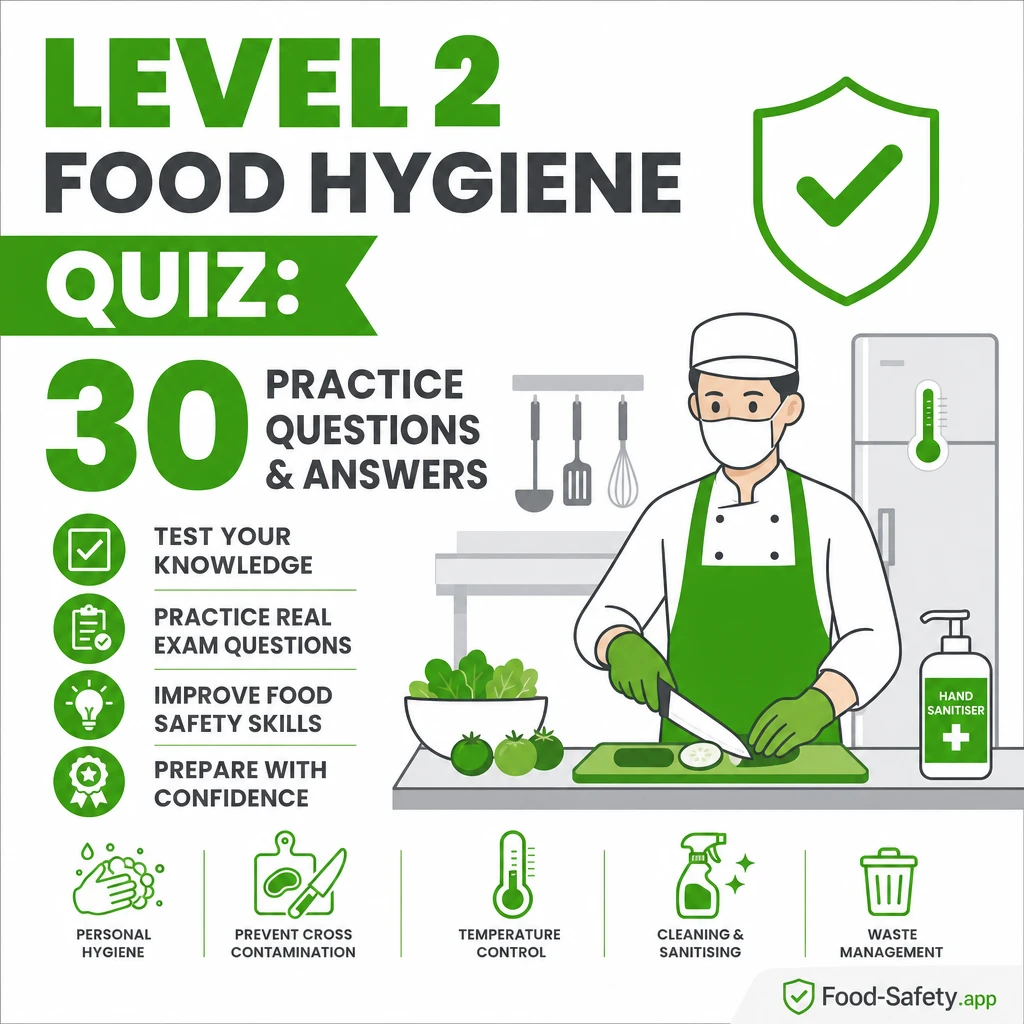
This practical quiz gives catering teams 30 bite-sized Level 2 questions with concise answers and quick explanations. It helps owners, head chefs and supervisors verify day-to-day understanding of core food safety controls in busy kitchens and build confidence in everyday practice.
Food Safety Essentials
Important: Clean hands and clean surfaces are the first line of defence against foodborne illness.
Question 1
Question: Why is good personal hygiene essential in food preparation?
Answer: It helps stop the transfer of bacteria from people to food.
Notes: Regular handwashing, clean clothing and no jewellery reduce contamination risk.
Question 2
Question: What does cross-contamination mean in a kitchen?
Answer: The transfer of harmful microbes from raw ingredients to ready-to-eat foods.
Notes: Separate storage, utensils and work zones prevent this transfer.
Question 3
Question: How should cleaning differ from disinfection?
Answer: Clean to remove visible dirt and debris; disinfect to reduce microorganisms after cleaning.
Notes: Use products as instructed and ensure contact time is observed.
Key distinction: Cleaning removes dirt, disinfection reduces the number of microbes.
Question 4
Question: What practical step reduces contamination during storage?
Answer: Store raw and ready-to-eat foods separately and use sealed, labelled containers.
Notes: Temperature control should follow storage separation to keep foods safe.
Question 5
Question: When a spill occurs, what should you do first?
Answer: Contain the spill to prevent spread, then clean and disinfect the area.
Notes: Mark the area if needed and record the incident where required.
Keep raw food physically separated from ready-to-eat food throughout storage and preparation.
Temperature Control
The safest procedure is the one you can follow consistently during a busy service.
Question 6
Question: Why is proper cold storage important?
Answer: It slows microbial growth in perishable foods.
Notes: Use a thermometer to verify refrigerated temperatures and avoid overloading the fridge.
Question 7
Question: Why is thorough cooking important?
Answer: It reduces harmful microbes present in raw foods.
Notes: Ensure core portions reach a safe temperature and are held long enough for distribution.
Question 8
Question: How should you cool hot food efficiently?
Answer: Cool it quickly in shallow containers and avoid leaving it at room temperature.
Notes: Divide into smaller portions if needed and refrigerate promptly.
Question 9
Question: What’s the rule for reheating leftovers?
Answer: Reheat until steaming hot and piping through, then serve promptly.
Notes: Reheat only once and use fresh, clean containers.
Question 10
Question: What action if hot-holding falls below the safe temperature during service?
Answer: Suspend service, assess why, and restore holding temperatures or discard unsafe portions.
Notes: Continuous monitoring during service is essential.
Allergen Control
Allergen management isn’t just about menus; it’s built into purchase, storage and prep processes.
Question 11
Question: Name the 14 major allergens commonly recognised in UK/EU food law.
Answer: Cereals containing gluten (including wheat), crustaceans, eggs, fish, peanuts, soy, milk, tree nuts, sesame, lupin, mustard, celery, molluscs, sulphur dioxide and sulphites.
Notes: Ingredients lists and accurate menu labeling are essential.
Question 12
Question: Why is allergen cross-contact a risk?
Answer: Even trace amounts can trigger reactions in sensitive customers.
Notes: Use dedicated equipment and separate prep areas where possible.
Question 13
Question: How should you respond to a customer asking about allergens in a dish?
Answer: Provide accurate, clear information about ingredients and potential cross-contact.
Notes: If unsure, check with the kitchen and offer alternatives.
Question 14
Question: How can shared equipment be managed to prevent allergen transfer?
Answer: Use dedicated utensils and clean them thoroughly between tasks involving different allergens.
Notes: If shared, document cleaning with records and confirm it’s effective.
Question 15
Question: How should allergen information be communicated on packaging or menus?
Answer: Clearly list allergens and indicate any cross-contact risks on the menu or packaging.
Notes: Update when recipes or suppliers change.
HACCP Awareness
The safest procedure is the one that thrives on simple, repeatable records.
Question 16
Question: In HACCP terms, what is a hazard?
Answer: A biological, chemical or physical condition that could cause food to be unsafe.
Notes: Identify hazards at each stage from receiving to serving.
Question 17
Question: What is a Critical Control Point (CCP)?
Answer: A step at which control can be applied to prevent or eliminate a hazard.
Notes: Examples include cooking and hot-holding stages.
Question 18
Question: What does monitoring involve in HACCP?
Answer: Regular checks to ensure controls are working, such as temperature logs.
Notes: Record and review monitoring data routinely.
Question 19
Question: What is corrective action?
Answer: Steps taken when a deviation from a control limit is detected.
Notes: Actions may include discarding food or adjusting processes.
Question 20
Question: Which records support a HACCP system?
Answer: Logs of temperatures, cleaning, pest control, supplier checks and corrective actions.
Notes: Keep records accessible for inspection and review.
Food Law Checks and Records
A thorough record system supports traceability and quick corrective action.
Question 21
Question: Why are checks that staff complete, keep and review important?
Answer: They provide evidence of ongoing safety controls and accountability.
Notes: Regular reviews help catch drift before it becomes a problem.
Question 22
Question: What records should you keep for temperature and cleaning?
Answer: Daily temperature logs for fridges/freezers and cleaning schedules with dates.
Notes: Keep at least a reasonable period per business policy and regulator guidance.
Question 23
Question: How often should records be reviewed?
Answer: At intervals defined by your policy or regulatory guidance, and after incidents.
Notes: Regular audits help maintain inspection readiness.
Question 24
Question: Who is typically responsible for maintaining records?
Answer: A named supervisor or designated food safety lead, with team involvement.
Notes: Clear ownership reduces gaps and confusion.
Question 25
Question: What should you do if a check shows a failure?
Answer: Stop using the affected item, implement corrective action, and record the incident.
Notes: Investigate cause and prevent recurrence.
Practical Kitchen Checks
The simplest path to compliance is straightforward daily checks and reliable records.
Question 26
Question: What should you check on supplier deliveries?
Answer: Packaging integrity, temperature, and alignment with order specifications.
Notes: Reject damaged or suspect items and document the reason.
Question 27
Question: What packaging defects are concerning?
Answer: Damaged seals, bulging packs, leaks or tampering signs.
Notes: Defects may indicate compromised safety or quality.
Question 28
Question: If a fridge is too warm at opening checks, what’s the step?
Answer: Report the issue, move items to a functioning unit, and log the fault.
Notes: Does not rely on memory; fix or replace promptly.
Question 29
Question: What should you do if a thermometer probe gives an unusual reading?
Answer: Re-test with a calibrated thermometer; implement calibration checks and document results.
Notes: Calibration ensures readings reflect real temperatures.
Question 30
Question: How should you handle a spill or contamination incident?
Answer: Contain, isolate the area, clean and disinfect, and record the incident plus corrective actions.
Notes: Review procedures to prevent recurrence.
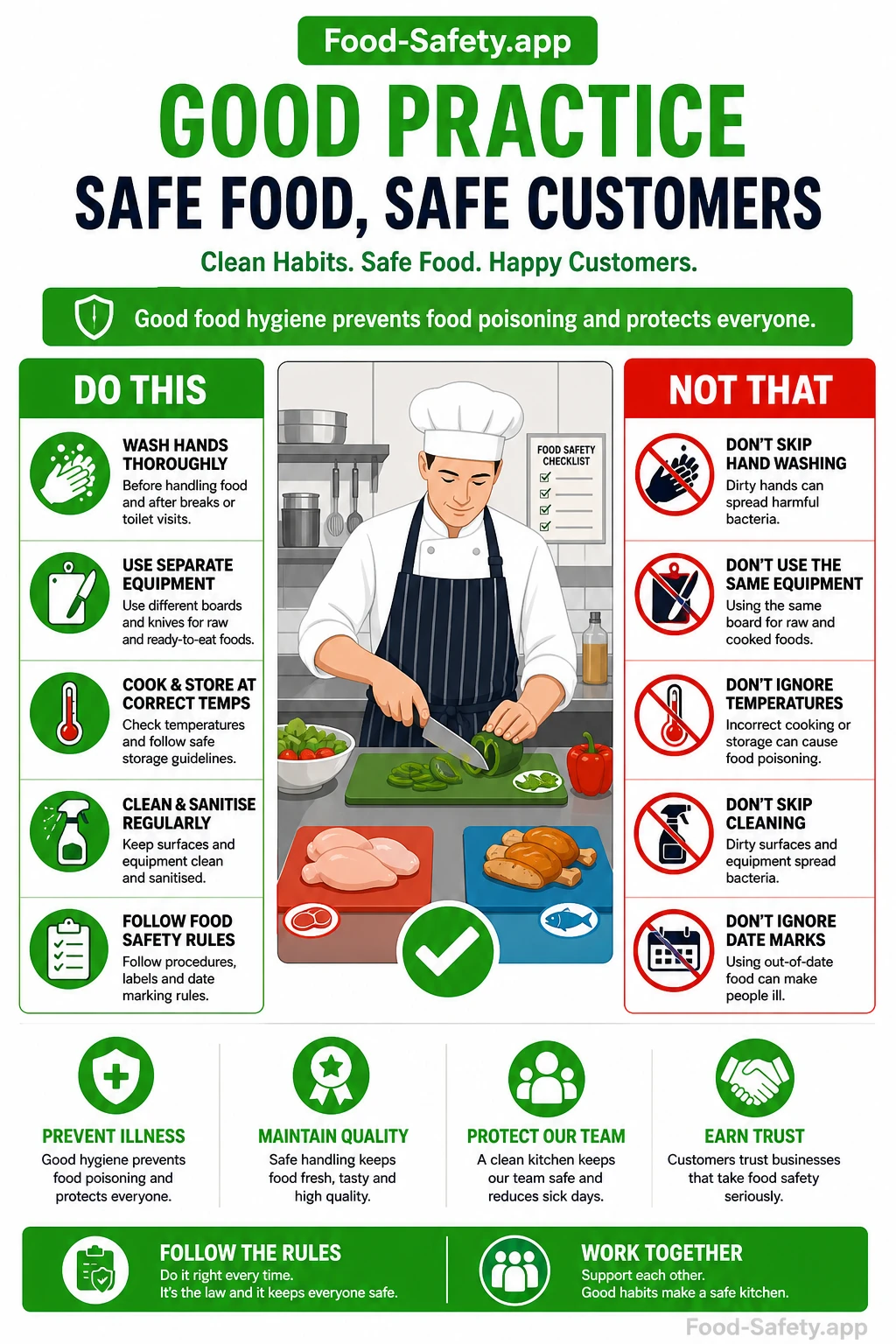
The simplest path to compliance is straightforward daily checks and reliable records.
If you’d like, I can tailor the questions to your kitchen’s specific equipment, processes or local guidance, or convert this into a printable staff quiz with answer sheets.