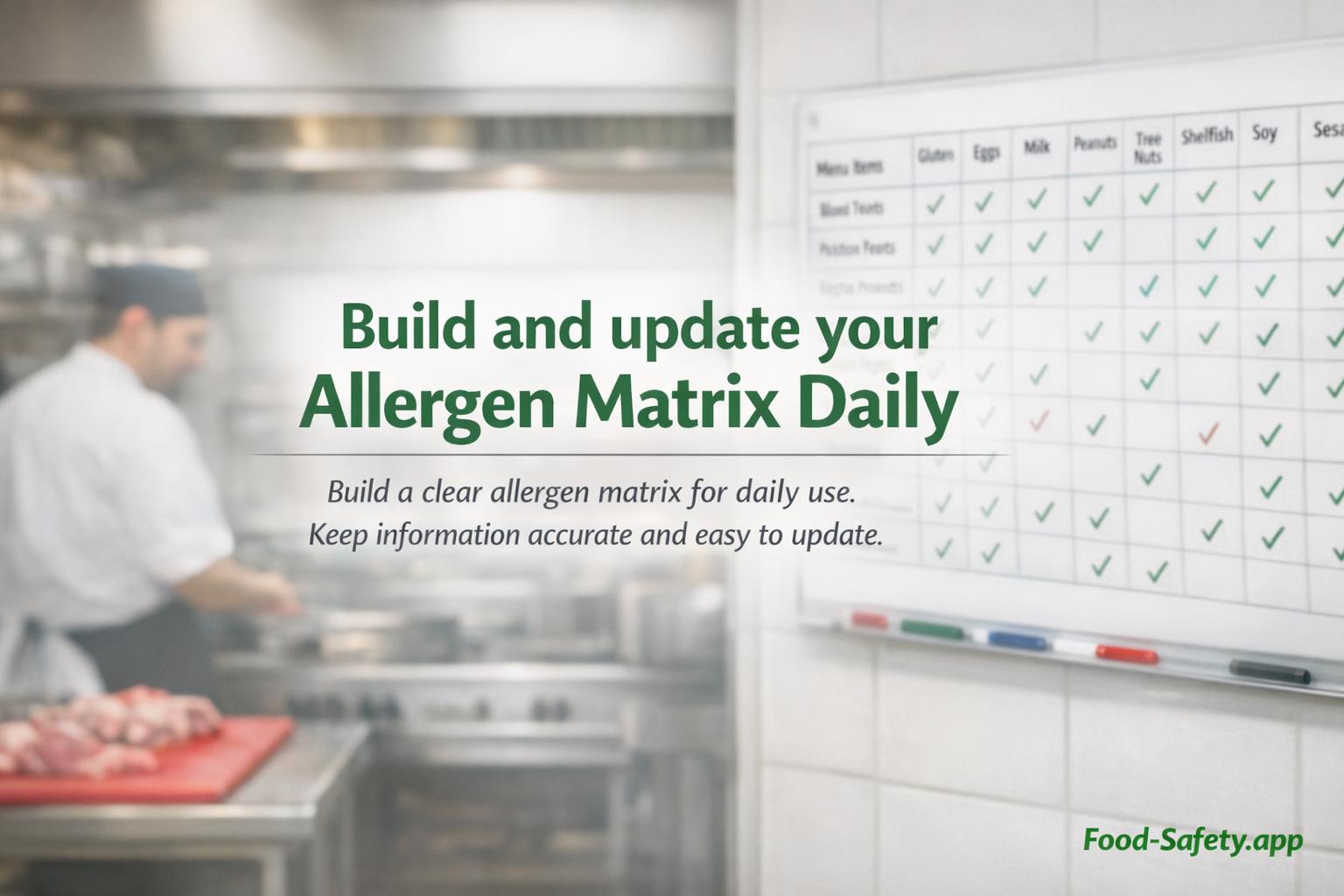
Building an allergen matrix is one of the simplest ways to keep allergen information clear, current and usable in a busy professional kitchen. When your menu changes, your suppliers switch ingredients, or a chef updates a recipe at short notice, a well-structured matrix helps your team check allergens quickly and avoid risky guesswork. Done properly, it supports safer service across restaurants, cafés, hotels, school canteens, takeaways and catering operations.
If you need a practical system that can be used every day, the aim is not to create a document that looks tidy but one that the team can rely on during prep, service and menu updates. A good allergen matrix should be easy to read, easy to update and based on the ingredients actually used in production. UK food law and allergen guidance apply here, but requirements can vary in other countries, so always follow the rules for your own location.
Table of contents
- What is an allergen matrix?
- Why it matters in a busy kitchen
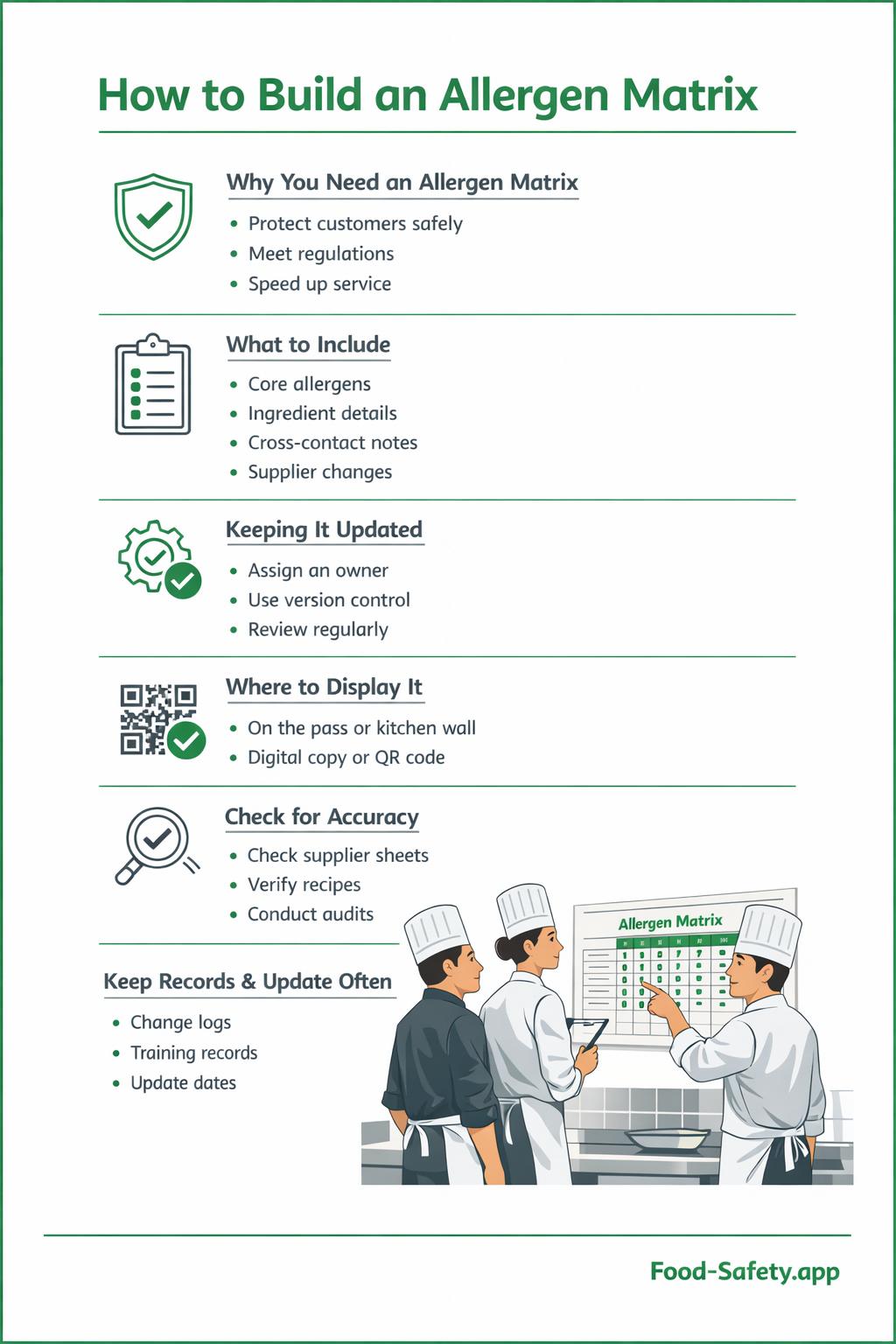
- What to include in an allergen matrix
- How to build an allergen matrix step by step
- How to keep it accurate and updated
- Common mistakes to avoid
- How to make it work in daily service
- Conclusion
What is an allergen matrix?
An allergen matrix is a clear table that shows which allergens are present in each menu item, recipe or product you serve. It is usually built from your recipes and ingredient specifications, then used as a quick reference by chefs, front-of-house teams and managers.
In practice, it saves time. Instead of checking several recipe sheets or asking different staff members for details, your team can look at one updated document. For a café with changing sandwich fillings, a hotel breakfast buffet, or a school canteen with rotation menus, this can make allergen communication much faster and more reliable.
For practical guidance on allergen management in busy kitchens, see our guide on managing allergens safely in a busy kitchen.
Why it matters in a busy kitchen
In a busy service, allergens are one of the easiest areas to get wrong because so many small changes happen every day. A different bread roll, a new sauce, a supplier substitution or a garnish added at the pass can change allergen content. If the information is scattered, staff may rely on memory, and memory is not a safe control.
A strong allergen matrix helps with:
- Fast checks during ordering and prep
- Consistent answers from all team members
- Better menu planning for special diets
- Clear communication between kitchen and front of house
- Fewer last-minute surprises during service
It is especially useful where teams are large, temporary or working across shifts. In hospitality, where service pressure is high, the best allergen systems are the ones that still work when the kitchen is under strain.
Acknowledging broader food safety frameworks helps integrate allergen control into daily practice. These concepts align with HACCP principles explained.
What to include in an allergen matrix
At minimum, your matrix should list each menu item or recipe alongside the relevant allergens it contains. In the UK, there are 14 named allergens commonly used for food information, but your matrix should also reflect any local requirements and any extra business-specific controls you use.
Include these details for each item
- Dish or product name
- Recipe version or date
- Ingredients used
- Allergens present in each ingredient
- Supplier or product code where needed
- Whether the item is prepared in a shared area
- Any risk of cross-contact during production or service
It also helps to note whether an item is made from scratch, assembled from bought-in components or reheated from chilled stock. For example, a chicken wrap may look simple, but the tortilla, marinade, dressing and mayonnaise may all contain different allergens. A matrix that only lists the finished dish without checking every component is not enough.
For practical guidance on allergen management in busy kitchens, see our guide on managing allergens safely in a busy kitchen.
How to build an allergen matrix step by step
Step 1: List every menu item and recipe
Start with the full range of items you actually serve, not just the main menu. Include specials, desserts, breakfast items, kids’ meals, staff meals, sandwiches, sauces, dips, garnishes and buffet items. If a dish is only served once a week, it still needs the same level of allergen control.
Step 2: Gather current ingredient specifications
Use up-to-date product specifications, labels and supplier information. Do not rely on old printouts if ingredients may have changed. In a commercial kitchen, substitutions happen all the time, so the ingredient list must reflect what is currently in use.
Step 3: Mark each allergen clearly
Go through every ingredient and mark which allergens are present. If the supplier information is unclear, stop and resolve it before the item is used. Guessing is not acceptable when you are building an allergen matrix.
Step 4: Add cross-contact risks where relevant
The matrix should show more than the recipe content if your operation has shared equipment, shared fryers or busy prep areas. For example, chips may not contain an allergen ingredient, but if they are cooked in oil used for battered items, that risk must be considered. Make sure your team understands the difference between ingredient content and cross-contact risk.
Step 5: Format it for quick use
Keep the design simple. Use clear headings, consistent allergen naming and a layout that can be read in seconds. Many kitchens use a spreadsheet with rows for dishes and columns for allergens. That is often the easiest way to update and print when needed.
Step 6: Check it against the kitchen workflow
A matrix is only useful if it matches how your kitchen works. If the chef refers to dishes by internal codes, include those. If front-of-house needs a simplified version for guest questions, create a version they can use confidently without having to interpret the full production sheet.
How to keep it accurate and updated
This is where many businesses fall down. An allergen matrix is not a one-off task. It must be maintained every time a recipe changes, a supplier is replaced or a dish is removed. Even small changes can alter allergen information.
Build a simple update routine
- Review the matrix whenever recipes change
- Check supplier specs when ordering new stock
- Update immediately after substitutions
- Remove discontinued dishes from active use
- Date every version so staff know which one is current
It is also useful to assign one named person to approve changes, even if several people contribute. That reduces confusion, especially in operations with multiple chefs or different sites. If you run more than one unit, keep local variations separate so the wrong matrix is not used in the wrong venue.
For practical guidance on allergen management in busy kitchens, see our guide on managing allergens safely in a busy kitchen.
For practical operational guidance on food information and allergens, the Food Standards Agency is a useful authority to keep on hand. For more on allergen labelling and legal requirements, see our clear allergen labelling guide.
Common mistakes to avoid
Using recipes that are out of date
If the recipe card no longer matches what is actually served, the matrix becomes misleading. This often happens after a new chef joins or a supplier changes a product.
Ignoring garnishes and finishing touches
Small items can carry allergens too. A sprinkle of nuts, a yoghurt drizzle or a crouton garnish can make a safe-looking dish unsuitable for some guests.
Mixing up ingredient content with customer requests
A dish may be listed as containing no specific allergen, but if a guest asks for a modification, the risk can change. The matrix should support staff judgement, not replace it.
Failing to separate high-risk items
If you prepare allergen-free orders, you need controls for utensils, surfaces, fryers and storage. The matrix should highlight where those controls matter.
Making the layout too complicated
If staff cannot read it quickly during service, they will stop using it. Simple always wins in a busy commercial kitchen.
How to make it work in daily service
A well-built allergen matrix should be part of the daily routine, not something buried in a folder. Print a current version for the pass, keep a digital master copy, and make sure supervisors know how to verify changes before service starts.
Train staff to use the matrix in the same way every time:
- Check the dish against the current version before serving
- Confirm any substitutions with the chef or manager
- Escalate anything unclear rather than guessing
- Keep allergen communication consistent across shifts
If your business handles a lot of allergen requests, it can help to build the matrix into your wider food safety system. For some operators, a food safety management system for catering businesses like Food-Safety.app can make version control and daily checks easier to manage without relying on memory or scattered paperwork.
For practical guidance on allergen management in busy kitchens, see our guide on managing allergens safely in a busy kitchen.
For practical operational guidance on food information and allergens, the Food Standards Agency is a useful authority to keep on hand. For more on allergen labelling and legal requirements, see our clear allergen labelling guide.
Such routines align with good kitchen safety practices.
Train staff to use the matrix in the same way every time:
- Check the dish against the current version before serving
- Confirm any substitutions with the chef or manager
- Escalate anything unclear rather than guessing
- Keep allergen communication consistent across shifts
If your business handles a lot of allergen requests, it can help to build the matrix into your wider food safety system. For some operators, a food safety management system for catering businesses like Food-Safety.app can make version control and daily checks easier to manage without relying on memory or scattered paperwork.
Conclusion
The best allergen matrix is simple, accurate and easy to update. Start with your real menu, use current ingredient information, include cross-contact risks where needed and keep one clear version in circulation. Then build a short update routine so changes do not slip through the cracks.
For catering and hospitality teams, that means fewer errors, faster answers and more confidence during busy service. When staff can trust the matrix, allergen management becomes more consistent across the whole operation.
For building a strong food safety culture in your kitchen, see Building a strong food safety culture that works.