Non-compliance in UK catering isn’t just about a single penalty. It ripples through stock, staff time and customer trust, often costing more than regulators’ fines. This guide explains the financial and operational impact, how inspections uncover gaps, and why reliable daily records matter as much as following procedures.
What non-compliance costs go beyond a fine
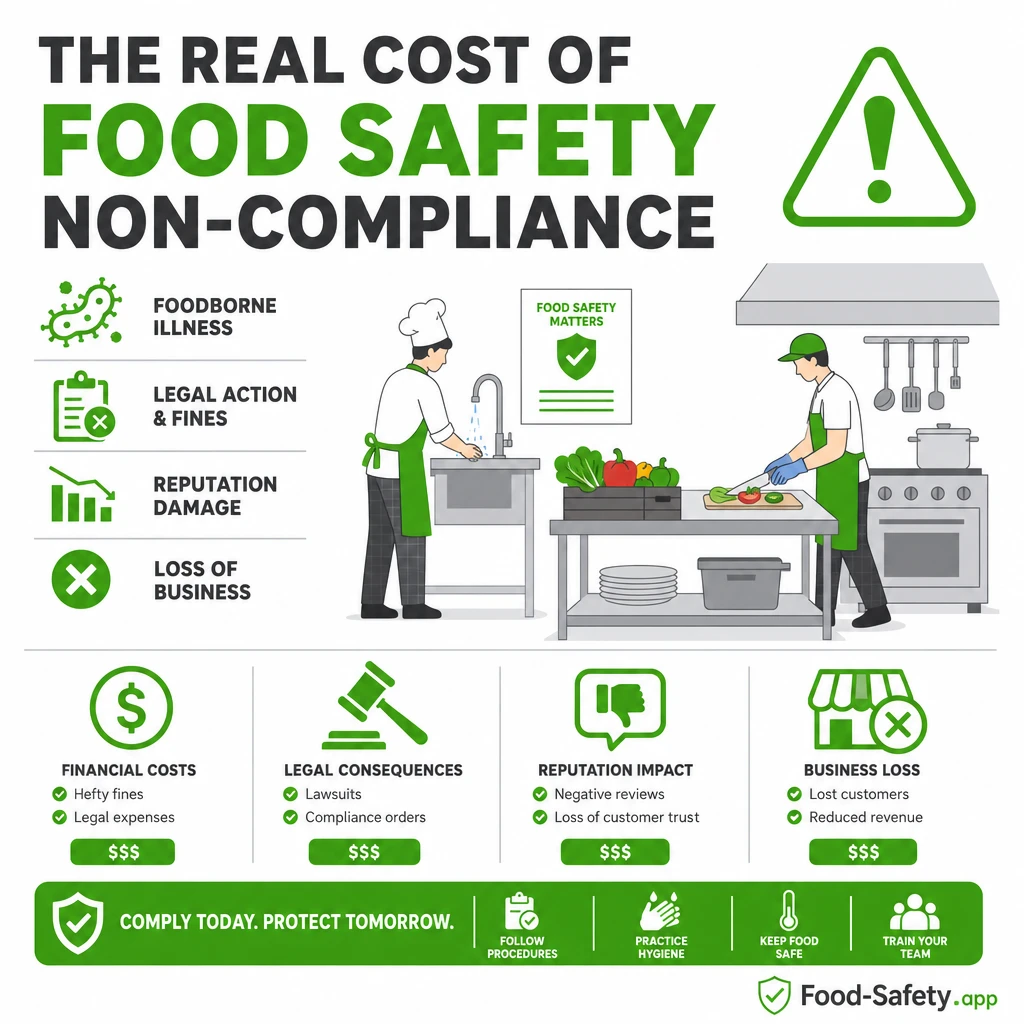
Non-compliance isn’t a one-off cost. It compounds—waste, downtime and the risk of closure can cost far more than a single penalty.
Non-compliance costs extend far beyond the stated penalty. Legal fees for advisors or representation, disposal costs for spoiled stock, and the time staff spend dealing with investigations add up quickly. Corrective work, temporary shutdowns, and re-inspection fees can disrupt service and erode cash flow. In smaller operations, a single issue can stall the whole kitchen, leading to missed bookings and reduced trade.
A practical example: a fridge breakdown isn’t just a repair bill. If stock becomes unsafe, you’ve got disposal costs, service disruption, and potentially a loss of customers who were relying on your reliability. The knock-on effect can stretch across the week and into supplier negotiations.
Keeping a robust set of daily records helps you demonstrate control when the worst happens.
Operational tip: focus on structured documentation for cooking, cooling, cold storage, reheating and hot holding. Clear records support containment actions and reduce ambiguity during investigations.
How inspections reveal weak controls
Inspections often expose gaps in temperature monitoring, cleaning records and pest prevention before they’re noticed in service.
Environmental health inspections probe the core controls that keep food safe, often exposing gaps before a busy service reveals them. Temperature monitoring, cleaning schedules, allergen management, goods-in checks, and pest prevention form the backbone of a compliant operation. A single weak link in any of these areas can trigger a finding, costly remedial work, and a diagnostic that regulators will expect you to address.
If a kitchen relies on memory or ad hoc notes, inspectors may view that as a control weakness. For example, inconsistent opening and closing checks may hide gaps in stock rotation or hot-holding integrity. The result is not just a fine; it’s a recommendation to establish formal routines and traceable records.
Practical focus: implement opening and closing checks, routine cleaning logs and a simple defect-report system. Ensure staff can quickly log issues and actions, even under pressure.
Why missing records still count as poor control
If it isn’t recorded, it didn’t happen in the eyes of regulators and insurers — even if staff were doing the right thing.
Incomplete records can complicate investigations, delay corrective actions and increase the time needed to reopen or extend contracts. They also feed into risk assessments that influence insurance terms and renewal decisions.
Action points: use simple, shift-friendly formats for all routine checks. Make it easy to log every delivery, allergen detail, probe calibration and pest sighting as soon as it’s observed.
The domino effect: complaints, reviews and lost business
A single issue can trigger complaints, adverse online reviews and loss of key contracts, accelerating a downward spiral.
A single lapse can trigger a cascade of consequences. Customer complaints, adverse online reviews and renewed scrutiny from buyers or councils can erode trust. Lost contracts with retailers or caterers often follow, as partners seek reliability and transparent controls. Even a well-run kitchen can suffer reputational damage if one incident surfaces in the wrong way, undermining confidence in your brand.
Mitigating this requires proactive, visible control evidence. When staff see that daily checks and corrective actions are recorded and reviewed, it supports a perception of reliability and professional management—even if a supplier or regulator turns up unannounced.
Suggested approach: align operational practices with clear documentation. Ensure corrective actions are timestamped and reviewed, so customers and partners see your commitment to continual improvement.
Insurance and due diligence: what records protect
Due diligence records protect both the business and the insurer by showing a proactive control environment.
Insurers increasingly expect evidence of due diligence, not just the absence of incidents. Comprehensive records reduce dispute risk, support favourable premium terms and prevent coverage gaps if a claim arises. Poor or missing records can increase premiums, limit cover, or even lead to policy exclusions for certain scenarios.
Regular reviews of allergen information, delivery checks, probe calibration and pest monitoring help keep insurance secure and pricing reasonable. When a claim happens, robust records speed up investigations and show that you’ve been actively managing risk.
Operational note: implement a simple timetable for reviewing key controls at least monthly, with documented actions following any test or incident.
From reacting to proving daily control
The most effective safeguard is daily, demonstrable control. Use practical, easy-to-complete records that staff can maintain during busy periods. Highlights include:
- Structured daily records for cooking, cooling, cold storage, reheating and hot holding
- Opening and closing checks that capture conditions on arrival and departure
- Cleaning logs and defect reports with clear corrective actions and timestamps
- Regular reviews of allergen information, delivery checks, probe calibration and pest monitoring
- A simple, user-friendly digital tool to reduce admin and improve inspection readiness
The difference between reactive firefighting and daily demonstrated control is reliable records you can trust.
Blockquote your way to clarity: a well-maintained logbook isn’t just paperwork; it’s your frontline defence.
Implementation takeaway: design records for real people on shift; avoid overcomplication. If staff can’t keep up, you’ll lose the opportunity to prove control when it matters most.
If you’d like to discuss practical templates or a lightweight digital solution to streamline your daily safety records, Food-Safety.app can help you tailor a simple system for your kitchen.