If you run a restaurant, café, hotel kitchen, school canteen or takeaway, understanding what a HACCP plan is can make day-to-day food safety much easier to manage. A HACCP plan helps you identify hazards, decide how to control them, and show that those controls are working. In plain English, it is a way of thinking through your menu, your processes, and your kitchen routines so you can spot risks before they reach the customer.
HACCP stands for Hazard Analysis and Critical Control Points.
In a professional kitchen, hazards can come from many places: raw chicken stored above ready-to-eat food, poor cooling of cooked rice, cross-contamination from dirty utensils, allergens not being managed properly, or hot holding that does not keep food safe through service. A good A HACCP plan does not just list these risks. It sets out what your team must do every day to control them.
Why is a HACCP plan needed?
A HACCP plan is needed because food safety in catering is not random. It depends on consistent control, especially when the kitchen is busy, short-staffed, or under pressure. A written plan gives your team a clear method to follow, even when service gets hectic.
It is also useful because it turns food safety into something practical. Instead of relying on memory, each stage of food handling is checked and managed. That can include receiving deliveries, storing food correctly, cooking thoroughly, cooling safely, reheating properly, and cleaning equipment in a way that prevents contamination.
For business owners and kitchen managers, the benefits are straightforward:
- It helps protect customers from foodborne illness.
- It gives staff a clear routine to follow.
- It supports training and supervision.
- It helps you respond quickly when something goes wrong.
- It can strengthen your food hygiene management during inspections.
If you want an official starting point for UK food safety expectations, the Food Standards Agency guidance on Safer Food, Better Business is widely used by catering businesses.
The seven principles of HACCP
Most HACCP plans are built around seven core principles. You do not need to turn your kitchen into a paperwork factory, but you do need to understand these stages.
1. Identify the hazards
Look at each step in your process and ask what could make food unsafe. Hazards may be biological, chemical, physical, or allergen-related. For example, a sandwich prep area may face cross-contamination from raw ingredients, cleaning chemicals stored badly, or loose packaging fragments.
2. Identify the critical control points
These are the steps where control is essential to prevent or reduce the hazard. In many kitchens, cooking, cooling, hot holding, chilled storage, and allergen segregation are common control points.
3. Set critical limits
These are the safe boundaries for each control point. In practice, that might mean keeping chilled food at the correct temperature, ensuring foods are cooked thoroughly, or limiting the time food spends at room temperature.
4. Set monitoring procedures
Decide who checks each control point, how often, and how the check is recorded. This might include temperature logs, stock checks, visual inspections, and allergen label checks.
5. Set corrective actions
If something goes wrong, your team must know what to do. For example, if chilled food is too warm, it may need to be discarded, rapidly investigated, or moved to another fridge while you identify the cause.
6. Verify the system works
Review records, check staff behaviour, and confirm the system is doing its job. Verification might include supervisor checks, internal audits, and spot checks on temperature monitoring.
7. Keep records
Good records show that controls are being carried out consistently. Keep them practical and easy to complete so staff actually use them during busy service.
What a HACCP plan looks like in practice
A HACCP plan is not a long document sitting in a folder. It is part of the way the kitchen works every day. In a hotel breakfast kitchen, for example, the plan may cover egg handling, hot holding of sausages and bacon, chilled storage of dairy, and allergen information for pastries and cereals. In a takeaway, the focus may be on cook times, safe cooling of batch-prepared fillings, and preventing contamination between raw and ready-to-eat items.
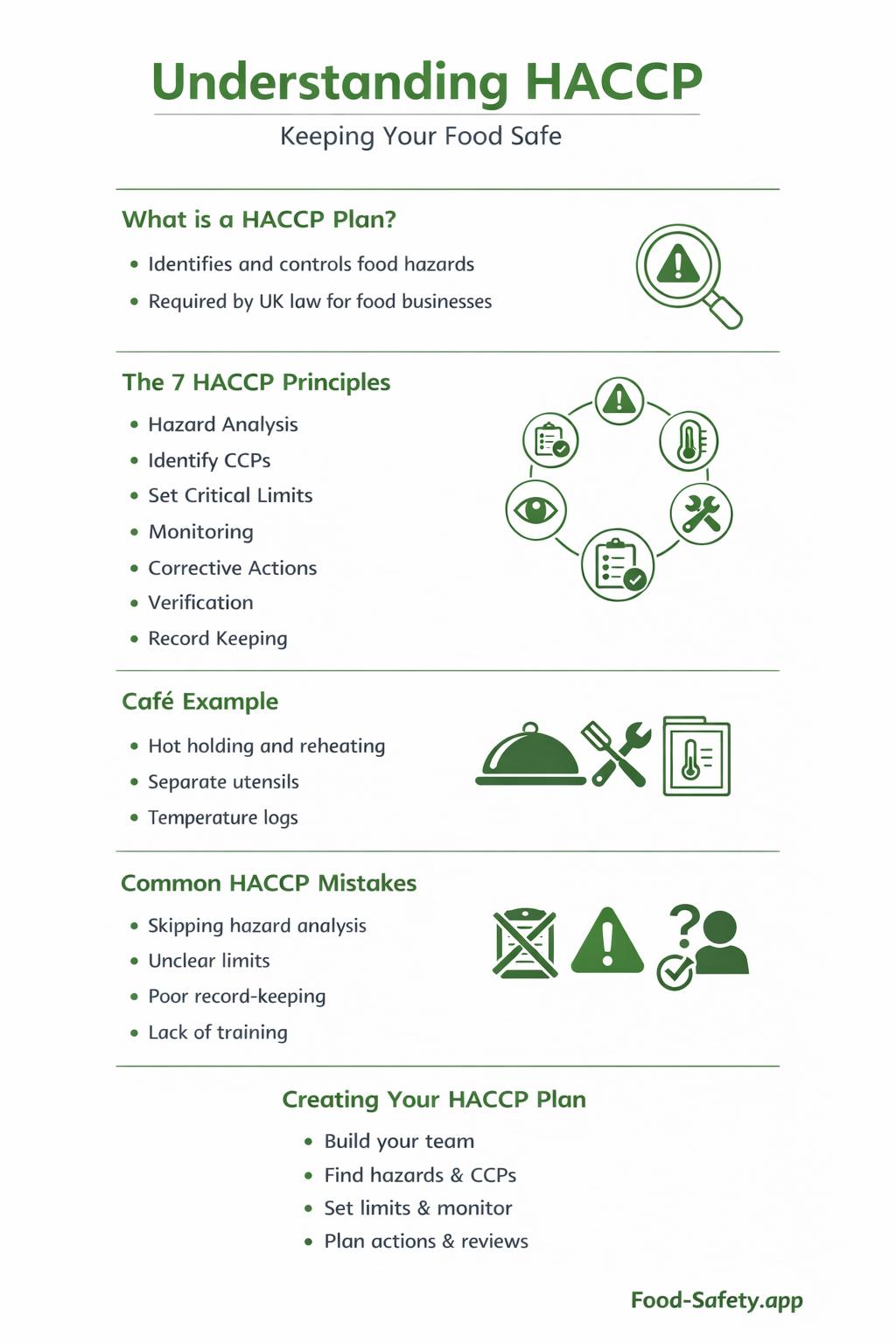
A practical plan usually includes:
- A simple flow diagram of how food moves through the kitchen.
- Hazards linked to each stage of that process.
- The controls used to manage those hazards.
- Monitoring checks and their frequency.
- Clear corrective actions for failures.
- Training notes so staff understand the system.
It is helpful to think in routines. For example:
- On delivery, check packaging, temperature, dates, and signs of damage.
- During storage, keep raw and ready-to-eat food separate and labelled.
- During prep, use dedicated boards, utensils, and handwashing between tasks.
- During cooking, follow agreed methods and check food is fully cooked.
- During service, protect food from contamination and keep holding conditions under control.
- After service, cool leftovers quickly where they are to be kept, and clean down properly before the next shift.
Common mistakes in busy kitchens
Even well-run businesses can struggle with HACCP if the system is too complicated or not matched to how the kitchen really operates.
Too much paperwork, not enough action
If monitoring sheets are long and awkward, staff will rush them or forget them. Keep records short, relevant, and realistic for the pace of service.
Plans that do not match the menu
A plan written for a generic kitchen may not cover your actual risks. A café serving filled baguettes, salad bowls and homemade soups has different hazards from a school canteen or a carvery.
Poor staff training
If the team does not understand why the checks matter, the plan will fail. Staff need to know what to do, what to look for, and who to tell when something is wrong.
Missing corrective actions
Many businesses record temperatures but do not say what happens if they are out of range. Every check needs a response, otherwise the record is just paperwork.
Not reviewing the plan
Your HACCP plan should change when your menu, equipment, suppliers, or processes change. If you add a new prep station or start serving sushi, your risks have changed too.
How to build a practical HACCP plan
If you are setting up or reviewing a HACCP plan, keep the process manageable. Start with the food you actually serve and the way your team really works.
Step 1: Map your menu and process
Write down every main product group, then follow each one from delivery to service. Include storage, prep, cooking, cooling, reheating, display, and disposal.
Step 2: Identify the main hazards
Focus on the most likely risks first: contamination, allergen cross-contact, undercooking, unsafe cooling, and temperature abuse. These are the issues most likely to cause trouble in catering.
Step 3: Decide your controls
Choose controls that fit your kitchen. That might mean temperature logging, dedicated prep areas, labelled containers, colour-coded equipment, or supervisor checks during service.
Step 4: Set clear responsibilities
Someone must own each part of the system. That could be a head chef, kitchen manager, shift leader, or duty manager.
Step 5: Train the team
Use short, practical training. Show staff what good looks like at the sink, fridge, pass, prep bench, and service hatch. A quick demonstration often works better than a long briefing.
Step 6: Check and improve
Review incidents, near misses, complaints, and audit findings. If a fridge is regularly running warm, fix the maintenance issue and retrain the team on loading and monitoring.
Where to start if your business is small
If you run a small café, sandwich shop, or takeaway, you may not need a large, complex document. What you do need is a sensible food safety management system that covers your real risks and can be followed during a busy shift. Many businesses use simple, structured templates and adapt them to their own menu and layout.
The key is to make the system fit the operation. A small business does not need to copy a hotel kitchen file page for page. It needs controls that staff understand and can keep up with while serving customers.
Used well, Food-Safety.app can support that approach as a food safety management system for catering businesses, especially when you want clearer checks without overcomplicating service.
Final thoughts
A HACCP plan is needed because safe food depends on repeatable control, not guesswork. It gives catering and hospitality businesses a practical way to spot hazards, manage them, and show that food safety is being taken seriously. The best plans are simple, specific to the menu, and realistic for the pace of a professional kitchen.
If you are reviewing your own system, start with the highest-risk steps, keep the records manageable, and make sure corrective actions are clear. That way, your HACCP plan becomes a working part of service rather than a file on a shelf. For most businesses, that is what makes the difference between a paper exercise and a genuinely safer kitchen.