Introduction
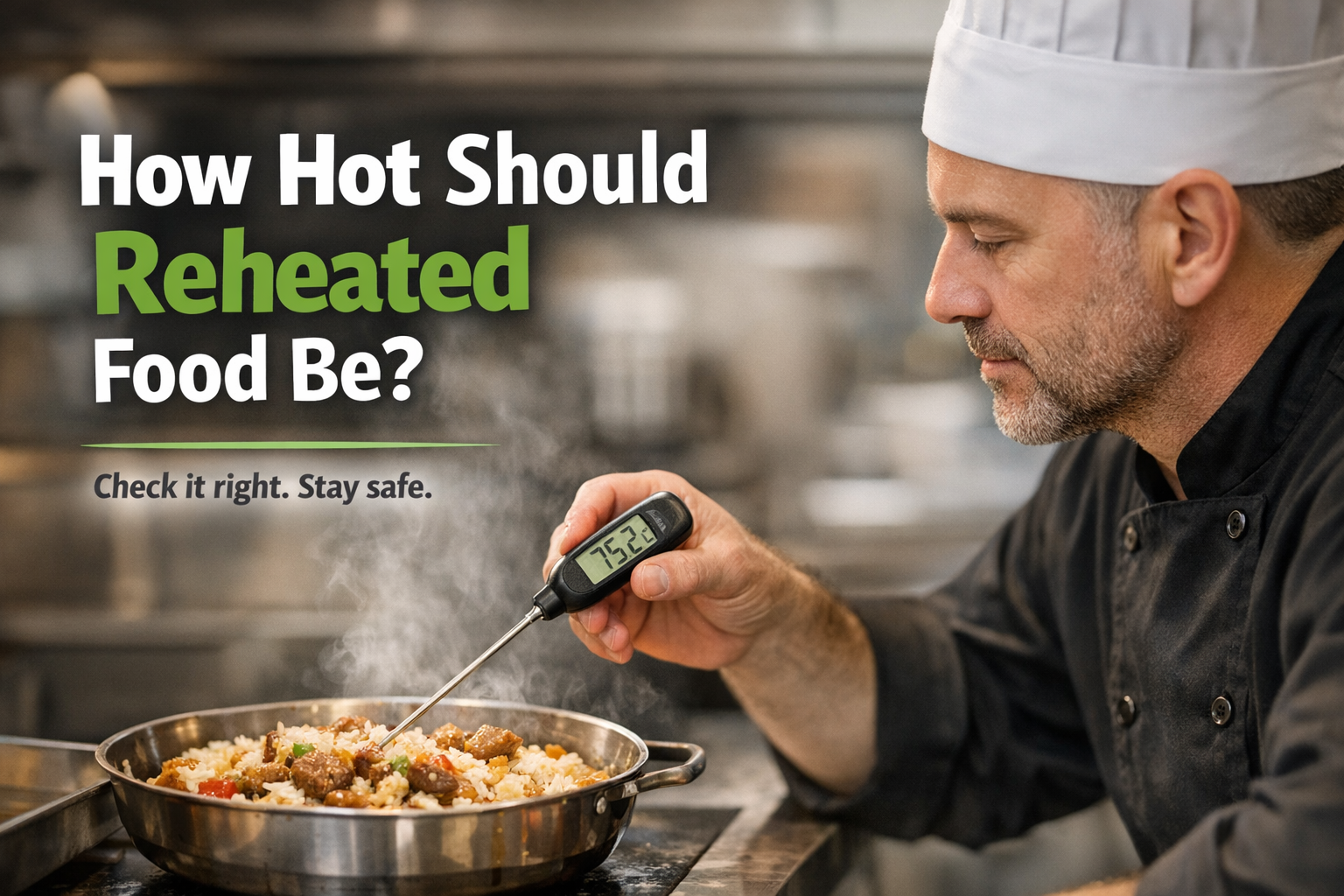
Reheating safely in a busy kitchen means achieving a uniform core temperature quickly to keep meals out of the danger zone. This article explains why reheating matters, the safe target temperatures, and practical checks for service to protect customers and maintain hygiene, quality, and compliance throughout the operation.
Reheating as a critical control point
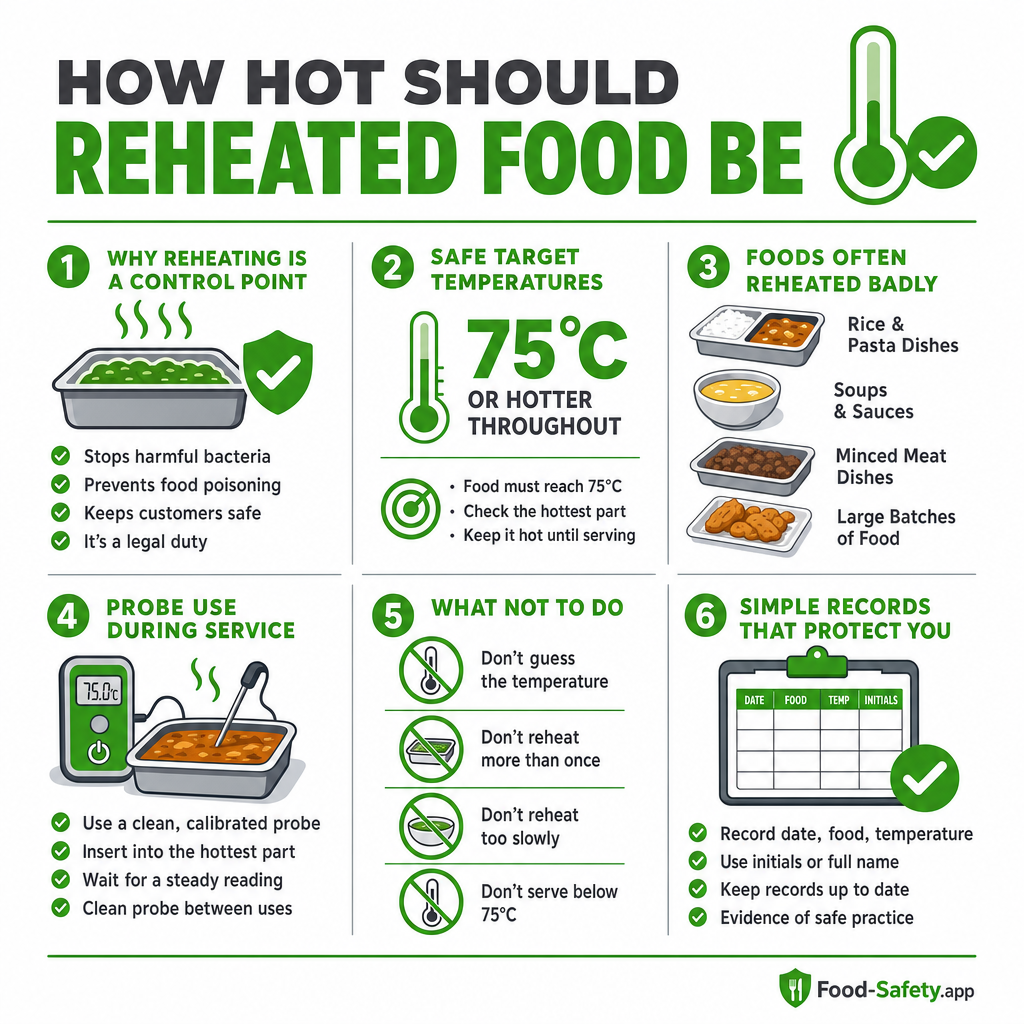
Reheating must achieve a safe, uniform temperature rapidly, not just warm the surface. The process should lower the time spent in the danger zone and prevent niche pockets of undercooked or overcooked food. In busy service, a clear reheating routine reduces risk, supports traceability, and increases confidence with inspections.
Why reheating is different from cooking from raw
Cooking from raw typically starts with fresh heat distribution; reheating starts from a cooked product that may have uneven internal temperatures. The goal is to bring every portion to a safe core quickly, rather than relying on surface appearance. This distinction matters for batch sizes, equipment performance, and service tempo.
Key risks to watch
- Uneven heating due to batch size, tray configuration, or microwave hot spots
- Prolonged time in the danger zone between 5°C and 63°C (or when following local guidance)
- Inaccurate readings from uncalibrated probes or contaminated equipment
Safe target temperature explained
The safe target temperature for reheated food is a core metric in many UK guidelines: the food should reach at least 75°C throughout. This means the centre of the dish must achieve 75°C or higher, not just the surface. Use a calibrated thermometer and a method able to confirm core temperature for the entire portion. This aligns with HACCP principles explained.
Why 75°C and what counts as equivalent
75°C is chosen because it reliably exceeds the minimum lethal temperature for many pathogens when held and time is considered. An equivalent method might involve time-temperature combinations validated by your HACCP plan, provided the method is evidence-based and approved by your food safety policy.
How to validate a method in practice
- Agree on a primary method (probe thermometer for core checks).
- Document the hitting of 75°C in the central portion of representative portions.
- Use the method consistently for all reheats of similar foods.
Centre temperature versus surface
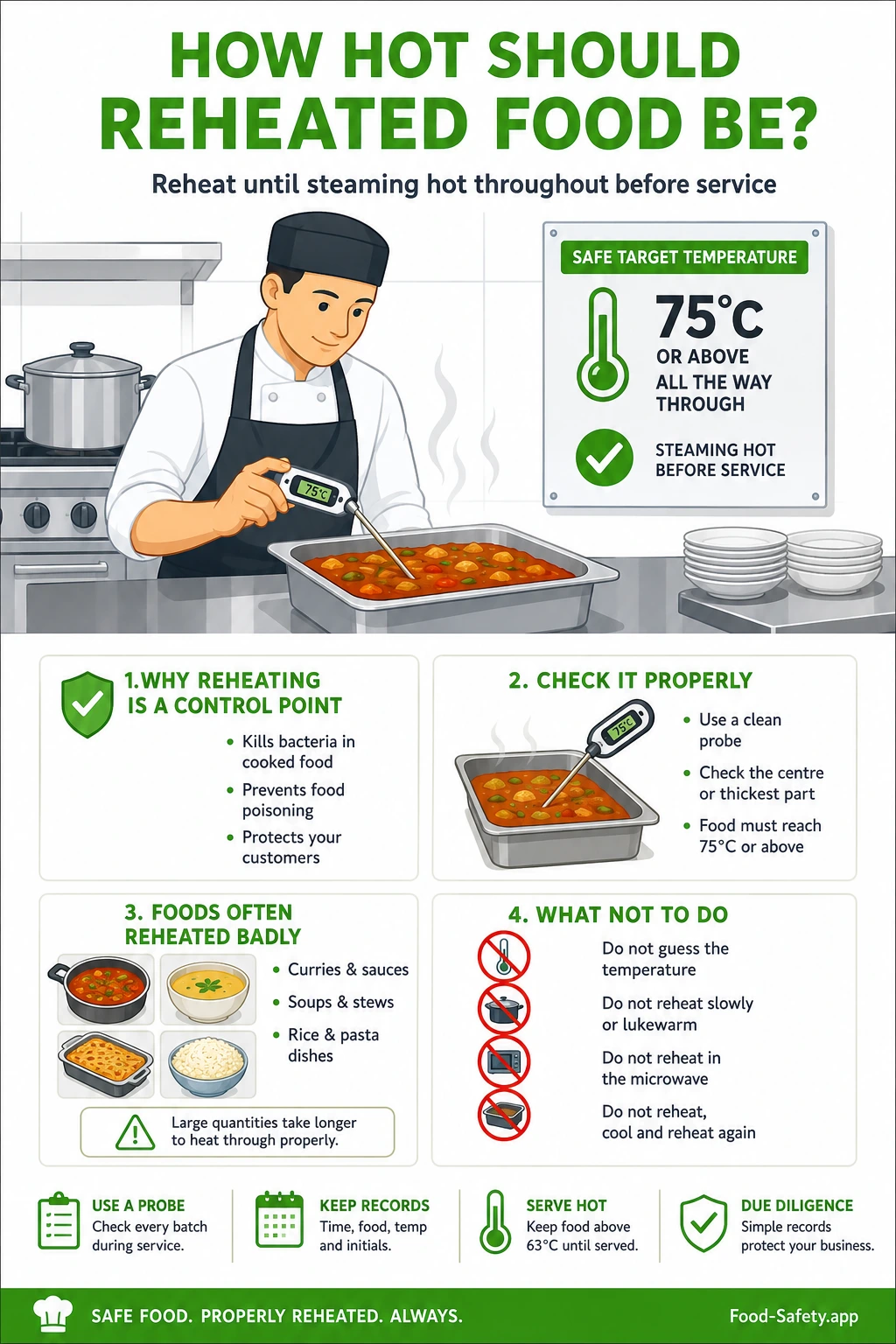
Always probe the centre rather than the outside. Surfaces can be hot while interiors remain dangerously cold. A typical center-check routine involves inserting the probe into the thickest part of the meal, away from edges or fat pockets, and confirming the reading is 75°C or more.
Practical centre checking steps
- Choose representative portions from different trays if serving from a bain-marie or hot counter.
- Insert the probe vertically into the thickest section; avoid near bones or metal.
- Record the core temperature and ensure all samples meet or exceed 75°C.
Handling edge cases
When portions vary (risotto, curry, or stews), check multiple points within a single serving to confirm uniform heating. If any portion remains below target, reheat that portion until it meets the standard.
How to remove cold spots
Stir, turn, or rotate food to eliminate cold zones during reheating. Large trays of pasta sauce or stews should be stirred at regular intervals, and shallow trays heat more evenly than deep ones in some ovens. For microwave reheating, pause to stir halfway through and recheck the centre.
Step-by-step routine for even heating
- Preheat or select the appropriate reheating method for the dish type.
- Reheat in batches that fit the appliance capacity to promote even heat distribution.
- Stir and rotate after every 2–3 minutes of microwaving or after reaching a quarter of the target time for ovens.
- Probe several portions to confirm 75°C core in all checks.
Edge cases
When portions vary (risotto, curry, or stews), check multiple points within a single serving to confirm uniform heating. If any portion remains below target, reheat that portion until it meets the standard.
Hot holding after reheating
Once the core temperature is confirmed, hold hot at a safe temperature until service. Do not leave reheated food standing in the danger zone. If service is delayed, promptly re-head or discard according to your policy to maintain safety and quality.
Holding time guidance
- Keep hot foods at or above 63°C if you are holding for extended periods in some guidelines; always verify local rules.
- Minimise the time between reheating and service to reduce risk.
- Discourage re-reheating of previously reheated items to avoid quality and safety concerns.
Hygiene, calibration and records
Probe hygiene and calibration matter for accurate readings. Clean probes between checks, and calibrate at regular intervals following the manufacturer’s guidance. Maintain simple records showing reheating checks, temperatures reached, and any corrective actions. This supports reliable evidence and ongoing compliance.
Probe care and measurement discipline
- Clean probes after each use with appropriate sanitiser and dry thoroughly.
- Calibrate thermometers periodically, and after any obvious drift or rough handling.
- Use a consistent method for every reheating check to ensure comparability over time.
Record-keeping essentials
- Item, batch or dish name
- Reheating method and equipment used
- Centre temperature reading and time taken
- Holding status and any corrective actions
- Person conducting the check and date
Service scenarios and common mistakes
Real-world service presents scenarios where reheating controls are challenged. Soups, stews, curry, rice, pasta sauces, gravy, and pre-cooked meats often require careful handling in bain-marie service or microwave reheating. Common mistakes include assuming “piping hot” means safe, topping up half-warmed food, or reheating the same tray multiple times. Avoid these with routine checks and clear procedures.
Practical scenarios to plan for
- Soup stored in large volumes; ensure cores reach 75°C across batches
- Bain-marie service where surface looks hot but the core is still below target
- Microwave reheating where edges are hot but the middle is cold
- Busy service with large trays needing frequent stirring and rechecks
Practical checklists and compliance
Simple routines make compliance easier and protect service quality. Below is a practical checklist you can adapt for daily use. Use it at shift handovers and during service audits to demonstrate due diligence and consistent practice. For practical daily use in a busy kitchen, see how to use SFBB in a busy small kitchen.
- Confirm you have the right equipment and calibrated probes ready
- Check the batch size and reheating method align with the dish type
- Reheat to 75°C core, verify across representative portions
- Stir or rotate to eliminate cold spots and recheck as needed
- Hold hot at safe temperature and log holding time
- Record the date, dish, batch, core temps and corrective actions
- Review the log at shift change to ensure continuity
Conclusion and practical next steps
Reheating is a purposeful control step in catering operations. By focusing on core temperatures, avoiding surface-only readings, and maintaining clear records, busy kitchens can reduce risk and improve consistency. For teams seeking practical support, consider integrating a digital record-keeping approach to keep time-stamped evidence ready for service and inspections. For many operators, Food-Safety.app can help manage reheating records, store probe calibration, and keep compliance evidence accessable during service and inspections.
Reheating safety resources
Access practical reheating checks and digital records to support safe service, traceability, and inspections across busy kitchens in daily operations.