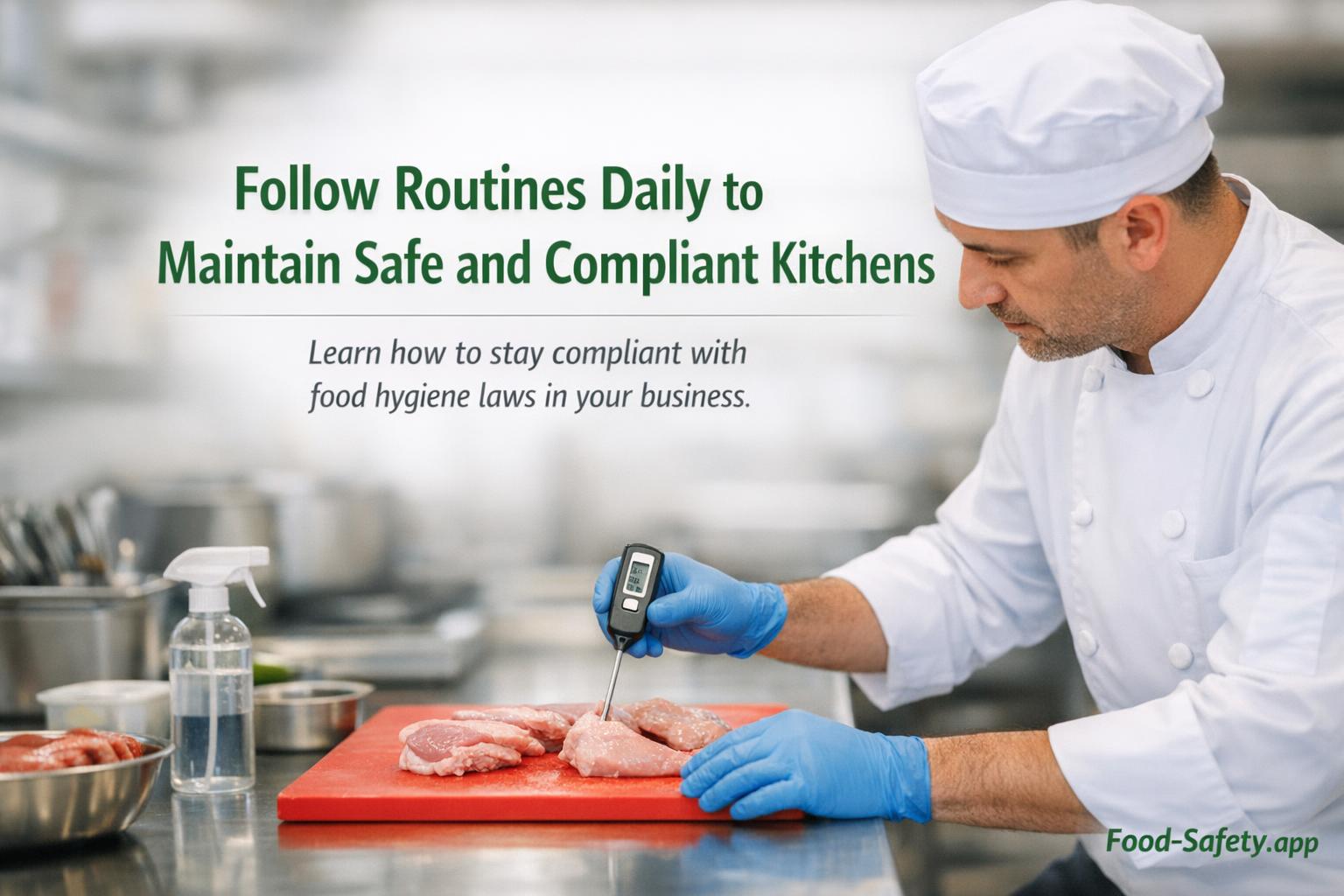
Food hygiene compliance is more than a legal obligation; it is the foundation of a successful catering business. Whether you manage a small cafe or a large hotel kitchen, your ability to prove that you produce food safely determines your food hygiene rating and your reputation. This guide moves beyond generic advice to provide a practical framework for maintaining high standards during a busy service.
The fundamentals of food hygiene compliance
In the UK, food safety is governed by the Food Safety Act 1990 and the General Food Law Regulation. Compliance requires every food business operator to identify food safety hazards and ensure that controls are in place to eliminate or reduce those risks to an acceptable level. Environmental health officers (EHOs) assess your business based on three criteria: hygienic food handling, the physical condition of the premises, and how you manage and document food safety.
Practical HACCP and documentation
A Hazard Analysis and Critical Control Point (HACCP) plan is the backbone of your compliance. However, a HACCP plan gathering dust in an office is useless. It must reflect what actually happens in your commercial kitchen.
- Identify your flow of food: map out every stage from delivery and storage to preparation, cooking, and service.
- Set critical limits: define the exact parameters that ensure safety, such as cooking poultry to 75°C for 30 seconds.
- Document corrective actions: clearly state what staff must do if a critical limit is missed. For example, if a fridge reaches 10°C, the corrective action might be to move food to an alternative fridge and call a technician.
For a deeper dive into building your system, read our guide on HACCP principles explained.
Daily compliance routines for busy services
Compliance often fails during peak hours. Building a routine ensures safety checks are not forgotten when the pressure is on.
Opening checks (the setup)
- Verify that all fridges are operating at 5°C or below.
- Check that handwash basins are fully stocked with warm water, liquid soap, and paper towels.
- Ensure all prep surfaces have been sanitised before any food handling begins.
- Check the staff sickness log to ensure everyone on shift is fit to work.
During service (the control)
- Use a sanitised probe to check core temperatures of high-risk foods.
- Maintain a “clean as you go” policy to prevent the buildup of food debris.
- Monitor contact times for sanitisers; most professional-grade chemicals require 30 to 60 seconds to work effectively.
Closing checks (the reset)
- Label all prepped food with “use by” dates and allergen warnings.
- Complete the daily diary or cleaning sign-off sheets.
- Ensure all waste is removed to external bins and the area is secured against pests.
Temperature control and critical limits
Temperature mismanagement is a primary cause of foodborne illness. You must be able to prove that food has stayed out of the “danger zone” (5°C to 63°C).
- Chilled storage: while the legal limit is 8°C, best practice in a professional kitchen is to maintain fridges at 5°C or lower.
- Cooking: use a calibrated probe to ensure food reaches a safe core temperature. Common standards include 75°C for 30 seconds or 70°C for 2 minutes.
- Hot holding: food must be kept at 63°C or above. If the temperature drops below this, you have a two-hour window to sell, reheat, or discard it.
- Cooling: hot food should be cooled as quickly as possible (ideally within 90 minutes) before being refrigerated.
Preventing cross-contamination
Cross-contamination is the physical, chemical, or biological transfer of harmful substances to food. In a busy service, this is most often managed through physical separation.
- Colour coding: use dedicated colour-coded equipment for raw meat, fish, dairy, and vegetables.
- Storage hierarchy: always store raw meat and unwashed vegetables on the lowest shelves of the fridge, below ready-to-eat foods.
- Dual-use equipment: avoid using the same vacuum packers or slicers for both raw and cooked meats unless they can be fully dismantled and disinfected between uses.
Maintaining good hygiene practices among staff is equally vital, particularly regarding handwashing after handling raw ingredients.
Allergen management and Natasha’s law
Allergen compliance is no longer optional; it is a life-saving requirement. You must provide accurate information for the 14 mandatory allergens.
- The allergen matrix: maintain a live document that lists every menu item and its allergen content. This must be updated every time a brand of ingredient is swapped.
- Natasha’s law: any food prepacked for direct sale (PPDS) must be labelled with the full ingredient list and allergens highlighted (e.g., in bold or italics).
- Communication: ensure front-of-house staff know exactly who to ask if a customer makes an allergen enquiry. Never guess.
For more details on implementation, see allergen management for UK food businesses.
Cleaning and disinfection standards
A visual “clean” is not enough for compliance. You must demonstrate effective disinfection.
- The two-stage clean: first, use a detergent to remove visible grease and dirt. Second, apply a disinfectant or sanitiser to kill bacteria.
- BS EN Standards: ensure your sanitiser meets BS EN 1276 or BS EN 13697 standards for food safety.
- Cleaning schedules: use a formal cleaning schedule that identifies what needs cleaning, how often, the method required, and who is responsible.
Managing EHO inspections and audits
An EHO inspection can happen at any reasonable time. Being prepared reduces stress and ensures a better rating.
- Keep records accessible: have your HACCP plan, temperature logs, training records, and pest control reports in a single, organised folder or digital system.
- Demonstrate knowledge: EHOs will interview staff. Your team should be able to explain why they use certain boards or what the cooking critical limits are.
- Be honest: if a fridge has just broken down, show the EHO the corrective action you have already taken. Transparency is better than hiding a fault.
Common compliance mistakes to avoid
Avoid these frequent pitfalls that often lead to a lower hygiene rating:
- The “phantom” diary: filling in temperature logs for the whole week in advance. EHOs can easily spot this, and it undermines your entire safety system.
- Overstocked fridges: packing a fridge too tightly prevents air circulation, leading to warm spots and bacterial growth.
- Dirty touch points: failing to clean fridge handles, light switches, and spice containers, which are prime sites for cross-contamination.
- Ignoring “best before” dates: while “best before” is about quality, “use by” is about safety. Serving food past its “use by” date is a criminal offence.
Frequently asked questions
What is the most important part of food hygiene compliance?
While all areas are vital, documentation is the only way to prove compliance. If it isn’t written down, in the eyes of the law, it didn’t happen.
Do I need a Level 2 Food Hygiene certificate for all staff?
Legally, staff must be trained “commensurate with their work activities.” In practice, most EHOs expect anyone handling open food to hold at least a Level 2 certificate.
How often should I calibrate my food probe?
You should perform a calibration check at least monthly. Use the ice point method (0°C) and the boiling point method (100°C) and record the results in your diary.
What happens if I fail a food hygiene inspection?
Depending on the severity, you may receive an improvement notice, a lower rating, or in extreme cases, an emergency prohibition notice which closes the business until the risk is removed.