How to stay compliant with HACCP requirements
If you are trying to stay compliant with HACCP requirements, the key is not just having a folder of paperwork on a shelf. It is making sure your food safety system actually works in a busy commercial kitchen, every day, during prep, service, cleaning and handover. In the UK, HACCP-based procedures are the standard approach to managing food safety; see HACCP principles explained, but the practical challenge is turning the principles into routines your team can follow consistently.
Whether you run a restaurant, café, hotel kitchen, school canteen or takeaway, HACCP compliance comes down to identifying the risks in your operation, controlling them properly, recording what matters and acting quickly when something goes wrong. This guide explains how to do that in a way that is realistic for catering and hospitality businesses.
Table of contents
- What HACCP compliance means in practice
- Build a HACCP system that fits your kitchen
- Control the critical points that matter most
- Keep records that prove the system is working
- Train your team and assign accountability
- Use corrective actions when things go off track
- Common mistakes that put compliance at risk
- Review and improve your food safety system
- Final thoughts
What HACCP compliance means in practice
HACCP stands for Hazard Analysis and Critical Control Point. In simple terms, it is a structured way of spotting what could go wrong with food and putting controls in place to prevent harm. In UK catering, this is usually done through a food safety management system based on HACCP principles. The system should reflect your actual menu, equipment, staffing and workflow.
Compliance is not about being perfect. It is about showing that you understand the risks in your operation and that you manage them consistently. A good HACCP-based system helps you control common hazards such as:
- Biological hazards, such as bacteria spreading through poor temperature control or cross-contamination.
- Chemical hazards, such as cleaning chemicals stored or used incorrectly.
- Physical hazards, such as glass, metal fragments or packaging debris getting into food.
- Allergen risks, such as incorrect labelling or shared equipment causing cross-contact.
For a busy service, compliance often breaks down when procedures are written for an ideal day rather than a normal one. The best systems are short, clear and easy to use at the pass, prep bench, cold room and delivery area.
Build a HACCP system that fits your kitchen
The first step in staying compliant with HACCP requirements is to build a system that matches what you actually do. A small café serving sandwiches and soups will not need the same controls as a hotel kitchen producing banquets, room service and breakfast service. Your hazard analysis should reflect the full menu, customer group and production method.
Start by mapping each stage of your operation:
- Receiving deliveries.
- Storing chilled, frozen and dry goods.
- Preparing food.
- Cooking, chilling, reheating or hot holding.
- Serving, packing and transport, where relevant.
- Cleaning, waste handling and pest prevention.
For each stage, ask what could go wrong and how you will control it. For example, in a school canteen, one common risk is cooked food standing too long before service because a queue is backed up. In a takeaway, another risk is ready-to-eat food being stored near raw meat during a busy delivery rush. In a hotel breakfast kitchen, the issue may be buffet holding times and staff topping up trays without checking the condition of the food already on display.
Once you have listed the risks, set simple controls that staff can follow. Keep them practical. If a control cannot be carried out reliably during service, it needs to be redesigned. That is one of the most important ways to stay compliant with HACCP requirements: make the system work for the kitchen, not just for the paperwork.
Control the critical points that matter most
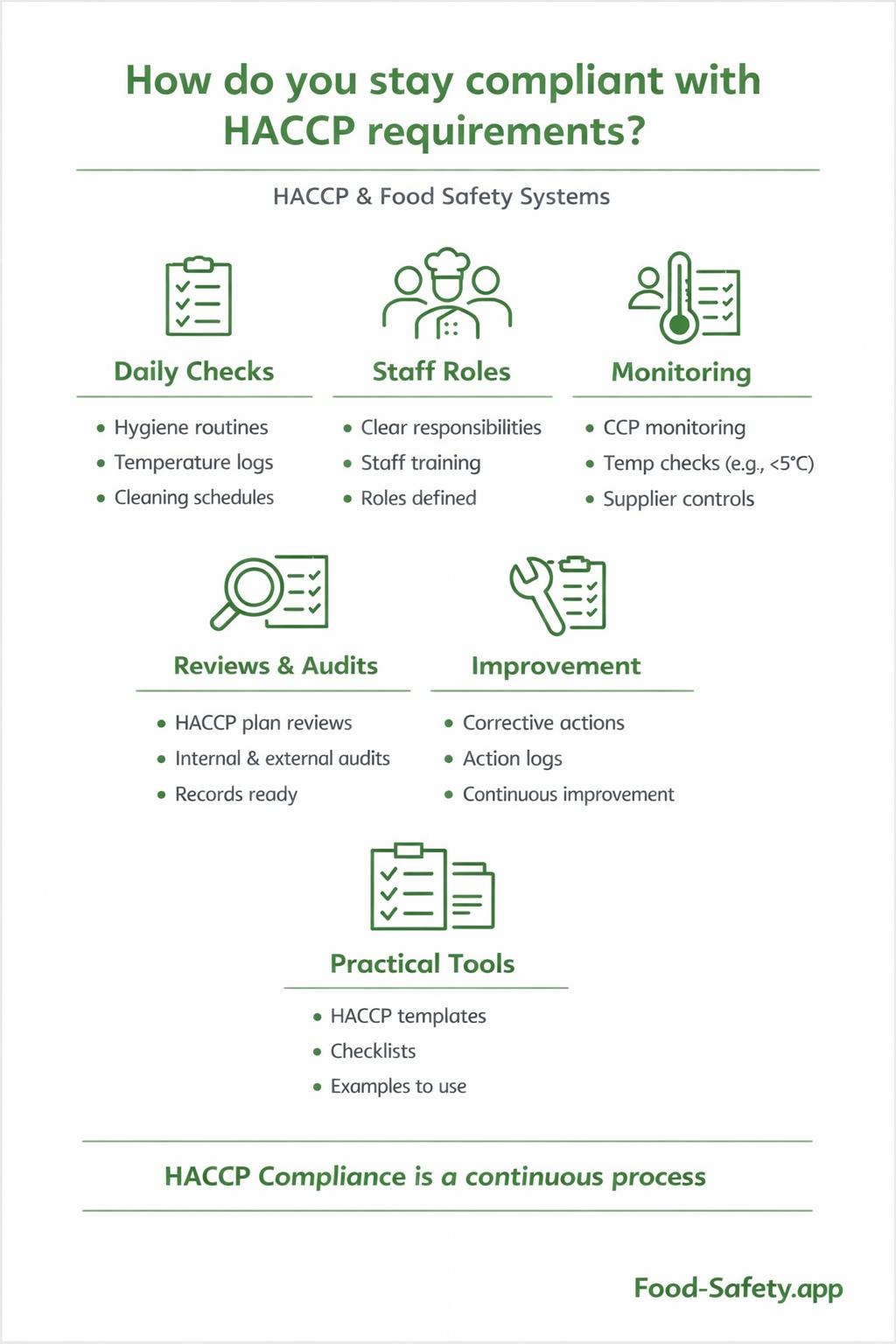
HACCP compliance depends heavily on getting the control points right. In catering, some of the most important controls usually relate to temperature, cross-contamination, cleaning, allergen management and supplier control.
Temperature control
Many food safety problems in commercial kitchens come from food being held, cooled, reheated or stored unsafely. You should have clear procedures for receiving chilled and frozen deliveries, storing food correctly, cooking thoroughly where required, cooling food quickly and keeping hot food hot or cold food cold during service.
Use calibrated probes and make sure staff know how and when to use them. A probe is only useful if it is clean, checked and used properly. If a reading is outside your safe control limits, the food should not just be put back and hoped for. The team needs to know whether to reheat, recool, reject or discard it, depending on the situation.
For practical fridge monitoring guidelines, see Fridge temperature monitoring.
Cross-contamination control
Raw and ready-to-eat foods need strict separation. In a professional kitchen, this means thinking about more than just storage shelves. It includes chopping boards, knives, sinks, cloths, tongs, gloves and even staff movement between tasks. A chef moving from raw chicken prep straight to sandwich assembly without proper handwashing is a common breakdown point.
Clear zoning, colour-coded equipment, well-placed handwash stations and sensible workflow all help. If space is limited, the procedure must be even clearer. Small kitchens cannot rely on memory alone during a lunch rush.
Small kitchens cannot rely on memory alone during a lunch rush. For more on How cross-contamination happens and how to stop it.
Cleaning and sanitation
HACCP compliance also relies on effective cleaning. Surfaces, equipment and utensils should be cleaned at the right frequency using the right method. High-risk areas such as slicers, prep tables, fridge handles and touchpoints need particular attention. If a task is critical to food safety, it should be assigned, checked and recorded where necessary.
Do not assume a surface looks clean because it is not visibly dirty. Cleaning schedules should include what is cleaned, how it is cleaned, who does it and when. For some equipment, disassembly and deep cleaning may be needed after service, not just a quick wipe-down.
A kitchen cleaning schedule in action can help keep this on track: Kitchen cleaning schedule in action.
Allergen management
Allergen control is now one of the most important parts of staying compliant with HACCP requirements in the UK. You need accurate ingredient information, clear labelling, strong communication between front and back of house, and a procedure for handling special requests carefully.
Typical failures include using the wrong garnish, mixing utensils, unclear delivery notes or staff giving off-the-cuff answers about ingredients. Every team member should know how to check allergen information and when to escalate if they are unsure. If you cannot guarantee a safe allergen modification, it is safer to say no than to guess.
Allergen management made practical for UK food businesses
Supplier and delivery checks
Compliance begins before food reaches the kitchen. Check deliveries on arrival for temperature, packaging condition, date marks and obvious contamination or damage. If there is a problem, reject the item or quarantine it immediately. A good supplier process reduces the chance of unsafe food entering your system in the first place.
Keep approved supplier information up to date and make sure goods-in staff know what to look for. A rushed delivery dock can be a weak point if nobody is responsible for proper checks.
Keep records that prove the system is working
Good HACCP compliance is not just about doing the job correctly. It is also about being able to show that you do it consistently. Records do not need to be complicated, but they should be accurate, clear and completed at the time the checks are made.
Useful records in a catering business often include:
- Delivery checks.
- Fridge and freezer temperature checks.
- Cooking, cooling and reheating logs where relevant.
- Cleaning schedules.
- Allergen and ingredient checks.
- Staff training records.
- Equipment maintenance and calibration checks.
- Incident and corrective action logs.
Make the paperwork short enough that staff can complete it during service. A one-page daily sheet used properly is better than a long form that nobody finishes. Digital systems can help reduce missed checks, but only if the process is simple and staff are trained to use it.
If you want an external reference for the UK approach to food safety and HACCP principles, the Food Standards Agency has practical guidance for food businesses: Food Standards Agency.
Train your team and assign accountability
One of the quickest ways to lose HACCP compliance is to assume that everyone already knows what to do. In busy kitchens, even good staff can miss steps if training is vague or inconsistent. Every person involved in food handling should understand the controls that apply to their role.
Training should cover:
- Handwashing and personal hygiene.
- Cross-contamination controls.
- Temperature checks and probe use.
- Allergen procedures.
- Cleaning routines.
- What to do when something goes wrong.
It also helps to assign ownership. Someone should be responsible for checking the fridge log, someone else for opening checks, and someone for closing and cleaning verification. If everybody is responsible, nobody is accountable. In a restaurant, that may be the head chef or kitchen manager. In a café or takeaway, it may be the shift leader. In a school canteen, it may be the cook-in-charge.
Short refreshers work well, especially before a change in menu, staffing or season. For example, summer service may bring more salad and cold food handling, while Christmas or event catering may increase cooling and reheating risks. Training should follow the operation, not just the calendar.
To help keep track of progress, Training records.
Use corrective actions when things go off track
A strong HACCP system does not just prevent problems. It also tells you what to do when control is lost. Corrective actions are essential because things will go wrong at some point: a fridge may run warm, a delivery may arrive damaged, or a tray of food may sit too long during service.
Your team should know the action to take without having to guess. Typical steps include:
- Stop using the food involved.
- Isolate or label the item clearly.
- Check whether the food can safely be corrected, reworked or must be discarded.
- Fix the equipment or process fault.
- Record what happened and what was done.
- Review whether the same issue could happen again.
For instance, if a chilled prep fridge is found running too warm at opening, the team should know whether food needs to be moved to another unit, checked, or discarded depending on the circumstances and your procedure. If a hot holding unit fails during lunch service, food may need to be taken out of service and assessed before it is served. The important thing is that the response is pre-decided and understood.
Corrective actions are not a sign of failure. They are part of compliance. A business that notices a problem, acts quickly and records it is usually in a far stronger position than one that never records anything at all.
Common mistakes that put compliance at risk
Most HACCP problems in catering businesses come from a handful of repeated mistakes. If you avoid these, you will already be ahead of many operations.
- Using a generic HACCP pack that does not reflect the menu.
- Failing to update the system after menu changes or new equipment.
- Leaving checks to one person so the business has no cover when they are off.
- Completing records after the shift instead of at the time of the check.
- Not acting on repeated fridge or cleaning issues.
- Assuming allergen information is correct without checking ingredients.
- Having procedures that are too long or complicated to follow in service.
Another common weakness is not reviewing the system after an incident. If a delivery was rejected, a fridge failed or a customer complaint highlighted an allergen issue, that is a signal to improve the process, not just deal with the immediate problem.
Review and improve your food safety system
To stay compliant with HACCP requirements, review your system regularly. This is especially important after any change in your business, such as:
- A new menu or recipe change.
- A new piece of equipment.
- A staffing change or new shift pattern.
- A supplier change.
- A complaint, incident or near miss.
- A busy seasonal period or event operation.
Walk through the kitchen at the times that matter: delivery, prep, lunch rush, close-down and cleaning. A procedure that looks fine on paper may fail in the pressure of service. Ask staff what slows them down, where mistakes happen and what is difficult to maintain. Their answers often point to the real weak spots.
Inspection readiness also depends on housekeeping. A tidy, well-organised kitchen with clear labels, clean records and obvious routines is easier to defend than a cluttered one where nobody knows where checks are kept or who signed them off.
Final thoughts
Staying compliant with HACCP requirements is mainly about building a food safety system that fits the way your business actually operates, then keeping it alive through daily routines, staff training and regular review. The strongest kitchens are not the ones with the thickest paperwork. They are the ones where the controls are simple, understood and followed under pressure.
Focus on the basics first: identify your risks, control the critical points, record what matters, train your team and act quickly when something goes wrong. If you do that consistently, you will be in a much better position to protect customers, support your staff and show that your business takes food safety seriously. For many catering businesses, using a food safety management system for catering businesses like Food-Safety.app can also help keep checks organised without adding unnecessary admin.