
When a customer or colleague asks about allergens, staff need a clear, safe response every time. The right allergen response for staff protects customers, reduces mistakes in busy service, and helps the business stay consistent across front of house, the pass, and the kitchen. In UK catering, the safest rule is simple: never guess, never assume, and never leave the customer with an uncertain answer.
See HACCP principles explained for how to structure allergen information and checks.
Table of contents
- Why allergen answers must be correct
- What staff must say when asked about allergens
- How to check the answer safely
- Front of house and kitchen workflow
- What to do when the answer is uncertain
- Common service situations and how to handle them
- Training and record keeping
- Practical checklist for every shift
- Final thoughts
Why allergen answers must be correct
Allergen questions happen in every type of food business, from cafés and school canteens to hotel banqueting and takeaway counters. In a busy service, the person serving may be under pressure, the chef may be in the middle of a rush, and the customer may need a quick answer before ordering. That is exactly when mistakes happen.
A good allergen response for staff is not just about sounding confident. It is about giving the customer information that is checked, current, and specific to the item they want to buy. UK food businesses must be able to provide accurate allergen information for the 14 declarable allergens, but the practical point for staff is simpler: if you are not certain, do not guess.
This matters because ingredients change, suppliers change, and recipes change. A sandwich filling that was safe last week may now contain mustard or sesame. A dessert may have a garnish added by the kitchen, or a sauce may be finished with cream. Staff who rely on memory alone are likely to make errors, especially during a lunch rush or a late-night takeaway service.
For practical guidance on allergen management in busy kitchens, see Allergen management made practical for UK food businesses.
What staff must say when asked about allergens
The best response is calm, polite, and direct. Staff should not be embarrassed to say they need to check. In fact, that is the correct and professional thing to do.
Safe example phrases for staff
- “Let me check that for you before I answer.”
- “I want to make sure I give you the correct allergen information.”
- “I’m not sure from memory, so I’m going to confirm it with the kitchen.”
- “I can check the ingredient information and come straight back to you.”
These phrases work because they avoid assumptions and show the customer that the business takes the question seriously. They are also useful in hotel kitchens and buffet settings, where dishes may look simple but contain hidden allergens in dressings, marinades, sauces, or toppings.
Staff should never say things like “It should be fine,” “I don’t think it has any,” or “That one usually doesn’t contain it.” Those answers can sound reassuring, but they are unsafe if they are not based on checked information.
How to check the answer safely
The correct allergen response for staff depends on a proper checking routine. The aim is to verify the exact dish, not a guess based on category or appearance.
Use the right source first
Staff should check the business’s allergen information system, recipe file, matrix, product labels, spec sheets, or digital records. If the answer is not immediately available, the next step is to ask the chef, duty manager, or trained supervisor who can verify it. For packaged items, always check the label rather than relying on the brand name.
For more context, see Clear allergen labelling on packaged food.
Check for hidden ingredients
Some allergens are obvious, but others are easy to miss. In professional kitchens, the following are common causes of confusion:
- Pre-made sauces, gravy, marinades, and dressings
- Composite ingredients such as pastry, stuffing, coatings, and crumb mixes
- Shared toppings and garnish trays
- Recipe substitutions made during service
- Supplier changes that have not yet been reflected in menus
If the dish is made to order, staff need to know whether any ingredient can be left out safely, or whether the item is prepared in an area where cross-contact is likely. That distinction is important. A dish may not contain a named allergen as an ingredient, but it may still be unsuitable for someone due to shared equipment or handling.
Give the answer for the exact item ordered
If a customer asks about a chicken wrap, do not answer for “wraps” in general. Check the exact filling, sauce, bread type, and side garnish. A small change can make a big difference, especially in cafés and takeaways where customers often swap items or add extras at the till.
Front of house and kitchen workflow
A safe allergen process works best when front of house and kitchen teams have a shared routine. Staff should know exactly who checks what, and how the answer gets back to the customer without delay or confusion.
A practical service flow
- The customer asks about an allergen.
- The server stops and does not guess.
- The server checks the menu, allergen matrix, or product information.
- If needed, the server confirms with the chef or manager.
- The answer is given clearly to the customer.
- If the dish is suitable, the order is flagged accurately for the kitchen.
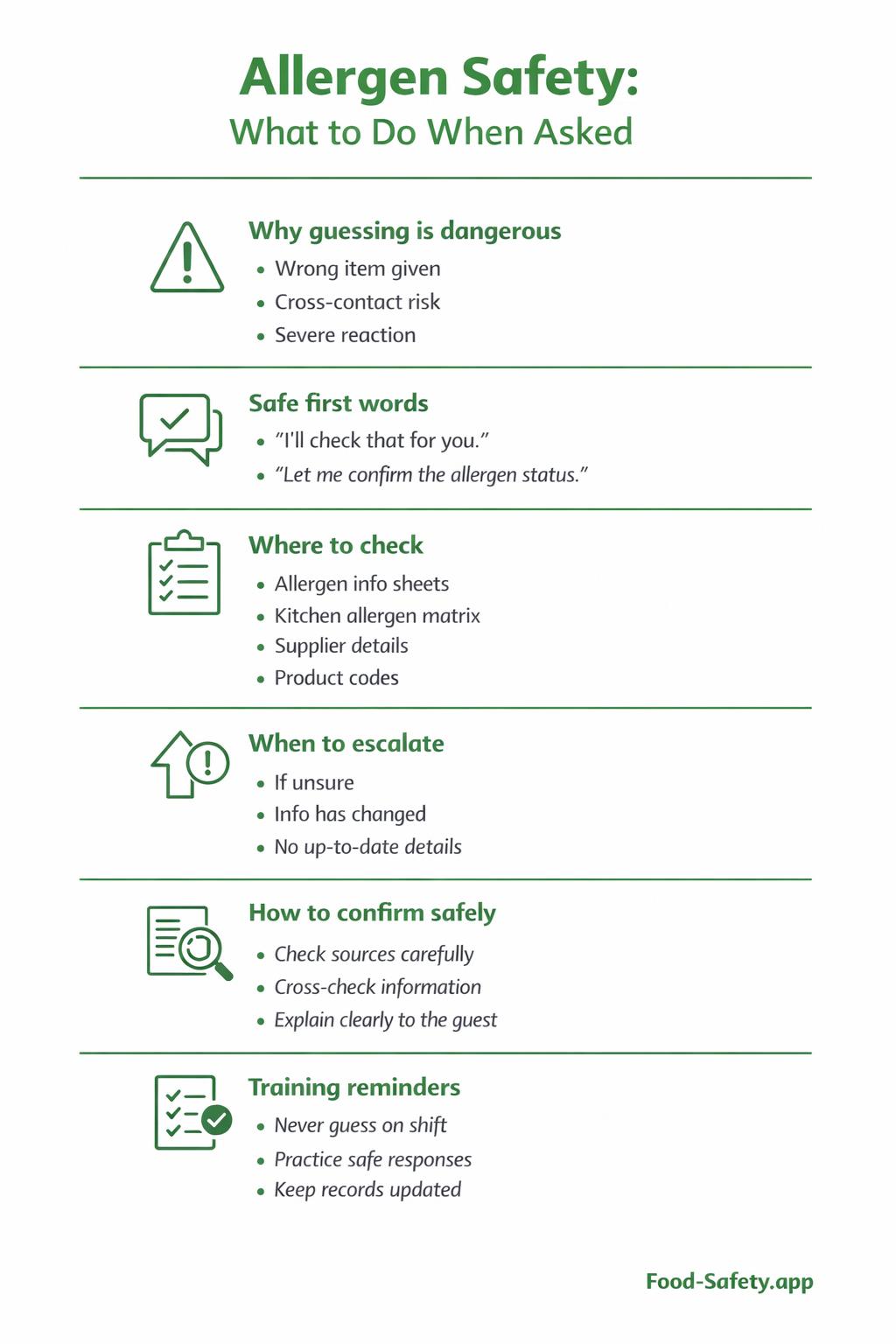
In a busy service, this flow should be quick and routine. The customer should not feel rushed, and staff should not feel they need to improvise. If the business uses an order screen, docket note, coloured ticket, or verbal handover, allergen requests must be obvious to everyone handling the order.
Make the handover specific
A note such as “allergy” is not enough on its own. The kitchen needs to know which allergen is being managed, what the customer ordered, and whether the item must be prepared separately or simply checked. This reduces confusion when several special requests are coming through at once.
For example, a customer asking about milk in a soup needs a different response from someone asking whether the soup can be made without butter and served with a clean ladle. The more specific the handover, the safer the service.
What to do when the answer is uncertain
If staff cannot confirm the allergen information, the safest action is not to serve the item as suitable for that customer. This is where professional judgement matters. It is better to lose one sale than to risk a serious incident.
Use a clear escalation route
When in doubt, staff should escalate immediately to the duty manager, head chef, or another trained person who can verify the information. If nobody can confirm it, the business should be honest with the customer and explain that the dish cannot be recommended as safe for that allergen.
That may feel awkward in the moment, especially in a small café or takeaway where the team is stretched, but it is the correct approach. A confident “I can’t confirm that, so I wouldn’t advise it” is far better than a risky guess.
Do not make risky substitutions on the spot
Substitutions can create extra allergen risks if the replacement ingredient has not been checked. Swapping a bun, sauce, or garnish during service may seem like good customer care, but it can make the dish unsuitable if the replacement has a different allergen profile or was handled on shared equipment.
Common service situations and how to handle them
Different catering environments create different pressures, but the same basic rule applies: check, confirm, and communicate clearly.
Restaurant and hotel table service
Servers should be able to answer basic questions, but they must also know when to pause and verify. If a customer asks about allergens in a special or chef’s recommendation, the server should check the dish components rather than rely on menu wording alone.
Cafés and counters
Counter staff often deal with rapid-fire questions while making drinks, taking payment, and calling orders. Keep the allergen information easy to access, and make sure staff know that “I’ll check” is an acceptable and expected answer.
School canteens and contract catering
Children’s meals often involve planned menus, but allergen answers still need checking because ingredients, brands, and serving methods can change. Make sure the person speaking to parents or pupils uses approved information, not memory.
Takeaways and delivery
Takeaway teams need a strong checking routine because orders are often made quickly and over the phone or app. If a customer mentions an allergy, the order should be clearly marked and checked before preparation. If the business cannot safely meet the request, it should say so before the order is accepted.
Training and record keeping
A reliable allergen response for staff depends on training that is practical, repeated, and tailored to the site. New starters should not be left to learn by watching others, because habits in busy kitchens can be inconsistent.
Training should cover
- Which allergens are relevant to the menu
- Where to find the official allergen information
- How to answer customer questions safely
- How to escalate uncertainty
- How to mark allergen orders for the kitchen
- What to do if ingredients change during service
Keep records up to date when recipes, suppliers, or preparation methods change. A printed matrix left in a drawer is not enough if it is out of date. The person answering the customer needs the latest version, not last month’s version.
For training resources, see Training records.
Build habits into shift routines
At the start of service, managers should check that allergen information is available and that any specials, substitutions, or low-stock replacements have been updated. During service, staff should be reminded to pass on requests clearly. At the end of the day, any issues should be logged so the team can improve the next shift.
For building a strong food safety culture in your kitchen, see Building a strong food safety culture in your kitchen.
Practical checklist for every shift
Use this simple checklist to help staff handle allergen questions safely and consistently:
- Know where the current allergen information is kept
- Check the exact dish, not just the menu category
- Never guess or rely on memory alone
- Escalate uncertainty to a trained manager or chef
- Use clear phrases that show you are checking properly
- Flag allergen orders clearly for the kitchen
- Confirm substitutions and specials before serving
- Update records when recipes or suppliers change
For UK businesses, the Food Standards Agency offers helpful guidance on food allergen information for catering and food businesses at Food Standards Agency allergen guidance for food businesses. Guidance can differ in other countries, so operators outside the UK should check their local rules.
Final thoughts
The most important thing staff must do when asked about allergens is to stop, check, and give a verified answer. That simple habit protects customers and helps the business run more smoothly under pressure. A good system makes it easy for staff to do the right thing, even in the middle of a busy lunch rush or a full evening service.
If your team is still relying on memory or informal handovers, now is the time to tighten the process. Clear allergen information, strong training, and a consistent response script make service safer and more professional. For businesses wanting better control, a food safety management system for catering businesses such as Food-Safety.app can help keep allergen checks, records, and procedures in one place.