Sick staff can contaminate food fast. Learn when workers must stay out how the 48 hour rule works and what managers should record before return.
Why illness matters in food safety
Illness in the kitchen is not a personal issue; it directly affects food safety. When staff work while unwell, pathogens can spread via hands, contaminated surfaces, shared equipment, and direct contact with prepared foods. In high-pressure service, shortcuts multiply risk: rushed washing, missed hand hygiene, or momentary lapses with gloves. A clear sickness policy reduces confusion, supports consistent decisions, and protects customers, staff welfare, and the business’s reputation. For practical steps, see our guide on simple food safety tips for busy kitchens.
How this translates to day-to-day routines
Effective controls start with simple practices: encourage reporting, isolate symptomatic workers, and ensure a smooth handover to cover staff. Regular briefings remind teams that prevention is cheaper than dealing with an outbreak, a dropped service, or a failed inspection.
Symptoms that should trigger action
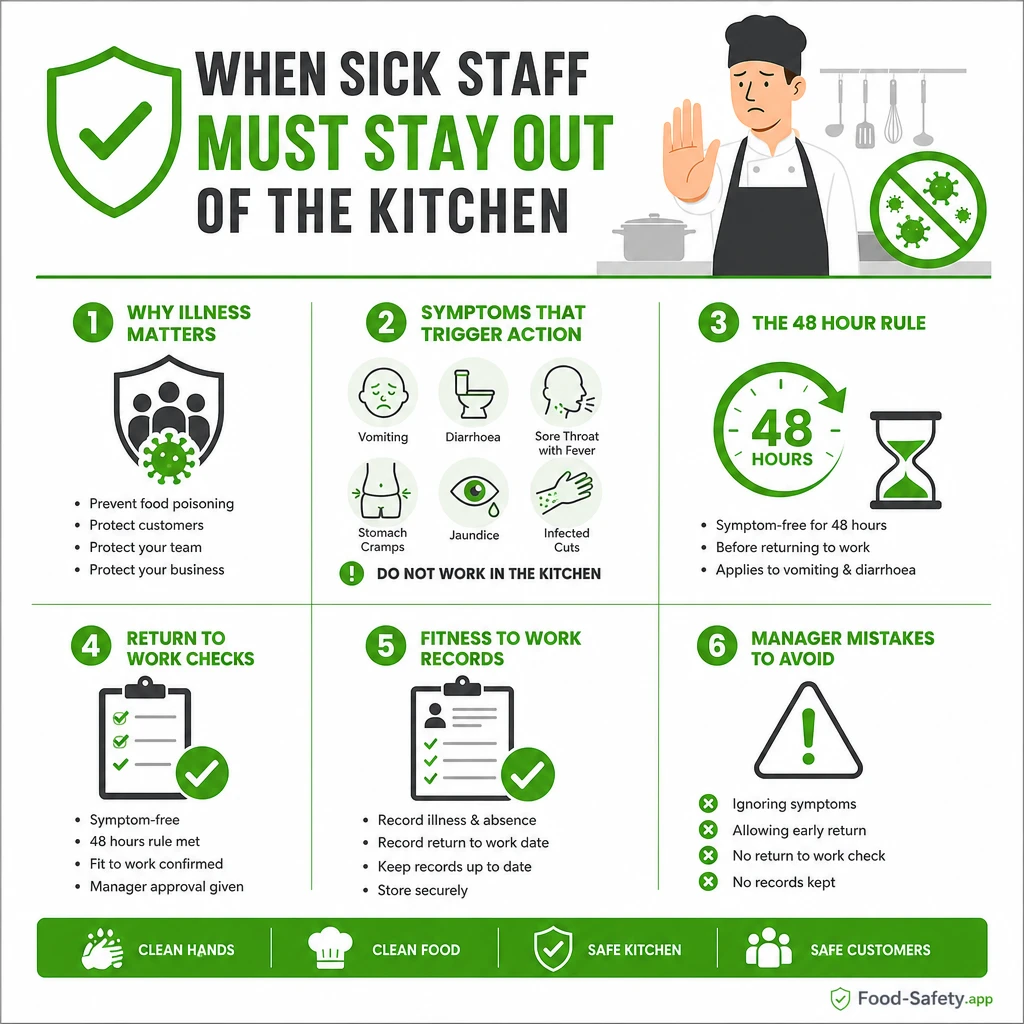
The following symptoms should trigger immediate exclusion from food handling and initiation of the return-to-work process. If any are present, treat the case as a potential food safety risk until a medical professional clears the individual.
- Vomiting
- Diarrhoea
- Fever
- Sore throat with fever
- Jaundice
- Infected skin lesions, especially on hands or arms
- Any suspected or confirmed food poisoning
If symptoms occur, exclude the person from handling and prepare suitable cover. For further guidance on managing foodborne illness risk, refer to our guidance on when staff must stay off after sickness.
The 48-hour rule
The 48-hour rule provides a simple, enforceable standard: staff should stay off food work until 48 hours after the last episode of vomiting or diarrhoea. This period helps ensure that pathogens are no longer being shed and that the individual is sufficiently recovered to resume duties without compromising safety.
- Isolate the person from food handling immediately when symptoms begin.
- Record the incident and the last episode time in the sickness log.
- Notify the hospitality manager or supervisor to arrange cover.
- Confirm 48 hours have passed since the last episode before any return-to-work discussion.
- Proceed to return-to-work checks once the 48-hour window has elapsed.
In practice, the 48-hour rule should be stated in your staff sickness policy and reinforced during inductions and toolbox talks. It aligns with the goal of preventing cross-contamination during fragile service periods.
Return to work checks
Before allowing a team member back into the kitchen, run a concise return-to-work check. This ensures that decisions are consistent, documented, and defensible during any inspection or audit.
Confirm symptom-free status for the past 48 hours (no vomiting or diarrhoea).
Ask about any remaining symptoms (e.g., persistent fever or coughing) and whether a medical professional cleared them.
Check that the individual can perform essential duties safely without risking others.
Assign light duties only if allowed by policy and only if they do not involve raw foods or shared surfaces; otherwise, restrict duties until full clearance.
Record the return-to-work decision and the date/time of clearance in the fitness-to-work log.
Ensure colleagues are informed of any ongoing precautions (hand hygiene reminders, surface sanitising schedules, etc.).
Documentation is critical. A quick checklist kept with the staff file signals to inspectors that the business takes illness management seriously and follows through on policy. For digital records, see what digital food safety records are and how they help.
Fitness to work records
Fitness to work records provide accountability and build inspector confidence. A simple, written log captures who, when, and what was observed or decided, reducing ambiguity during busy periods and improving recall for audits.
| Date | Staff | Symptoms observed | Action taken | Return-to-work clearance |
|---|---|---|---|---|
| 2026-06-26 | J Patel | Vomiting, diarrhoea | Excluded, 48-hour rule applied | Cleared 2026-06-28 by manager after review |
Keep fitness-to-work records in a central, accessible location. Prefer a simple form that records entry, outcome, and sign-off. If you use a digital system, ensure data retention complies with your policy and local guidance.
Manager mistakes to avoid
Addressing these missteps early protects customers, staff, and the operation’s integrity. Clear expectations, consistent application of policy, and prompt coverage decisions are key to reducing risk during peak service.
Failing to record illness or return-to-work decisions creates gaps in accountability.
Avoid allowing light duties that still involve high-risk tasks or close contact with raw foods.
Do not ignore symptoms in agency or casual workers, assuming they will self-report or just turn up.
Practical scenarios
A commis chef reports sickness before a busy lunch shift
The cook reports vomiting the night before and remains cautious about service. Exclude from food handling, arrange cover for prep areas, and implement the 48-hour rule. Use the return-to-work checks to clear only after the 48-hour window and current symptom resolution.
A bartender helps with garnish prep after a stomach bug
Garnish tasks are lower risk, but the person should not handle ready-to-eat items or contact raw ingredients. Assign non-food-contact duties and review readiness before any shift involving food handling. Monitor to ensure symptoms don’t recur.
A supervisor sends a recovering staff member straight back onto salad service too early
Salad service involves raw and ready-to-eat components and demands rigorous hygiene. The supervisor would be advised to adhere to the 48-hour rule and the return-to-work checklist, with a progressive return strategy only after clearance.
A delivery day where a poorly team member is tempted to “just come in for a bit”
Heavy service and high contact with customers increase risk if someone comes in unwell. Enforce the sickness policy strictly, arrange cover, and avoid accepting late entries. Reinforce that absence is a safety measure, not a hindrance to service.
Putting it into practice
Publish a clear sickness policy covering exclusion criteria, the 48-hour rule, and return-to-work steps.
Train supervisors to act decisively and document every decision.
Create a simple fitness-to-work log and ensure it is accessible to managers and health and safety leads.
Communicate the policy to all staff, including agency workers and casual staff, with a quick briefing during every shift change.
Review the policy periodically and adjust for seasonal demand or new guidance from health authorities.
Use a dependable system to timestamp entries and store records in a compliant, auditable format.
Conclusion and next steps
Managing sickness in a busy catering business requires clear rules, prompt action, and solid record-keeping. By enforcing the exclusion of sick staff, applying the 48-hour rule, and using consistent return-to-work checks, you reduce the risk of cross-contamination and protect service quality. Food-Safety.app, a food safety management system for catering businesses, can help with fitness to work records, return-to-work checks, and automatic timestamped documentation, supporting small kitchens with clear evidence during inspections and day-to-day management.
Take control of your kitchen health today
Streamline sickness policy and return-to-work processes with a trusted food safety platform designed for busy kitchens, giving you timestamped records and clear audit trails.