See where verbal allergen systems break down in real kitchens and how to add simple checks that protect customers during busy service.
Why verbal allergen communication breaks down in busy service
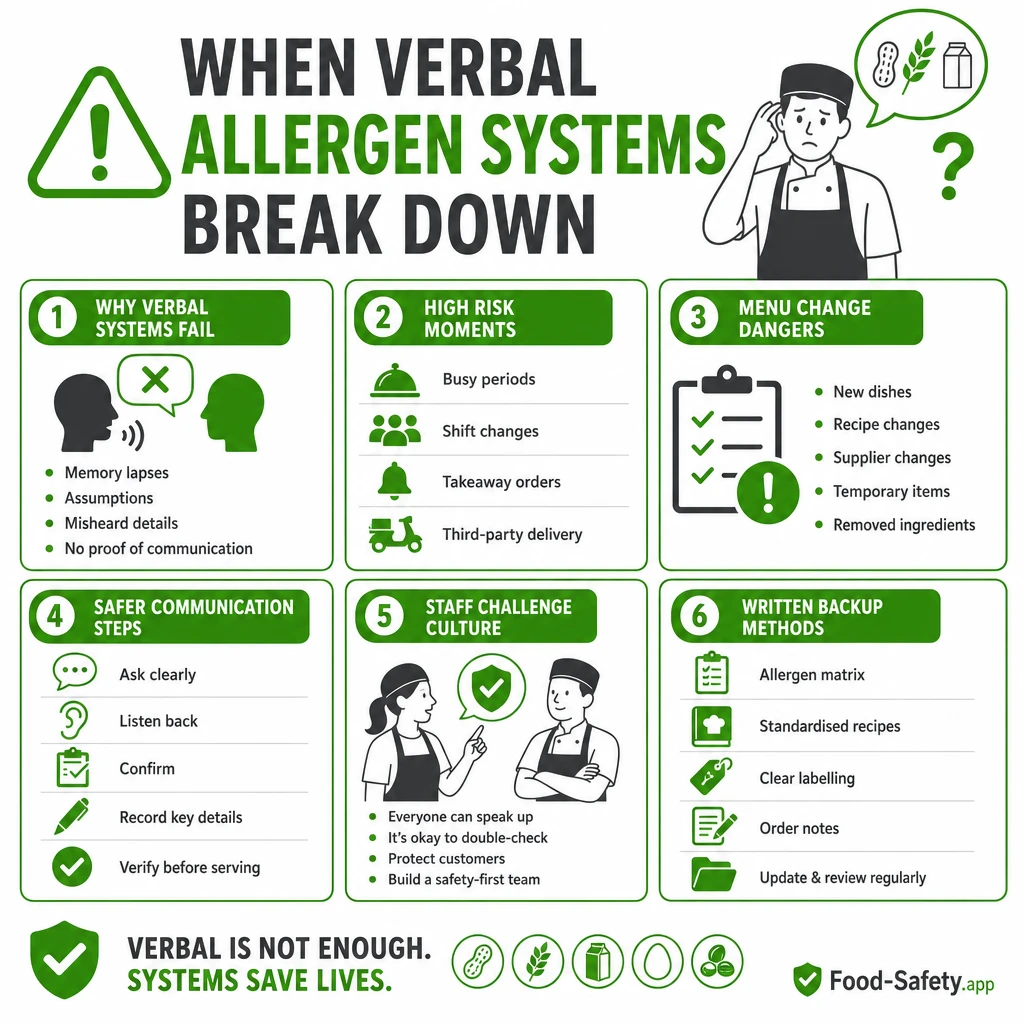
In a bustling commercial kitchen and front-of-house environment, verbal allergen communication can falter under pressure. A robust Allergen management approach helps reduce risk by providing written cues and checks that complement memory. Noise, multiple conversations, and the pace of service make it easy to mishear or misinterpret. Staff changes mean new team members carry less experience with current recipes. Assumptions creep in when someone assumes “the recipe didn’t change” or “the server knows,” and memory naturally becomes less reliable as the shift wears on. These factors undermine the clarity of verbal instructions and raise the risk of cross-contact and incorrect allergen responses.
Noise and rushed service
- Background chatter, music, and kitchen clatter disrupt clear dialogue about ingredients and allergens.
- Rushed handoffs between shifts or between kitchen and front-of-house leave key details implicit rather than explicit.
- Under pressure, staff may opt for quick, confident answers instead of slow, verified ones.
Staff changes and memory limits
- New or temporary staff may not share the same level of allergen awareness as permanent crew.
- Memory alone cannot reliably track recipe changes, substitutions, or supplier substitutions across a busy service.
Assumptions and misinterpretations
- Assuming “the chef knows” or “we’ve always done it this way” can bypass necessary checks.
- Relying on one person’s recall without a documented backup increases the chance of gaps during peak times.
High-risk moments that test verbal systems
Some moments are inherently high risk for verbal miscommunication. Recognising them helps you put checks in place before service begins.
Menu changes and specials
Any modification to ingredients, garnishes, or sauces can alter allergen profiles. Verbal updates may not reach everyone, especially on busy service nights.
Substitutions and off-menu requests
Substituting a component mid-service is common, and a verbal note on the pass can be missed or forgotten during the rush.
Shift handovers and relocations
During shift changes, critical allergen information must cross from outgoing to incoming staff. Verbal handovers are prone to omissions if not structured.
Off-site catering and delivery mistakes
Delivery drivers or off-site teams may bring substitutions or new products that alter allergen profiles unless a written record is referenced.
Where confusion happens: ingredients, cross-contact and messaging
Confusion tends to cluster in four areas: the ingredients list, cross-contact risks, prep area practices, and how messages are conveyed to customers or front-of-house staff.
Ingredients and allergen clarity
Ingredient lists on hand • recipes updated in the kitchen • substitutes announced verbally without a traceable record.
Cross-contact and shared equipment
Shared cutting boards, utensils, and pans are common sources of unintended allergen transfer when verbal notices fail to reach all teams involved in a dish’s preparation.
Prep areas and workflow
When different dishes pass through the same station, a verbal warning may be forgotten as the queue grows.
Front-of-house messaging
Patrons rely on clear signage or staff statements. Verbal assurances that change with last-minute updates can mislead if not backed by written records.
The limits of “ask the chef” without a written backup
Asking the chef for an allergen answer during service is valuable, but it should not be the only control. Memory, time pressure, and rotating staff mean that relying on a single response is a risky habit. The “ask the chef” approach must be supported by stored, accessible information the team can consult at any moment. This should align with HACCP and broader food safety systems.
Illustrative scenarios
- A server tells a customer a dish is egg-free, but the morning recipe changed to include egg.
- A chef swaps a sauce during service and the allergen note on the pass is not updated for the chef de partie who plates the dish.
- A temporary member offers the wrong answer because they were not briefed on the current allergen status.
- A buffet item is relabelled verbally after a supplier substitution, with no written update for staff and guests.
- A delivery contains a new ingredient that changes the allergen profile of a standard dish. For recalls and lessons, see prepared-fruit-recall-food-safety-lessons-every-kitchen-should-know.
How to challenge unsafe assumptions and encourage check habits
Shifting from “guessing” to deliberate checking is a cultural move as much as a procedural one. The goal is to create habits that slow service just enough to verify, without hampering customer experience. Cross-contamination training that staff remember can reinforce these habits and help embed checks into daily practice.
Encourage the pause and check mindset
- Train staff to say “I need to check” instead of guessing an allergen status.
- Institute a quick, repeatable check routine at key moments: menu changes, substitutions, and shift handovers.
- Make verification part of the standard service protocol, not an exception.
Structured handovers that stick
- Use a consistent handover format so everyone receives the same information.
- Include the dish name, current allergen status, any substitutions, and the responsible station.
- Archive handover notes so they can be reviewed for training and inspections.
Practical steps to build a robust written allergen system
Create and maintain a written system that acts as the backbone when verbal communication falls short. The result is better consistency, easier inspections, and greater confidence for the team, grounded in food safety fundamentals (the 4 Cs).
- Keep a written allergen matrix for all 14 recognised allergens. This should be easily accessible to kitchen and front-of-house staff and reviewed with every menu change.
- Update menu and recipe changes before service starts. Ensure substitutions are reflected in the pass and allotment sheets.
- Use structured handover notes for shift changes and specials. A simple template can include dish name, current allergen profile, substitutions, and responsible station.
- Train staff to say “I need to check” rather than guess. Encourage a culture where verification is normal, not a sign of weakness.
- Keep records that can be reviewed and exported for inspections. Ensure the system supports offline access and timestamped entries.
- Link allergen controls to wider food safety systems, including cleaning, defect reporting, corrective actions and training records. A single, coherent system makes audits smoother.
| Allergen | Common sources | Notes |
|---|---|---|
| Cereals containing gluten | Wheat, barley, rye, and products | Watch for sauces and marinades |
| Crustaceans | Shrimp, lobster, crab | Cross-contact risk in sauces |
| Eggs | Eggs in batter, mayo, desserts | Verify egg-free substitutions |
| Fish | Fish fillets, sauces | Check for hidden fish ingredients |
| Milk | Dairy, cream, butter | Consider dairy-free alternatives |
| Trees nuts | Almonds, walnuts, pistachios | Allergen handling requires separate prep |
| Peanuts | Peanut sauces, oils | Cross-contact risk in fryers |
| Soy | Tofu, soy sauce, processed foods | Check for hidden soy in dressings |
| Sesame | Sesame seeds, oils | Common in garnishes |
| Celery | Seasonings, stock | Often used in soups and broths |
| Mustard | Condiments, marinades | Important in dressings |
| Lupin | Some breads and substitutes | Less common; verify supplier notes |
| Sulphur dioxide/Sulphites | Dried fruit, wine, prepared foods | Labelled in many products |
| Molluscs | Shellfish like clams, squid | Separate prep recommended |
For compliance guidance, consider official sources such as the Food Standards Agency when reviewing allergy controls and best practices. Food hygiene ratings.
To support teams in day-to-day operations, consider adopting a practical digital system that keeps written records accessible and auditable. Food-Safety.app is a food safety management system for catering businesses. It helps store allergen records, update menu items, and maintain a clear digital history for inspections and internal reviews. It also supports offline access and exportable PDFs for records retention.
Learn more about written allergen management
Explore how Food-Safety.app can streamline allergen controls, keep accurate records, and support inspections with a practical digital system designed for catering teams.