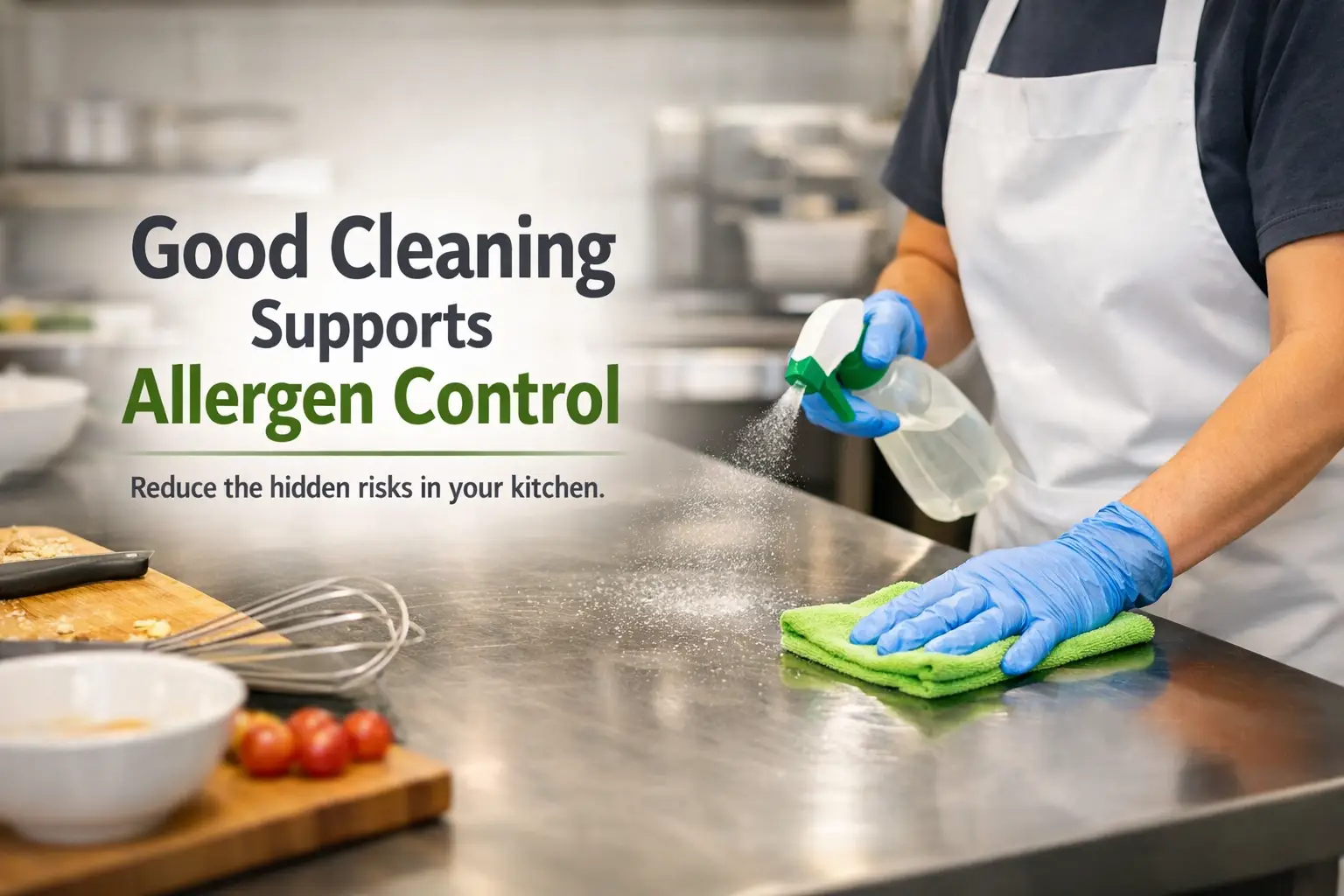
Good cleaning supports allergen control. Learn practical steps that fit busy service.
Understanding allergen cross contact in a busy kitchen
Allergen cross contact is not just about a single spill. In a busy service, allergens can spread via multiple vectors if controls are not consistently applied. Understanding where this happens helps you design routines that stop transfer at the source.
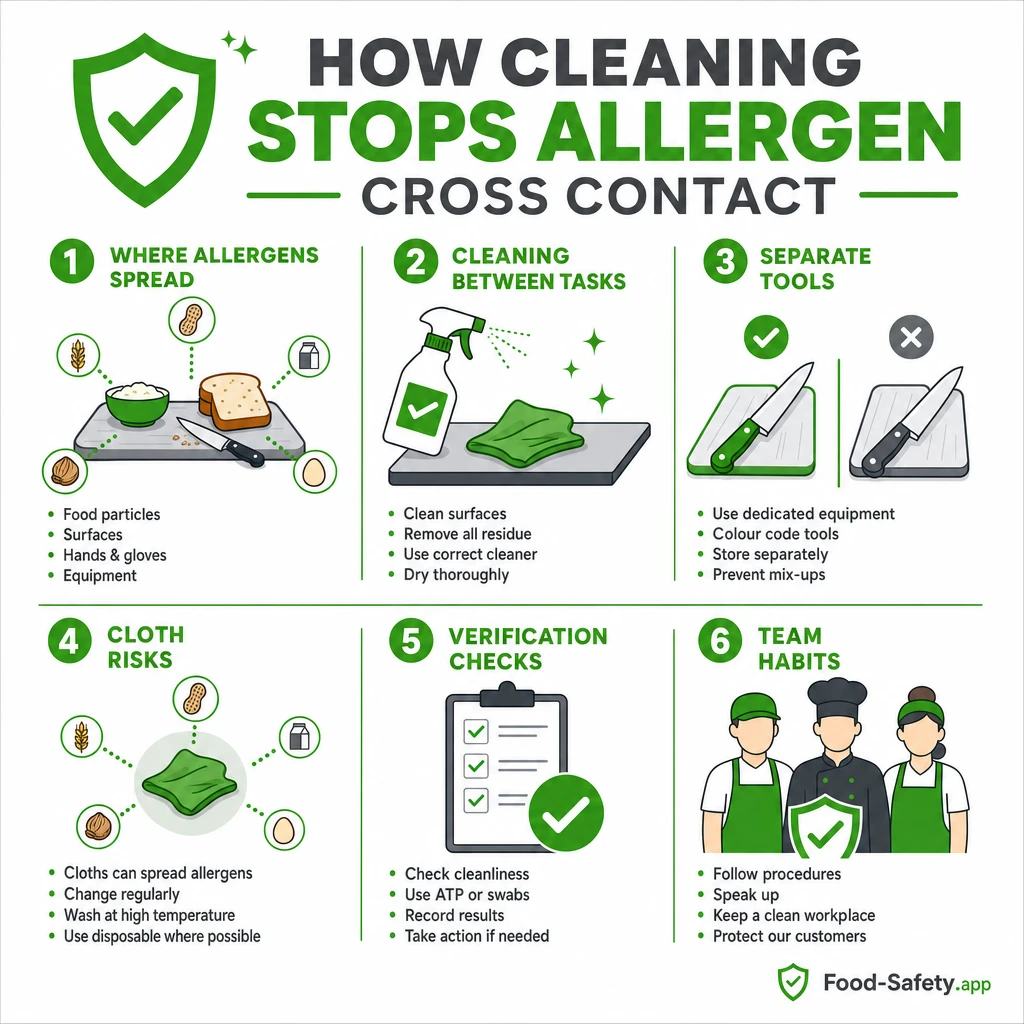
Areas include worktops and prep surfaces, utensils and knives used across stations, chopping boards and scale mats, fryer baskets and utensils used in multiple oil bases, cloths, towels, and cloth aprons, hands and gloves after touching allergen-containing ingredients, shared equipment and small electrical tools, and containers and squeeze bottles that move between tasks.
Between-task cleaning matters more than end-of-service cleaning
Cleaning between tasks is the moment when cross-contact risk spikes. If surfaces are only cleaned at the end of a shift, traces can transfer when the next dish is being prepared. Between-task cleaning creates a barrier that travels with each new job, preventing allergen residues from lingering on tools, cloths, or surfaces.
Between-task cleaning: how-to-clean-to-reduce-allergen-cross-contact provides practical steps to implement these controls in busy kitchens.
Stops residue transfer during high-frequency task changes; preserves separation between allergen-containing and allergen-free work; reduces risk during staff handovers and line changes; reinforces consistent workflows for all kitchen staff.
Separate tools for allergen-free prep
Colour-coded boards
Use clearly marked boards for different allergen paths. A gluten-free board, nut-free board, and dairy-free board, for example, help staff avoid cross-contact during rapid prep shifts. how-to-stop-cross-contamination-in-service supports this approach.
Colour-coded knives
Align knives with board colours so a single blade cannot be used across allergen categories without a deliberate switch and cleaning step.
Separate containers and cloths
Dedicated containers, squeeze bottles, and cloths for allergen-free work reduce the chance of residue transfer. When a container or cloth is used with an allergen, swap and sanitise or replace before the next task.
Dedicated equipment where possible
Where feasible, keep specific equipment (blenders, mixers, spoons) assigned to particular allergen tasks. If this isn’t possible, implement a strict cleaning and changeover routine between tasks.
Risks from wiping surfaces with the same cloth
Wiping a surface with a cloth that has been used on other ingredients can move allergens from one area to another in seconds. This is a common, addressable risk in busy service when speed overrides hygiene checks.
Always use separate cloths for allergen-free prep and general cleaning; Never wipe two stations in quick succession with the same cloth without a wash, rinse, and sanitise cycle; Design a cleaning sequence that includes cloth colour changes as you move between tasks.
Handwashing, glove changes and apron changes after allergen handling
Handwashing is the first line of defence. Staff must wash hands at defined points, and gloves or aprons should be changed after handling allergen ingredients or cross-contact events.
Wash hands thoroughly before starting a new task; Change gloves when moving from allergen-containing to allergen-free work; Remove and replace aprons after handling allergen ingredients or shared equipment; Dry hands completely and avoid recontamination from wet surfaces or sleeves.
What clean looks like before starting the next task
“Clean enough” is a measurable state, not a feeling. Before starting the next task, check for visible residues, odd smells, or sticky surfaces, and ensure tools are sanitised and correctly stored. Visual and tactile checks should be part of a standard routine, not a guess.
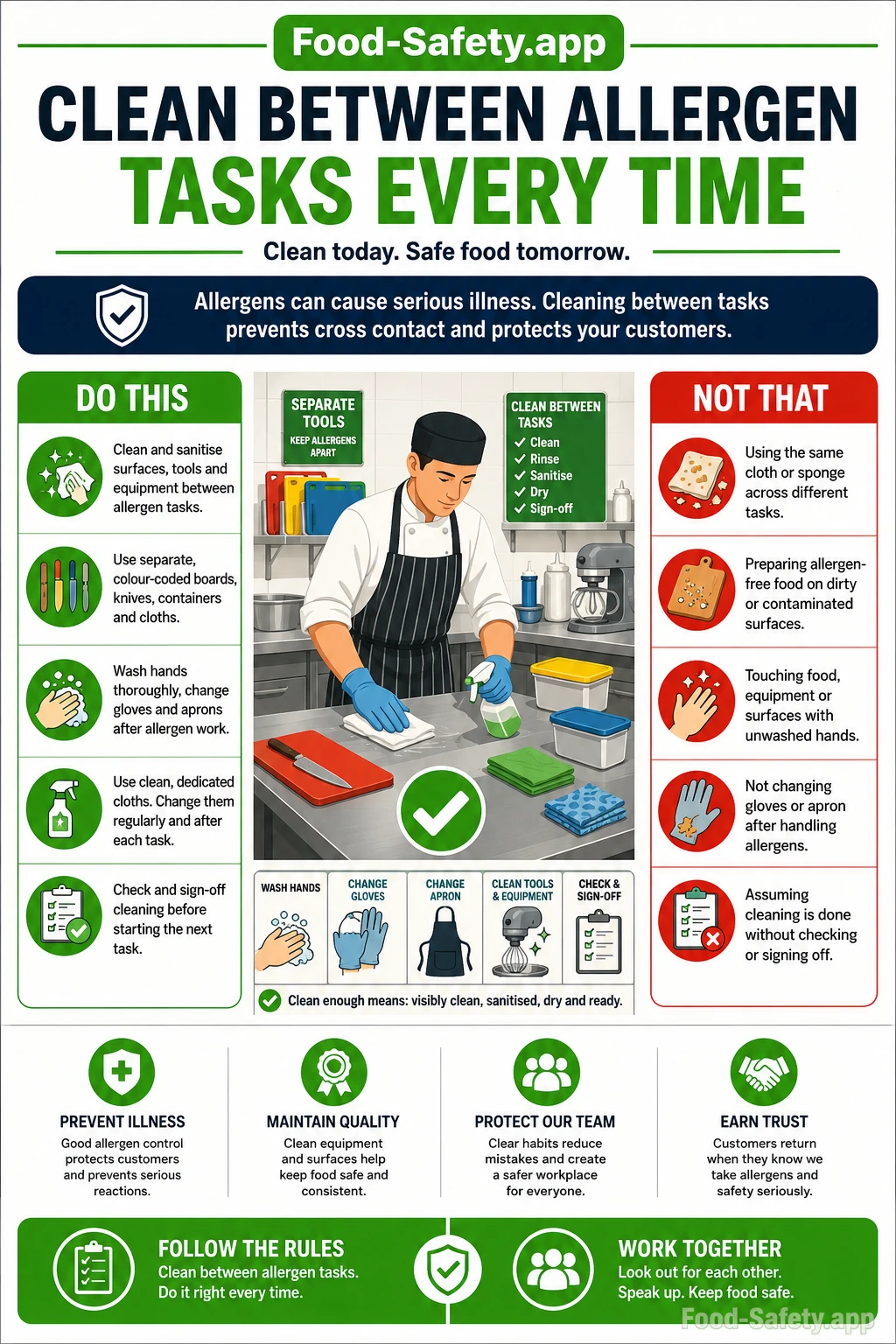
All surfaces appear dry, with no visible residues; Cloths are clean, dry, and colour-appropriate; Containers and tools are switched or sanitised if used on multiple tasks; Handwashing and glove-changing steps have been completed.
How to verify cleaning is done properly
| Area | Method | Evidence | Frequency | Sign-off |
|---|---|---|---|---|
| Worktops after allergen task | Visual check and wipe-down with sanitiser | Surface dry, no residue | Between tasks | Supervisor |
| Utensils and knives | Wash, rinse, sanitise, air dry | Empty wash basket, sanitiser contact | Between tasks | Section lead |
| Prep area between lines | Dry wipe, colour-switch cloth | Cloth colour changed | Between shifts | Shift supervisor |
Team habits that reduce mistakes during service, prep and production changes
Small daily habits add up to big reductions in cross-contact risk. Build these into standard operating procedures so every staff member knows their responsibilities during service, prep, and production changes.
Pre-service briefings that confirm allergen-free zones and tool sets; A clear handover checklist between shifts, covering allergen tasks; Regular reviews of high-risk areas and shared tools; Colour-coded systems reinforced by spot checks during service; Prompt corrective actions when a lapse is observed.
Practical scenarios and corrective actions
Scenario: Preparing a gluten-free meal after handling breaded products on the same station.
Corrective actions: switch to gluten-free board and knives, sanitise surfaces, and rewash hands before continuing. Verify no breadcrumbs remain on the station.
Scenario: Using a shared cloth to wipe a surface after nut-containing dessert prep.
Corrective actions: discard the cloth, replace with a clean colour-coded cloth, and perform a full wipe-down with sanitiser on the affected area.
Scenario: Switching from dairy-heavy breakfast service to allergen-sensitive lunch prep.
Corrective actions: perform a dedicated clean of the prep area, switch to allergen-free containers, and confirm hands and gloves are clean before the next start.
Scenario: Cleaning mixer attachments, scoops and squeeze bottles between recipes.
Corrective actions: fully wash, rinse, sanitise and air-dry all attachments; use colour-coded items for each recipe family.
Scenario: Reopening a prep area after staff changeover.
Corrective actions: re-brief the team, perform a rapid between-task clean, and document sign-offs for the handover period.
Operational compliance and HACCP focus
In a HACCP-based system, allergen controls must be documented, auditable, and integrated into daily routines. Focus on high-risk areas, shared tools, and reusable cloth use; keep training records up to date so staff demonstrate understanding of cross-contact risks.
For authoritative guidance on allergen controls, see the Food Standards Agency allergen guidance.
Technology aid for allergen cleaning verification
Technology can help you record cleaning tasks, create custom checks, and provide evidence with timestamps. A practical system supports inspection readiness and permits quick review of who did what and when.
In today’s catering environment, a digital approach to cleaning verification reduces guesswork and strengthens accountability. For operators seeking a reliable digital partner, consider a platform that records all allergen-related controls and exports audit-ready reports.
Food-Safety.app, a food safety management system for catering businesses
can record cleaning tasks, custom checks, allergen-related controls, and automatic timestamps for evidence during inspections. It also supports allergen management records, custom cleaning lists, and PDF export for audit readiness.
Digital allergen controls for busy kitchens
Explore a digital solution that records allergen controls, supports audits, and strengthens accountability across busy kitchens for operators seeking reliable scalable food safety management.