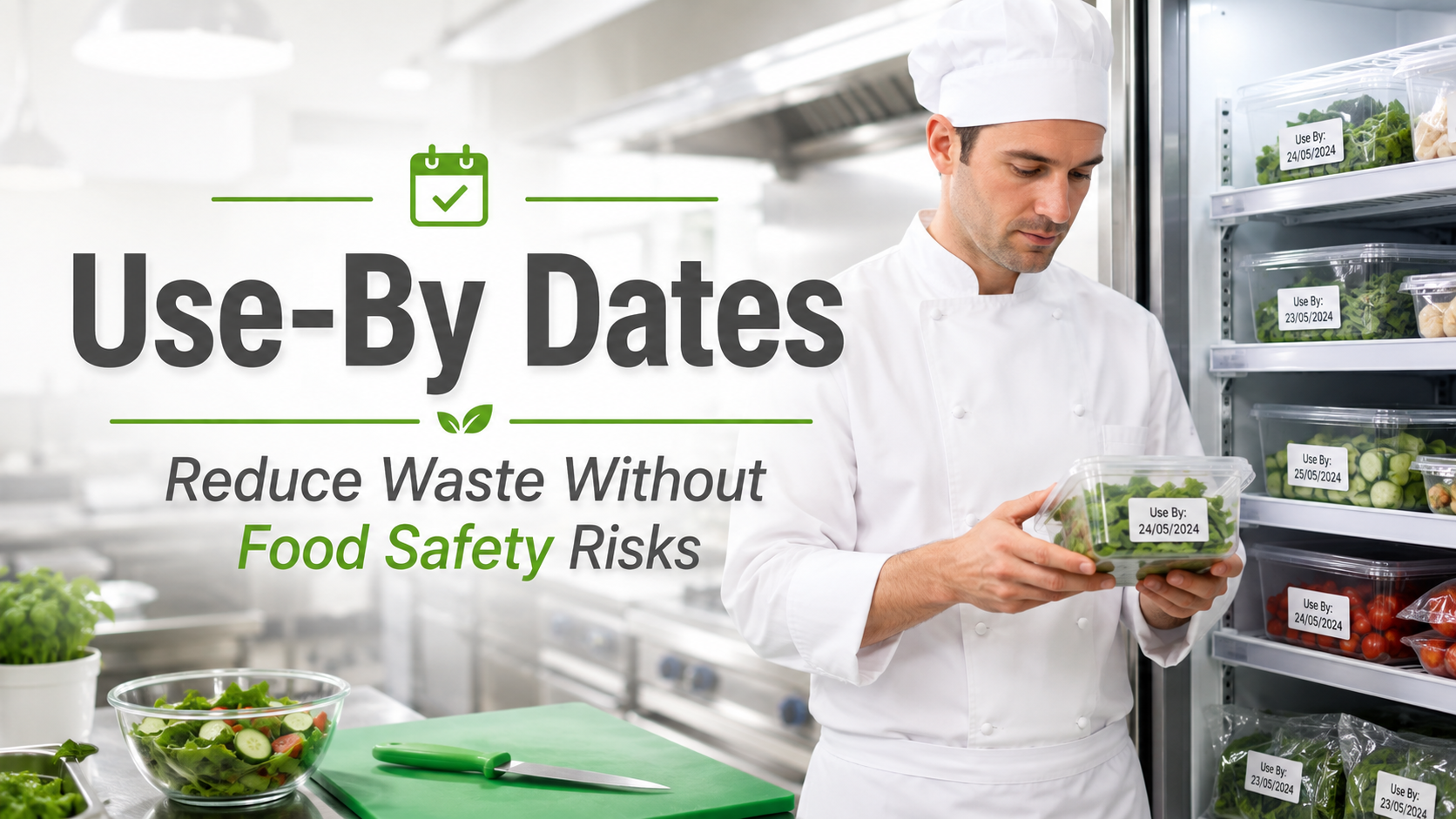
Good food safety management helps catering businesses understand use-by dates, reduce waste and avoid taking unnecessary food safety risks.
Table of contents
What Does a Use-By Date Mean?
A use-by date is about food safety. It’s normally found on foods that can become unsafe relatively quickly, including chilled meat, fish, cooked meats, prepared salads and some dairy products.
The Food Standards Agency advises that food shouldn’t be eaten after its use-by date, even if it looks and smells fine. Harmful bacteria can be present without causing an obvious change in appearance, smell or taste. This means the familiar “smell test” isn’t a suitable way of deciding whether food past its use-by date is safe.
For catering businesses, checking dates should form part of everyday food safety management, alongside refrigeration, stock rotation, cleaning and other routine controls.
Can food be used on its use-by date?
Yes. Food can normally be used up to and including the use-by date, provided it has been stored correctly and the manufacturer’s instructions have been followed. The FSA also advises that suitable food can be cooked or frozen before the use-by date expires.
You can read the Food Standards Agency guidance and research on use-by dates for further information.
What’s the Difference Between Use-By and Best-Before?
The easiest way to remember the difference is that use-by relates to safety, while best-before relates mainly to quality.
A product that has passed its best-before date may lose some flavour, texture or freshness, but it may still be safe to eat if it has been stored correctly. A use-by date is different because it marks the point after which the food shouldn’t be consumed.
This distinction is particularly important when training staff. Throwing away safe food unnecessarily increases waste, but keeping food beyond a safety date can create an avoidable risk.
Can you rely on smell after the use-by date?
No. Food poisoning bacteria don’t always make food smell, look or taste unusual. A food business shouldn’t override a use-by date because a product appears acceptable.
What Did the Latest FSA Research Find?
Recent Food Standards Agency research found that in March 2026, 64% of consumers surveyed reported that they or someone in their household had eaten food past its use-by date as a way of saving money.
It’s important to be clear about what this research tells us. The survey looked at consumer behaviour in households, not practices within food businesses. It shouldn’t therefore be used as evidence that catering businesses are routinely serving food past its use-by date.
What it does show is a concerning attitude towards food safety when people are under financial pressure. For some consumers, saving money appears to be important enough that they’re prepared to ignore a recognised food safety date and potentially put their health at risk.
The same research found that 60% reported eating leftovers that had been kept in the fridge for more than two days, while 39% reported reheating leftovers more than once as ways of saving money.
These behaviours don’t necessarily mean that every meal involved an immediate food safety risk, but the findings demonstrate how easily established food safety advice can be pushed aside when people are trying to reduce household costs.
The figures come from the FSA’s Consumer Insights Tracker, which surveys adults in England, Wales and Northern Ireland. The full FSA Consumer Insights Tracker report provides the original research and methodology.
Why should food businesses pay attention to consumer research?
Food businesses operate under different responsibilities and controls, but consumer attitudes still matter. If customers are becoming more relaxed about use-by dates at home, it reinforces the need for catering businesses to maintain clear standards and provide staff with accurate food safety training.
Commercial food safety controls shouldn’t be weakened because ingredients are expensive or because throwing food away affects margins. The better approach is to improve purchasing, storage and stock management so less food reaches the point where it has to be discarded.
What Should Food Businesses Be Doing?
Managing use-by dates doesn’t need to be complicated. A few consistent controls can significantly reduce the chance of expired food remaining in storage.
- Check use-by dates when deliveries arrive.
- Rotate stock so older products are used first.
- Check dates during routine fridge inspections.
- Clearly date food that has been opened or prepared on site.
- Follow manufacturers’ storage instructions.
- Keep chilled foods at appropriate temperatures.
- Freeze suitable food before its use-by date where appropriate.
- Remove expired food promptly so it can’t be used accidentally.
These checks should sit alongside your HACCP records, cleaning controls, temperature checks and other food safety procedures. Good routines can also help businesses demonstrate effective control during an inspection and support a stronger food hygiene rating.
How Can Businesses Reduce Waste Safely?
Food safety and waste reduction don’t need to conflict. The better approach is to prevent food reaching its use-by date unnecessarily rather than taking a risk once that date has passed.
Start with ordering. Regularly compare what you purchase with what you actually use. If the same products are being discarded every week, ordering quantities or menu planning may need adjusting.
Stock rotation is equally important. Put newly delivered products behind existing stock where practical and make sure dates remain visible. Foods approaching their use-by date can be prioritised in menu planning where appropriate, provided they’re still within date and have been stored safely.
Temperature control also matters. Poor refrigeration can increase food safety risks and lead to unnecessary waste. Recording fridge and freezer temperatures gives managers a clearer picture of whether chilled storage is working as expected.
Can Digital Food Safety Records Help?
Records won’t replace good judgement or staff training, but they can make everyday checks easier to organise. Digital food safety records can help businesses keep temperature checks, opening and closing checks, delivery records and corrective actions together rather than relying on separate sheets of paper.
This can also make it easier to spot recurring problems. If refrigeration temperatures are repeatedly outside limits, deliveries are regularly arriving with short dates, or food is continually being wasted, records provide information that managers can act on.
Where does Food-Safety.app fit in?
Food-Safety.app is a food safety management system designed to help smaller catering and hospitality businesses manage routine digital records. It includes temperature recording, opening and closing checks, cleaning schedules, delivery checks, corrective actions and other practical food safety controls.
The aim isn’t to create more paperwork. It’s to make existing checks easier to complete, review and keep organised.
Use-By Dates: The Key Point
The FSA research relates to consumers, not food businesses, but the findings are still significant. They show that when money is tight, some people are prepared to disregard food safety advice to avoid wasting food.
For catering and hospitality businesses, the answer isn’t to take the same risk. Better ordering, stock rotation, refrigeration, date labelling, staff training and accurate records can all help reduce waste before products reach their use-by date.
Reducing waste makes good commercial sense, but use-by dates remain a food safety control. Good food safety management helps businesses control both without having to choose one over the other.
Make food safety checks easier to manage
Food-Safety.app helps catering and hospitality businesses organise routine food safety records, including temperature checks, opening and closing checks, cleaning schedules, delivery checks and corrective actions. Keep essential controls together, make everyday checks easier to review and support consistent food safety management across your business.