
Understanding the food danger zone in UK kitchens is one of the simplest ways to reduce the risk of food poisoning, protect customers, and keep service running smoothly. In busy kitchens, the problem is usually not one big mistake, but lots of small timing and temperature slips: hot food left too long on the pass, chilled ingredients sat out during prep, or probe checks skipped because the lunch rush is kicking off. This guide explains the food danger zone in practical UK terms, along with the checks, routines, and corrective actions that help catering teams stay in control. For a practical framework, see HACCP principles explained.
Table of contents
What is the food danger zone?
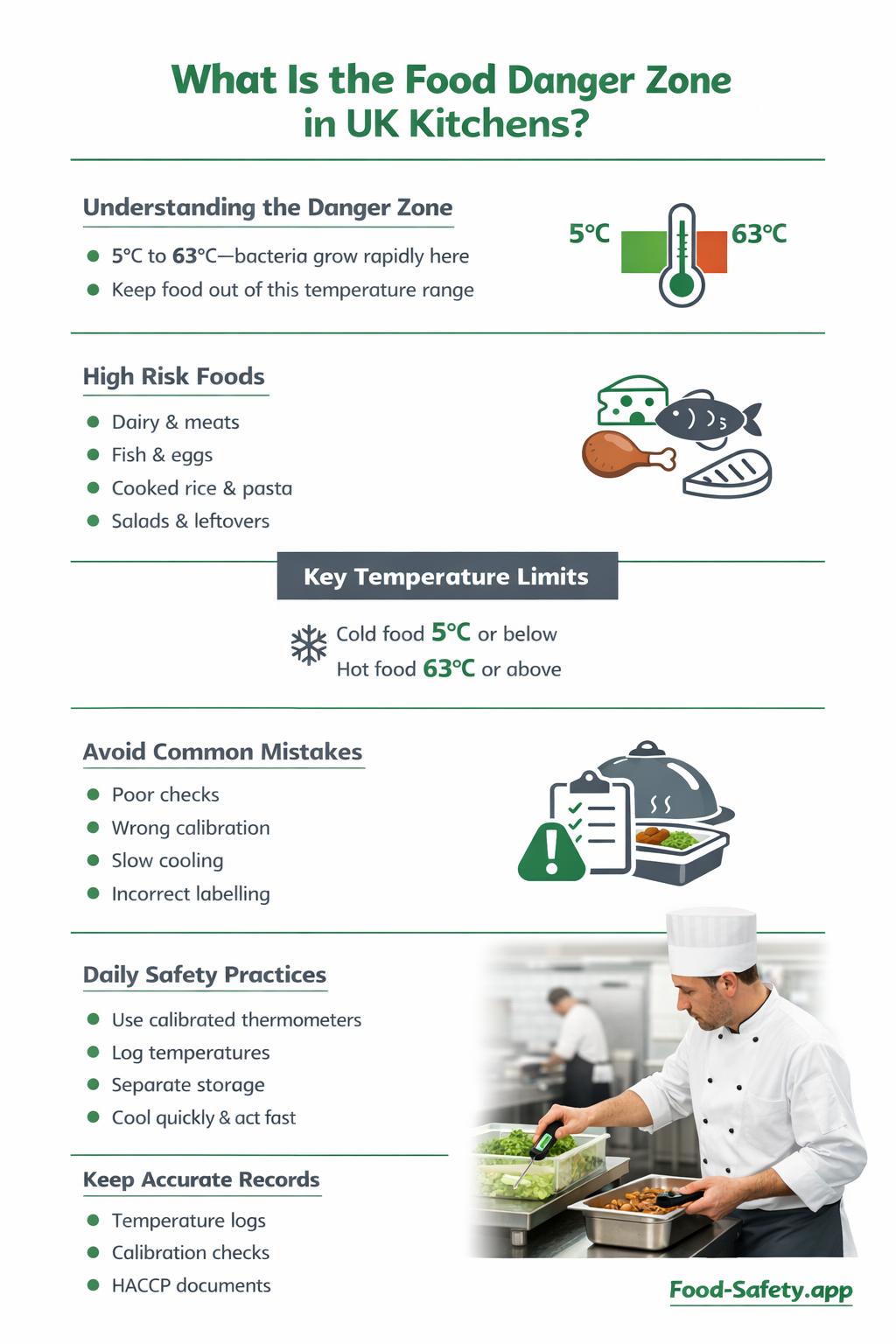
The food danger zone is the temperature range where harmful bacteria can multiply more quickly on food. In UK kitchens, that usually means keeping cold food cold and hot food hot, with extra care during prep, cooking, cooling, holding, and transport. The exact guidance can vary a little by country, but for UK food businesses the key idea is the same: do not leave perishable food sitting in the middle for longer than necessary.
In practical terms, the danger zone matters for anything high risk, such as cooked rice, sliced meat, dairy-based fillings, cooked poultry, gravies, soups, ready-to-eat salads, and desserts that contain cream or eggs. If these foods spend too long at room temperature, the risk rises fast, especially in warm prep rooms, beside ovens, or on crowded service counters. Allergen management is essential in busy kitchens; see Allergen management made practical for UK food businesses.
For official UK guidance on safe temperatures and food hygiene, see the Food Standards Agency. For practical daily checks, see fridge temperature monitoring.
Why it matters in a professional kitchen
In a domestic kitchen, a missed temperature check might be inconvenient. In a restaurant, hotel kitchen, school canteen, takeaway, or contract caterer, it can affect dozens or even hundreds of meals. The food danger zone in UK kitchens is important because staff are often juggling prep, deliveries, allergens, equipment limits, and a busy service all at once.
Common failure points include:
- Cold ingredients being left out while mise en place is finished.
- Cooked food cooling too slowly because trays are too deep or stacked too tightly.
- Hot holding units being overloaded during service.
- Food being reheated unevenly, leaving cold spots.
- Probe thermometers not being cleaned between checks.
Cross contamination is a major concern; see Cross contamination and food safety management.
These are not unusual mistakes. They happen when the kitchen is under pressure. That is why the best control systems are simple, repeatable, and easy for every shift to follow.
Where the danger zone shows up during service
During delivery and storage
The danger zone can begin before prep starts if chilled deliveries are delayed, left in the loading bay, or unloaded into an overfilled fridge. Check chilled items promptly and put them away in the right order. If a delivery arrives warm, damaged, or with signs that temperature control has failed, treat it as a food safety issue and decide whether it is still fit for use. For ongoing checks on temperature control at delivery, see fridge temperature monitoring.
During prep
Prep tables are often where food spends the longest outside temperature control. Keep small batches out rather than lining up large volumes. Work on one tray at a time, return ingredients to the fridge when not in use, and avoid leaving high-risk foods out while staff are distracted by orders or equipment changes.
During cooking and reheating
Cooking should bring food to a safe temperature throughout, but the risk returns if the process is rushed or uneven. In batch cooking, the middle of the product is what matters. Thick sauces, casseroles, and bulk trays need careful checking, not just a quick glance at the surface.
During hot holding
Hot holding is not the same as cooking. If food sits too long below the right holding temperature, it may drift into the danger zone while still looking and smelling fine. Stir soups and sauces regularly, keep lids on where appropriate, and do not overcrowd bain-maries or hot cabinets.
During cooling
Cooling is a major weak point in busy kitchens. Large pans of rice, stew, or gravy cool slowly in the centre, which gives bacteria more time to grow. Use shallow containers, smaller portions, and a clear cooling method. Never put huge hot containers straight into the fridge and assume that is enough.
During service and transport
Buffets, deliveries, school service lines, and off-site catering all create extra exposure. Food can move in and out of control when it is plated, transported, displayed, or replenished. Build a routine around time, temperature, and batch size rather than relying on visual checks alone.
Simple temperature checks that work
To control the food danger zone in UK kitchens, a kitchen needs more than a thermometer in a drawer. It needs a clear checking routine that staff can carry out under pressure.
Use a calibrated probe thermometer properly
A probe thermometer is one of the most useful tools in the kitchen, but only if it is clean, accurate, and used correctly. Clean and sanitise the probe before and after use, insert it into the thickest part of the food, and wait for the reading to settle. Take multiple checks for large batches.
Check at the right times
- On receipt of chilled and frozen deliveries.
- After cooking, before service.
- During hot holding for long services.
- During cooling, especially for bulk cooked food.
- Before reheated food goes back out.
Know your own critical points
Different menus bring different risks. A hotel breakfast service, a school lunch line, and a takeaway kitchen will not control temperatures in exactly the same way. The point is to identify where your own food is most likely to drift into the danger zone and make those checks non-negotiable.
Watch the whole process, not just one reading
If a hot dish is not holding properly, do not just take one temperature and move on. Look at the pan depth, lid use, stirring, equipment load, and how long it has been there. The reading is a signal, but the cause is usually a process failure.
What to do when food falls into the danger zone
If a check shows food has been in the danger zone longer than it should be, act quickly and consistently. Good kitchens do not guess; they follow a decision and document it.
For hot food
Check whether it can be safely reheated to the correct standard, if the food type and process allow it. If it has already been held too long, discard it. Review whether the hot holding unit was overloaded, set too low, or opened too often.
For chilled food
Return it to refrigeration immediately if it is still suitable. Check how long it was out, and whether the kitchen room temperature made the risk worse. Discard it if time out of control cannot be confirmed or if there is any doubt about safety.
For cooling failures
Split the batch into shallow trays or smaller portions. Move it to a safer cooling method, such as a blast chiller if available. Do not leave large pans to “cool on their own” overnight.
The best corrective action is not only deciding what to do with the food, but also fixing the reason it happened. Otherwise the same mistake will return on the next busy shift.
Good routines for catering teams
Strong temperature control is usually built on small habits that fit the pace of a working kitchen. A few practical routines make a big difference.
Start each shift with a temperature sweep
Check fridges, freezers, hot holding equipment, and any food left from the previous shift. This catches problems before they become service issues.
Batch prep for control, not just speed
It is tempting to prep everything at once, especially in a takeaway or school kitchen. But smaller batches help keep ingredients out of the danger zone for less time. Top up as needed instead of crowding the workstation.
Keep lids, labels, and timers in place
Simple visual controls support temperature checks. Lids help retain heat and reduce contamination. Labels and timers help staff know what has been out, what needs checking, and what should be discarded.
Separate high-risk foods from low-risk tasks
If a chef is plating salads while also handling hot curry pans and checking deliveries, the chance of error rises. Where possible, divide tasks so one person is not trying to control too many temperature-critical jobs at once.
Plan for the busy service
The danger zone becomes more of a problem when the kitchen is short-staffed, the pass is overcrowded, or the dining room suddenly fills. Build in a service plan that includes holding capacity, backup trays, and who is responsible for temperature checks.
To support these practices, a kitchen cleaning schedule in action can help ensure consistent sanitation. See kitchen cleaning schedule in action.
Records, training, and accountability
Written temperature records are useful when they are simple and actually used. A log should help the team spot trends, not create paperwork for the sake of it. Record checks at the key control points, and make sure someone reviews them rather than filing them away and forgetting them.
Training should cover more than the numbers. Staff need to understand why the food danger zone matters, what foods are most at risk, how to use a probe properly, and what to do when something is out of range. A new starter should be able to follow the same routine as a senior chef without needing hand-holding every time. For new staff, consider food safety induction training for new staff.
For businesses that want more reliable oversight, a food safety management system for catering businesses like Food-Safety.app can help bring temperature checks, actions, and records into one place without adding unnecessary complexity.
Key takeaways
The food danger zone in UK kitchens is not just a technical term. It is a practical warning about the time and temperature mistakes that can happen in any commercial kitchen, from cafés to hotel banqueting.
If you want safer service, focus on a few basics: check deliveries, keep prep batches small, monitor hot holding, cool food quickly and correctly, and act fast when a reading is out. The kitchens that stay safest are usually the ones that make temperature control routine, not optional.
When your team knows what the danger zone is, where it appears, and what to do next, you reduce risk without slowing service down. That is good food safety and good business.
Keep temperature checks simple
Food-Safety.app helps catering teams record temperatures, corrective actions, cleaning checks, training records, and daily routines in one simple digital system.