
Training new kitchen staff on day one sets the tone for everything that follows. If the first shift is rushed, confusing, or inconsistent, mistakes tend to carry on into service. A clear day one kitchen staff training plan helps new starters understand the standards, the pace, and the basics of working safely in a professional kitchen from the start. It also protects the business by reducing errors, improving teamwork, and making it easier to spot who needs more support.
For restaurants, cafés, hotel kitchens, school canteens, takeaways, and catering teams, day one should never be just “watch and learn”. It should be structured, practical, and checked properly. The exact approach may vary by business and by country, but in the UK it is sensible to follow current food safety guidance and local procedures for hygiene, allergens, cleaning, and record keeping.
Table of contents
Prepare before the first shift
Good day one kitchen staff training starts before the new starter arrives. If the team is scrambling to find an apron, a knife, or a copy of the menu, the shift begins badly and the new person quickly feels left behind. A few minutes of preparation makes a big difference.
Get these basics ready
Before the shift starts, prepare uniform, apron, hair restraint, safety footwear if required, induction checklist, training notes, a simple site map, key procedures, and a named mentor or supervisor. The new starter should also have a planned rota showing what they will see, do, and practise.
It also helps to match the first shift to the business rhythm. If possible, avoid putting someone brand new straight into the busiest lunchtime without support. A quieter prep period can be a better starting point, followed by controlled exposure to service later on.
Start with a proper welcome and safety brief
The first 15 to 20 minutes should give the new starter confidence and clarity. Keep it simple, direct, and practical. Explain who they report to, how the kitchen works, and what “good” looks like in your business. In a busy service, people need clear direction quickly, not long theory sessions.
Cover these points early
Explain who the supervisor is, how to ask for help, where to store belongings, when to wash hands, how to move safely around hot equipment, sharp tools, and wet floors, and what to do if they feel unwell, injured, or unsure about a task.
Make it clear that asking questions is expected. New staff often stay quiet because they do not want to slow the team down. In practice, that is when small errors become food safety issues, waste, or complaints.
Cover the essential food safety basics
A strong day one kitchen staff training plan always includes the food safety essentials. This should be practical and relevant to the role. A KP, prep assistant, chef de partie, or front-of-house support worker all need different levels of detail, but everyone should understand the basics.
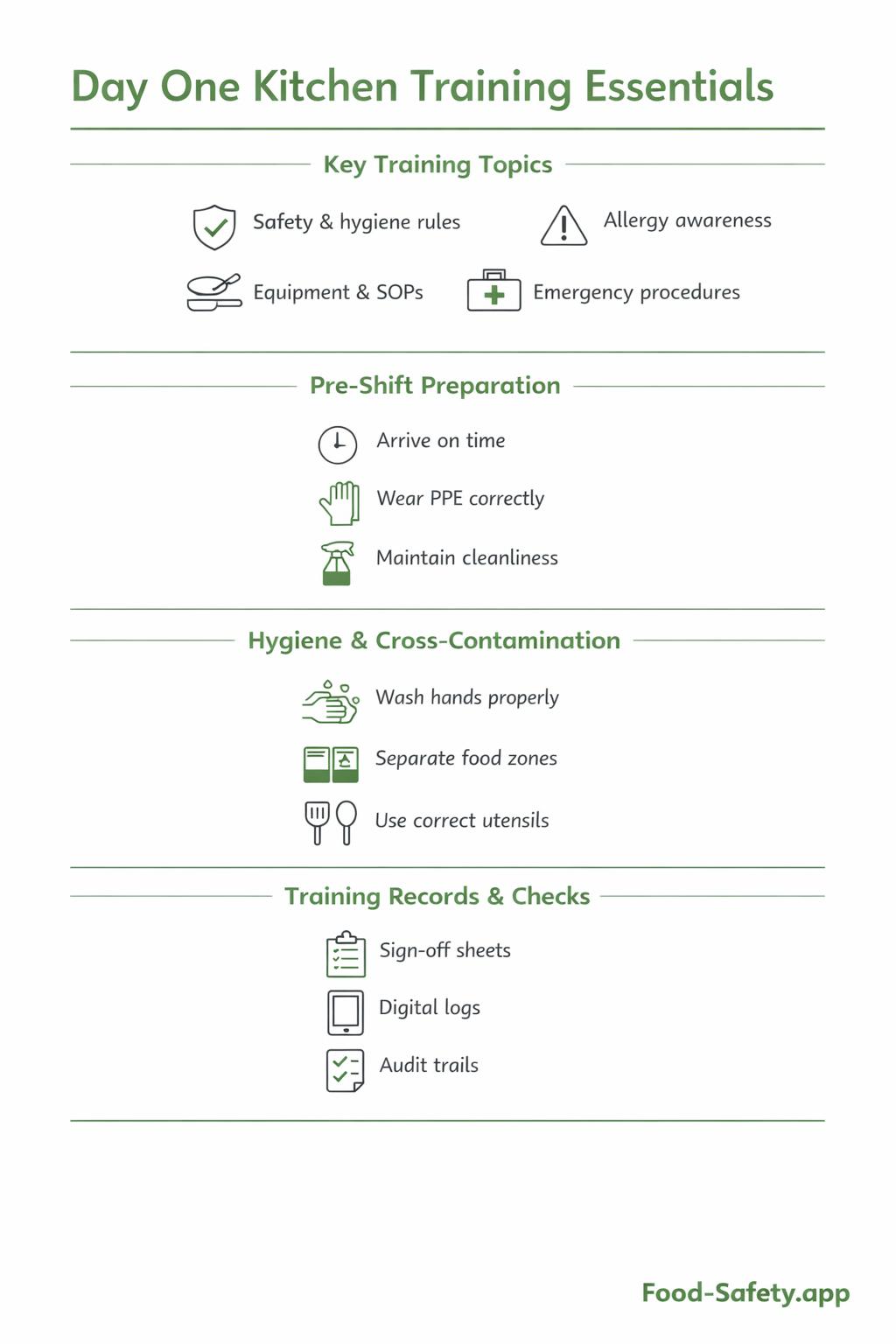
Key topics to include
- Hand hygiene and glove use, including when gloves do not replace handwashing.
- Cross-contamination risks, especially between raw and ready-to-eat foods.
- Cleaning and sanitising routines for work surfaces, tools, and equipment.
- Allergen awareness, including how your kitchen handles allergen communication. Allergen management made practical for UK food businesses.
- Safe storage, labelling, and stock rotation.
- Temperature controls and why food should not be left out unnecessarily.
- Personal hygiene, including cuts, jewellery, illness, and wound covering.
- HACCP principles explained
- Colour-coded chopping boards in use
If your operation serves vulnerable groups, such as schools or care settings, make sure the new starter understands the extra care needed around allergen control, cross-contact, and cleanliness. Even in smaller businesses, a rushed reply to an allergen question can create serious risk. For practical UK guidance, the Food Standards Agency business guidance is a useful place to check current advice.
Use kitchen examples, not just policy
Instead of saying “avoid contamination”, show what that means on the line. For example: raw chicken prep should be separated from salad prep; cloths used on raw areas should not be reused on ready-to-eat areas; and a knife used on raw meat must be cleaned before touching cooked or fresh food. New staff remember what they can see and do far better than abstract rules.
Train by task, not by assumption
One of the biggest mistakes in day one kitchen staff training is expecting a new starter to pick things up just by watching. Watching is useful, but only if it is followed by short, supervised practice. Break tasks into small steps and show them once before asking them to repeat it.
A practical way to train tasks
Explain the task briefly, demonstrate it slowly, ask the new starter to repeat it, correct anything unsafe or inefficient straight away, then repeat later under normal service pressure.
For example, if you are showing stock rotation, do not just point at a shelf. Show how to read the date label, where to place older stock, what to do with damaged packaging, and who to tell if there is a discrepancy. If the task is cleaning a slicer or a mixer, show the safe isolation step, the correct method, and the areas that are commonly missed.
Focus on the first day’s high-risk jobs
Prioritise setting up a prep station safely, reading labels and date marks correctly, portioning simple items without unnecessary contact with ready-to-eat food, cleaning and resetting a station between tasks, and taking customer allergy information accurately.
Do not overload the new starter with every recipe, every supplier, and every piece of equipment on day one. Prioritise the tasks they will actually do in the first shift and the ones that carry the highest food safety risk.
Check learning during service
Training only works if you check it. In a professional kitchen, a new person can look busy without actually understanding what to do. That is why supervisors need to observe, ask short questions, and step in early if something looks wrong.
Good ways to check understanding
Ask them to show where they would wash hands before prep, what they would do if a label is missing, how they would deal with an allergen request, and watch how they store raw and ready-to-eat items.
Keep feedback calm and specific. Instead of saying “that’s wrong”, say “that board is for raw prep, so swap it before you start salad work”. That style of correction is quicker to understand and much better for confidence. If they repeat the same mistake, stop the task, reset the instruction, and watch them do it again.
For formal tracking of training, see Training records.
Look out for warning signs
Watch for signs that they hesitate before every task, copy others without understanding, skip handwashing when busy, cannot explain basic allergen or cleaning steps, or seem lost while trying to hide it. These signs usually mean the training pace is too fast, the instructions were unclear, or the person needs a better mentor. Fix it on the day rather than hoping it improves on its own.
Common day one mistakes to avoid
Many businesses lose time because the first day is too informal. A new starter may be capable, but if the introduction is poor, the whole team feels the effect. Watch out for these common mistakes.
Do not
Do not throw the person straight into service with no proper induction, assume previous experience means they know your procedures, give too many instructions at once, leave them unsupervised too early, use different rules depending on who is on shift, or fail to record what was covered.
Consistency matters. If one chef says one thing and another says something different, the new starter will follow the most confident voice, not necessarily the correct one. Agree the basics as a team and make sure supervisors are giving the same message.
Record the training clearly
Clear records protect the business and help the new starter progress. A simple checklist is often enough on day one, as long as it shows what was covered, what was understood, and what still needs follow-up. This is especially useful in larger kitchens where more than one supervisor may be involved.
What to record
- Date and shift worked.
- Name of trainer and new starter.
- Topics covered, such as hygiene, allergens, cleaning, and equipment.
- Tasks observed and tasks practised.
- Any mistakes or concerns raised.
- What needs revisiting on the next shift.
Keep the wording factual. For example, write “needs more practice on allergen order communication” rather than “not ready”. That gives you a clear action point and avoids vague records that are hard to use later.
If you use digital systems, make sure the information is easy to access for supervisors and managers. A food safety management system for catering businesses, such as Food-Safety.app, can help keep training records, checklists, and follow-up actions organised without relying on loose paper forms.
Set up the next steps after day one
Day one should finish with a short review. Ask the new starter what made sense, what felt unclear, and where they would like more practice. Then explain what will happen next shift so they know training is continuing, not ending.
Useful follow-up actions
Assign a small number of repeat tasks for the next shift, revisit any part of the process they struggled with, check again on handwashing, allergens, and cleaning routines, increase complexity only when the basics are reliable, and include allergen-control training for staff where needed.
In many kitchens, the best staff develop quickly because the first few shifts are structured properly. They are shown the standard, watched while they practise it, and corrected before bad habits settle in. That approach saves time later and gives the team more confidence during busy service.
Conclusion
Effective day one kitchen staff training is not about cramming in everything at once. It is about giving new starters a calm introduction, showing them the non-negotiable food safety basics, and checking that they can actually do the tasks safely. Prepare before the shift, keep the training practical, correct mistakes early, and record what happened. That combination helps new staff settle in faster and supports safer, smoother service from the start. Building a strong safety culture also includes implementing robust food safety systems in place.
Make staff training easier
Food-Safety.app helps catering teams keep training records, daily checks, allergen controls, cleaning routines, and follow-up actions organised in one simple digital system.