Know what to do when a customer reports food poisoning. Learn the first checks records and actions that help small businesses respond properly and fast.
Take the report seriously and capture initial details
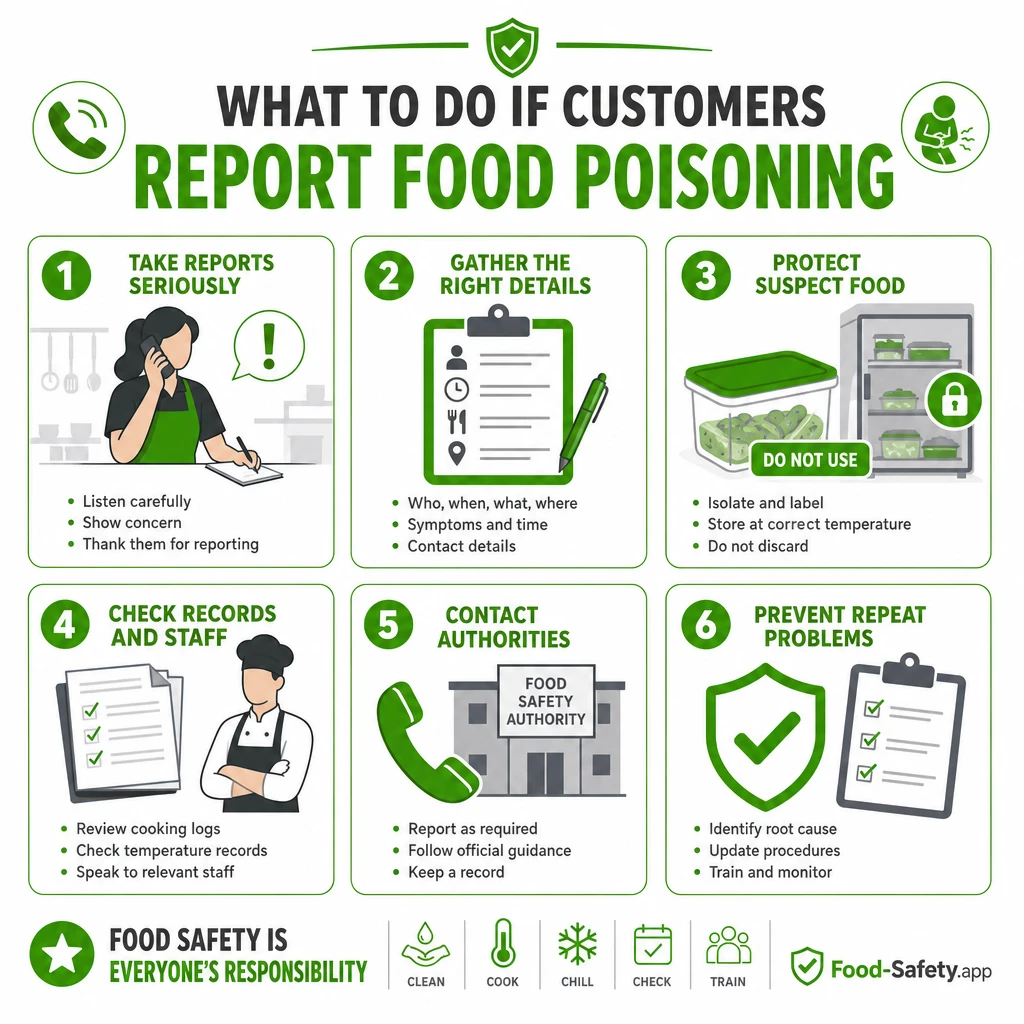
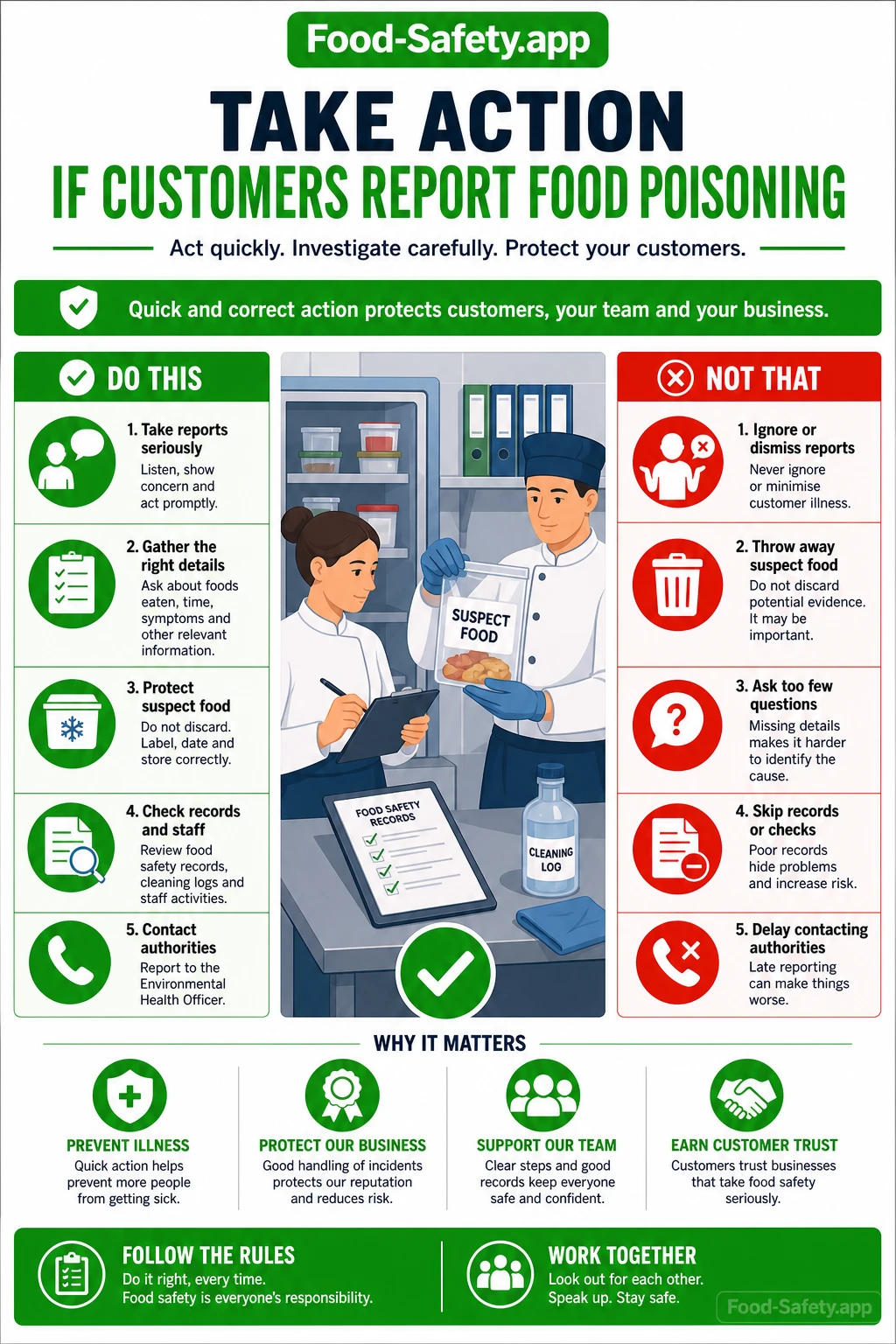
Treat every customer report as potentially serious. Record the time and date of the report, customer contact details, what was eaten, and the symptoms described. Capture the exact meal or service context (buffet, formal service, delivery) and whether others are affected. This foundation supports timely investigations and helps demonstrate due diligence to inspectors.
What to capture immediately
- Customer name and contact details
- Date and time of the meal or service
- Items consumed and approximate portion sizes
- Onset time of symptoms and severity
- Other people affected and service context (eat-in, takeaway, or event)
- Staff on duty and any unusual events (power outage, equipment fault, delays)
Gather useful information from the customer
Ask clear, open questions to build a concise timeline. Clarify what else was eaten, where the meal was sourced, and whether any other venues served the same dish. This helps separate potential foodborne causes from, for example, seasonal illnesses or unrelated factors.
Key questions to ask
- When was the meal consumed, and when did symptoms start?
- What specific items were eaten, and were there any ingredients that differ from usual?
- Did others who shared the same dish become unwell?
- Was the food fully consumed or leftover portions retained?
- Were there any delivery or service issues (late delivery, temperature concerns)?
Protect evidence and suspect items
Preserve evidence to support an investigation. Do not discard suspect foods or packaging before an authorised review. Maintain the cold chain for refrigerated items and label any remaining portions with date, time, and item details. Collect batch codes, supplier information, and opening or use-by dates where possible. See cross-contamination guidance.
What to secure and how
- Suspect food, packaging, and any labels or placards
- All remaining portions and any leftovers if permissible
- Batch numbers, lot codes, and supplier invoices
- Delivery notes and temperature probes used during service
- Cleaning and sanitising records related to the area where the food was prepared
Check cooking, cooling, cold storage, and service records
Review recent records to identify temperature control failures, timing gaps, or missed steps. Focus on cooking temps, cooling times, hot holding, cold storage temperatures, and delivery checks. Also review opening and closing checks, cleaning schedules, pest control records, and probe calibration data to spot potential weak points.
Routine checks to review
- Temperature logs for fridges, freezers, and hot-held items
- Open and close checks and shift handovers
- Cooking, cooling, and reheating procedures
- Deliveries and stand-down temperatures on arrival
- Cleaning, sanitising, and frequency of task completion
- Probe calibration records and equipment maintenance
- Pest control and waste management records
| Record type | Why it matters | What to verify |
|---|---|---|
| Temperature logs | Confirms safe holding and rapid cooling | Last 24 hours of readings, any excursions |
| Opening/closing checks | Reveals potential missed tasks | Staff initials, completed items, anomalies |
| Cleaning records | Links to surface hygiene and cross-contamination risk | Areas cleaned, date/time, cleaners |
| Probe calibration | Ensures measurement accuracy | Last calibration date and method |
Review staff hygiene, sickness reporting, and controls
Assess how hygiene practices were applied during the service. Verify staff health declarations, sickness reporting policies, and adherence to handwashing, glove use, and utensil handling. Weakness in hygiene controls or undocumented sickness can contribute to incidents and affect inspection outcomes.
What good practice looks like
- Clear sickness reporting policy and prompt staff exclusion when needed
- Validated handwashing and glove-use procedures
- Regular hygiene audits and spot checks during service
- Training records for food safety and allergen awareness
When to escalate to Environmental Health or the local authority
Escalate when there is strong evidence of a food safety risk, persistent issues, or repeat reports from different customers. Early escalation supports rapid investigation and helps protect public health. Maintain a clear trail of actions, communications, and responses to aid any subsequent authority review. For authoritative guidance on reporting and escalation procedures, consult the authoritative guidance.
Escalation criteria and process
- Unreliable temperature control linked to confirmed illness
- Multiple similar reports from separate customers
- Suspected cross-contamination or serious hygiene failures
- Incomplete or missing records despite follow-up requests
Record everything in a structured way and look for prevention
Document the incident in a structured log that tracks actions, decisions, and timelines. Identify what went wrong and implement practical controls to prevent recurrence. A consistent approach helps future audits, staff training, and service continuity.
Structured incident record tips
- Use a single incident file with dates, times, and responsible staff
- Log corrective actions, responsible person, and target dates
- Keep copies of any lab results, supplier communications, and delivery notes
- Review the incident after action to capture lessons learned
Identify what went wrong and put controls in place to stop it happening again
Turn findings into practical controls. Update procedures, refresh training, and adjust checking routines. For example, if a buffet item was left out too long, implement stricter time limits and display warnings. If a fridge fault is identified, enforce proactive temperature monitoring and quicker fault reporting. Turn insights into tangible improvements in the kitchen workflow.
Practical scenarios and ongoing improvement
Operational scenarios help teams apply learning. Consider these common patterns and the corresponding controls:
- A customer reports illness after a buffet item left out too long — review standby times, reinforce food display rules, and tighten service checks.
- Several guests fall ill after a wedding or event service — trace batch codes, verify supplier compliance, and train staff on rapid response if symptoms appear.
- A delivery issue is suspected after chilled food arrives warm — enhance supplier temperature verification and temperature monitoring on arrival.
- A fridge fault is linked to unsafe storage temperatures — implement proactive fridge maintenance and continuous temperature monitoring with alert thresholds.
- A missing cleaning task may have affected a prep area — strengthen opening/closing checks and cross-contamination controls in prep zones.
Food-Safety.app, a food safety management system for catering businesses, supports incident logging, temperature and hygiene record storage, corrective-action tracking, and quick evidence export for investigation and inspection.
Further resources for incident management
Access practical guidance on logging incidents, analysing causes, and implementing effective prevention measures for your kitchen operations, and maintaining compliance with food safety regulations.