If you run a small food business, you’ve probably asked yourself whether you really need HACCP or whether that sounds like something only the big chains with shiny clipboards and endless paperwork need. The short answer is: yes, you need food safety management based on HACCP principles, but that does not always mean a giant, complicated document set. For many small businesses, a simple HACCP based system or Safer Food, Better Business style paperwork is enough, provided it is suitable for what you do and actually works in the kitchen.
In the UK, the key question is not “do I have a massive HACCP plan?” but “can I show I understand my food safety hazards and control them properly?” That matters whether you’re running a café, takeaway, school kitchen, hotel breakfast service, or a small catering operation where the fryers never seem to cool down for five minutes.
What HACCP means for small food businesses
HACCP stands for Hazard Analysis and Critical Control Points. In plain English, it means looking at your food process step by step, spotting where things could go wrong, and putting controls in place to stop unsafe food reaching customers.
For a small food business, that might mean checking delivery temperatures, separating raw and ready-to-eat foods, cooking thoroughly, cooling food safely, and keeping hot food hot. Nothing glamorous. Nothing that makes the front of house team clap. But it’s the sort of thing that keeps customers safe and protects your business.
The important bit is that HACCP is not meant to be paperwork for paperwork’s sake. It is meant to match what happens in your commercial kitchen during a busy service, when the oven timer is beeping, the delivery van has just arrived, and someone is asking where the clean tongs have gone.
Do small food businesses really need HACCP
Yes, but usually not in the form of a huge, fully customised food safety manual unless your operation is complex. In the UK, food businesses are expected to have food safety management procedures based on HACCP principles. For many small businesses, that can be done through a simpler, practical system.
The size of the business does not remove the duty. A tiny café with one chef and two servers still has risks. So does a takeaway with limited menu items but high-volume production. The difference is how complicated the controls need to be.
A small business may only need:
- Clear daily checks
- Simple temperature records
- Cleaning schedules
- Allergen management
- Training that staff can actually follow
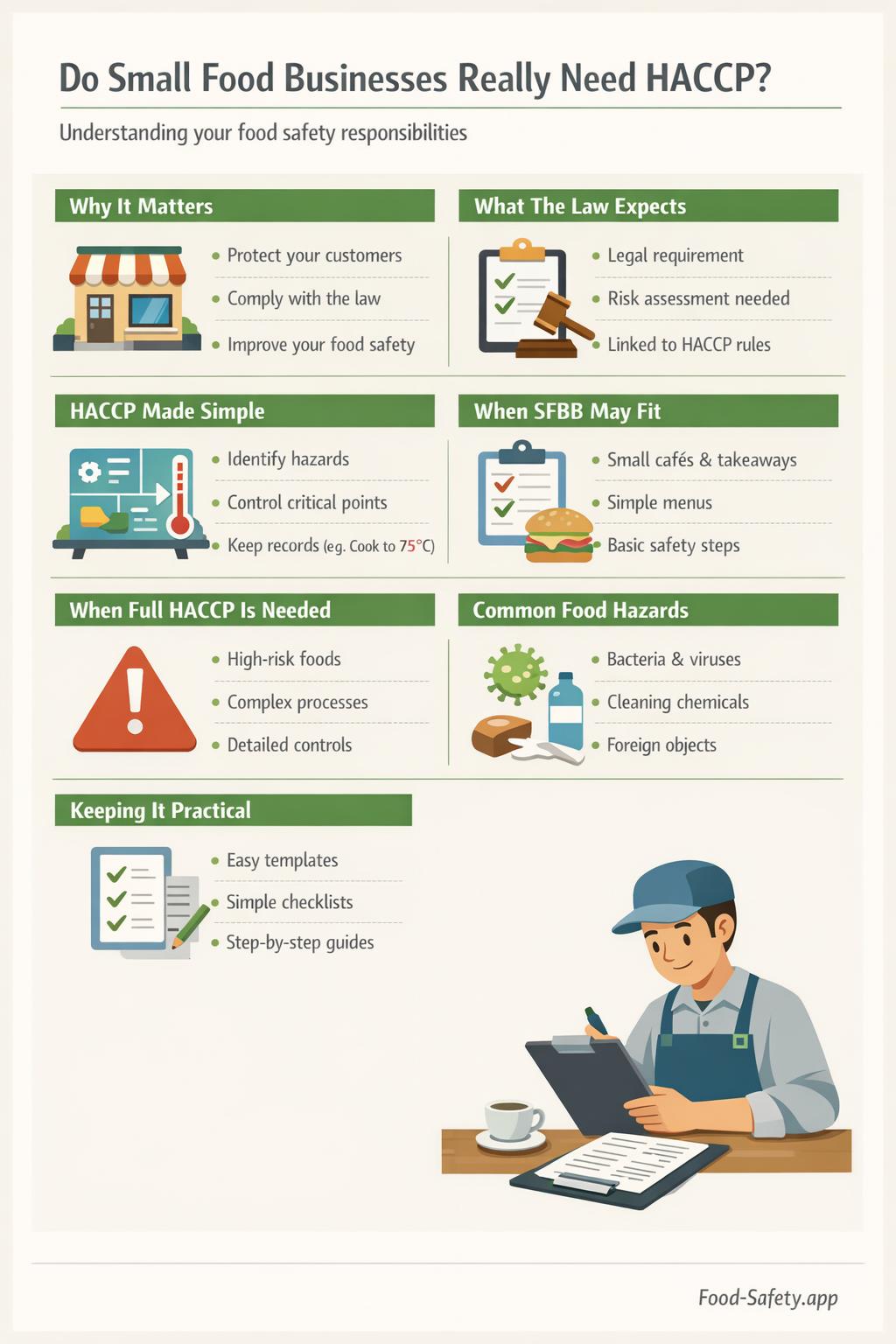
If your menu is straightforward and your processes are stable, a simpler system is often perfectly acceptable. If you cook, chill, reheat, display, transport, and serve a wide range of high-risk foods, you’ll need a more detailed approach. The size of the venue matters less than the risk in the process.
When a simple HACCP based system is enough
A simple HACCP based system is usually enough when your business is low to medium risk and your food handling is not overly complicated. For example:
- A café making sandwiches, soups, and light lunches
- A small takeaway with a focused menu
- A school canteen using defined recipes and set prep routines
- A hotel breakfast kitchen with predictable service patterns
- A caterer using a limited number of proven menus
What makes it work is consistency. If your team does the same tasks in the same way every day, your controls are easier to manage. You do not need a novel. You need a system that survives a Friday lunch rush and still makes sense on Monday morning.
What simple should still include
- Supplier checks and delivery inspections
- Safe storage and stock rotation
- Cooking, cooling, reheating, and hot holding controls
- Cleaning and disinfection routines
- Allergen management
- Staff training and supervision
If your system only exists in a folder that nobody opens, it is not really a system. It is more of a decorative paperweight.
How SFBB fits in
In the UK, Safer Food, Better Business is a common example of a simple food safety management system designed for smaller food businesses. It helps you record the basics without drowning in admin, which is useful when you have actual food to make and a sink full of pans that seem to multiply overnight.
SFBB can be a good fit if your business is straightforward and the guidance matches your activities. You still need to use it properly, keep records where needed, and adapt it to your menu and risks. If your operation changes, the system should change too.
For a business in Scotland, Wales, or Northern Ireland, the general principle is similar, though details can vary. If you operate outside the UK, requirements may differ, so always check the rules that apply where you trade.
What environmental health officers look for
When an environmental health officer visits, they usually want to see whether your food safety controls make sense and are actually being used. They are not expecting theatre. They are expecting evidence that the business is in control.
They may look at:
- Whether staff understand basic food safety
- Whether temperatures are checked and recorded sensibly
- Whether cleaning is happening properly
- Whether allergens are managed with care
- Whether raw and ready-to-eat foods are separated
- Whether your procedures match what happens on site
If the paperwork says one thing and the kitchen does another, that is where problems start. For example, if your chilled foods are recorded as being within limits but the fridge is packed like a game of Tetris in August, the system is not convincing.
For practical tips on preventing cross-contamination, see How cross-contamination happens and how to stop it.
Good signs they want to see
- Named staff responsible for checks
- Completed records, not blank sheets
- Staff who can explain the basics confidently
- Corrective actions when something goes wrong
What you should document
You do not need to document everything under the sun. But you do need enough paperwork to show control. For most small businesses, the useful records are the ones that support daily operations rather than create admin for its own sake.
Practical records to keep
As part of temperature control, you should have fridge temperature monitoring.
- Delivery checks for chilled and frozen food
- Fridge and freezer temperature checks
- Cooking and reheating checks where relevant
- Cooling records for foods made in advance
- Cleaning schedules
- Staff training records
- Allergen information and cross-contact controls
Just as important is what you do when something goes wrong. If a fridge is warm, move food to a safe unit, check whether any food must be discarded, fix the fault, and record the action. That corrective action is part of HACCP thinking. It shows you are managing risk, not just admiring it from a distance.
Common mistakes small businesses make
One common mistake is assuming that a small menu means no real risk. Even a simple menu can cause trouble if cooking, storage, or allergen control is poor.
Another is buying a generic folder and never adapting it. Every business has its own layout, equipment, team, and service style. A system should reflect that. Otherwise it becomes another thing on the shelf next to the spare aprons and the mysterious jar of pen tops.
Other frequent issues include:
- Missing temperature checks during busy shifts
- Poor separation of raw and ready-to-eat foods
- Unclear allergen communication with customers
- Staff not knowing what to do if a control fails
- Cleaning records signed off without the cleaning being done properly
A practical compliance checklist
If you want to know whether your business is on the right track, ask yourself these questions:
- Do we know our main food safety risks?
- Are our controls simple enough for staff to follow during service?
- Do we check fridges, freezers, and deliveries regularly?
- Do we have clear allergen controls and communication?
- Do we clean, record, and review properly?
- Do we take action when something is out of spec?
If the answer to any of those is “not really”, that is your starting point. Food safety is much easier to manage when the system is realistic, and much harder when everyone is pretending the spreadsheet is the same as the kitchen.
Final takeaways
So, do small food businesses really need HACCP? Yes, but usually as a practical, scaled-down food safety management system based on HACCP principles rather than a huge formal package. If your controls are sensible, documented where needed, and actually used by staff, you are far more likely to meet your legal duties and keep customers safe.
Focus on the basics that matter most: safe temperatures, good hygiene, proper separation, allergen control, and clear corrective action when something slips. For many businesses, that approach is enough to stay compliant without turning the kitchen office into a paper factory.
If you want a simple way to organise food safety procedures, Food-Safety.app is a food safety management system for catering businesses that can help structure the day-to-day side of compliance. A well-run system should make service smoother, not more painful.
For UK operators, the safest path is to build a system that fits your actual menu, team, and service style. Keep it simple where you can, detailed where you must, and always make sure it works in the middle of a busy service, not just on a quiet Tuesday with no covers booked.
For further official guidance in the UK, the Food Standards Agency is a useful place to check current expectations.
Organise food safety procedures simply
A simple practical system helps small kitchens stay compliant without drowning in paperwork. With clear workflows, built in HACCP logic, and ready to use templates, Food-Safety.app guides teams through daily checks, corrective actions, and records, easing audits and everyday service.