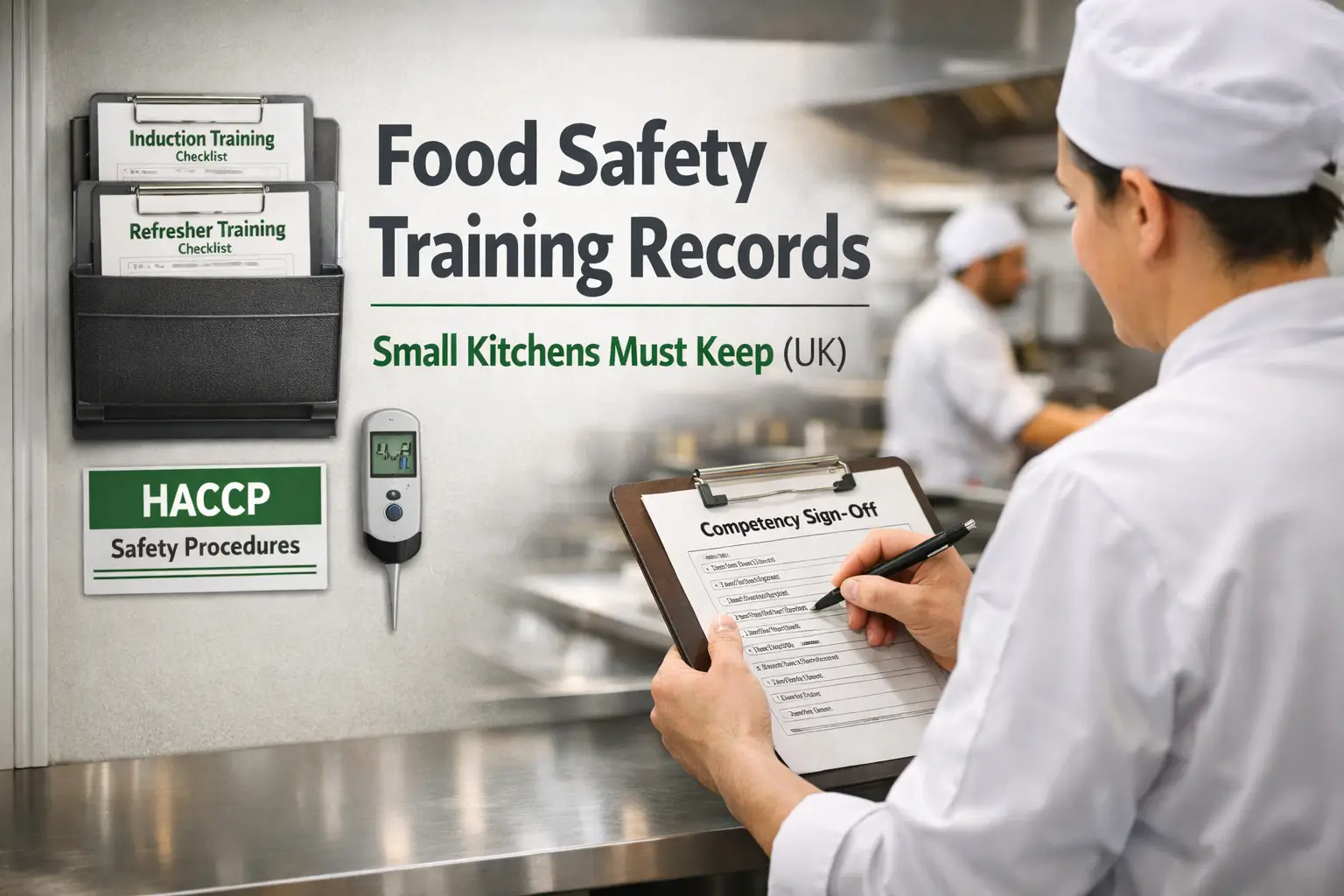
Staff in small kitchens often juggle many tasks at once. Keeping robust training records helps you show inspections you’ve prepared your team to handle hygiene tasks correctly, not just that you briefed them once. Clear evidence also supports day-to-day accountability, staff confidence, and consistent service during busy shifts.
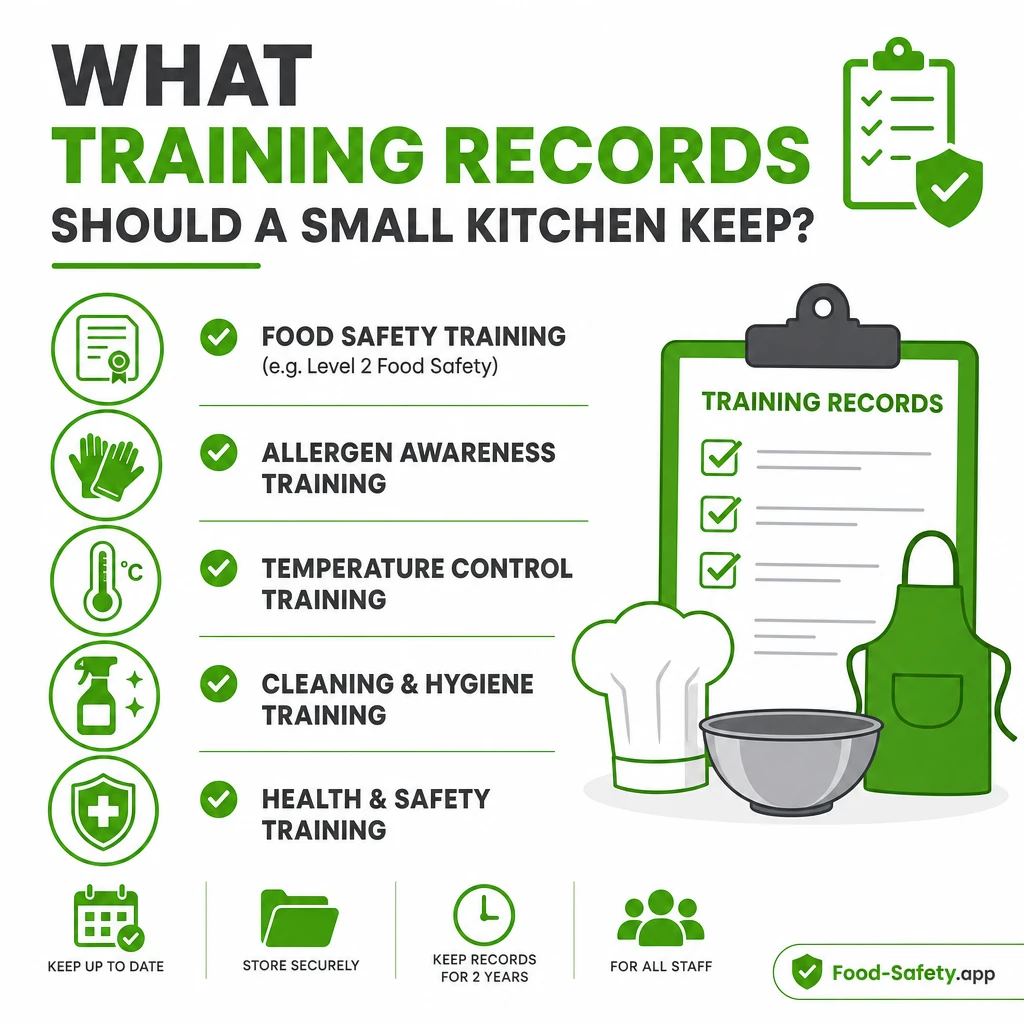
This article outlines what training records you should keep, why they matter, and practical formats you can deploy. It covers induction basics, triggers for refreshers, role-specific checks, how to prove understanding, and how to store everything in a practical, audit-friendly way. It also explains how Food-Safety.app can help you manage these records efficiently.
In the UK, inspections look for a clear picture of how you brief, supervise, and assess staff on food safety tasks. The guidance below emphasises practical proof of competency and ongoing competence, with a focus on everyday operations rather than theoretical training alone.
Evidence of briefing, supervision and assessment shows staff can perform tasks safely, not just that they were told once.
Why training evidence matters
Training records are the backbone of an auditable safety culture; they translate what was learned into consistent action on the passable line during service.
Training records are a concise, auditable trail that staff have been briefed, supervised and assessed on key food safety tasks. They help you demonstrate control of hazards over time, not merely a one-off conversation. Well-maintained records support decisions during inspections, provide reassurance for managers and owners, and aid staff transitions when personnel change roles or shifts.
They also help you manage risk: if a defect, near miss or deviation occurs, a dated record showing the corrective training or rebriefing can contextualise the incident and guide improvements. In small kitchens, where teams are tight and turnover can be high, a clear record-keeping routine reduces ambiguity and protects both staff and the business.
A dated, signed record that links to the staff member’s role makes it straightforward to show what was covered and when competence was checked.
Induction basics
Induction should be practical and observable, not a single verbal briefing. Observe opening checks and confirm understanding.
Induction should lay the foundations for safe practice and open channels for ongoing learning. Core topics typically include hygiene rules, handwashing, cross-contamination prevention, allergens, temperature checks, cleaning schedules, reporting defects, and pest awareness. The aim is to establish consistent starting points for every new recruit.
Induction formats can range from short, practical sessions to a checklist completed with a supervisor. In busy kitchens, pairing a compact 15-minute briefing with a practical check on opening duties often proves most effective.
Key induction evidence you might keep:
- Induction checklist completed and signed
- Names of trainers and dates
- Specific competencies demonstrated (e.g., correct handwashing technique, temperature monitoring)
- Any notes on immediate follow-up actions
Refresher triggers
Refresher training should occur when changes happen (menu, equipment, roles) or after incidents; document triggers and dates.
Regular refreshers reinforce learning and adapt to changes. Trigger scenarios include new menu items, new equipment, a change in job role, incidents or near misses, failed checks, inspection feedback, or a long gap since the last training event.
Identify and record triggers to ensure timely rebriefing. A simple policy might specify refresher training whenever a lead hazard changes or a critical control step is updated.
Practical triggers to track in records:
- New equipment or calibration procedures
- Introduction of allergy information changes
- Revisions to critical control points (CCPs) or time-temperature guidelines
- Post-incident reviews or corrective actions
- Seasonal staff onboarding after the off-season
Role-specific checks
Competence should be demonstrated, not assumed: short Q&A, observation, signed competency check, and follow-up review if needed.
Different roles warrant different checks to ensure competency across the operation. Common roles include chefs or cooks, kitchen porters (KP), front-of-house staff, delivery drivers, supervisors, and managers. Each role has distinct responsibilities in hygiene, allergen handling, cross-contamination prevention, and temperature control.
Typical role-focused competencies:
- Chef/cook: proper cooling and reheating, avoiding cross-contact between raw and ready-to-eat foods
- KP: cleanliness of work surfaces, waste disposal, basic hygiene routines
- Front-of-house: allergen awareness, questions handling, clean utensil management
- Delivery staff: safe transport, temperature control on delivery routes
- Supervisor/manager: oversight of training, corrective actions, and incident logging
Proving understanding
The safest procedure is the one that can be followed consistently during a busy service.
Proving understanding goes beyond completion of a training module. Methods should be practical, observable, and linked to day-to-day tasks. Consider a mix of short question-and-answer checks, direct observation during shifts, and signed competency sign-offs. Follow-up reviews help confirm retention over time, particularly after menu changes or new equipment.
Evidence formats you can use:
- Short Q&A sheets linked to each role
- Observation checklists logged by a supervisor
- Competency sign-off forms with dates and reviewer identity
- Brief follow-up notes after the first week of handling a new task
Easy record formats
Induction should be practical and observable, not a single verbal briefing. Observe opening checks and confirm understanding.
Keeping records simple and accessible improves compliance. Several practical formats work well for small kitchens:
- Induction checklist: basic topics, signatures, and date
- Training matrix: a grid showing staff, roles, and completed training items
- Refresher log: dates and topics of refreshers per individual
- Competency sign-off: formal confirmation that tasks were understood and can be performed
- Toolbox talk record: notes from short, on-shift briefings (often used for quick updates)
A compact, legible format should capture:
- who trained whom
- what was covered
- when competence was checked
- where in the kitchen the tasks apply (role-linked)
- any required follow-up actions
Practical examples or scenarios
Training records are most useful when they clearly tie to a role and a task, and show ongoing validation.
Real-world examples help you tailor records to routine operations:
- New starter in a busy lunch kitchen receives a 15-minute induction and is observed performing opening checks correctly
- A cook is retrained on cooling and reheating procedures after moving to a different section
- Front-of-house staff are briefed on allergen questions and given access to current menu allergen information
- A supervisor records a refresher after a probe calibration issue or a fridge temperature alarm
- Seasonal staff are signed off before handling ready-to-eat foods
Structured notes from these scenarios improve traceability during inspections and staff reviews. They also demonstrate that training aligns with the kitchen’s HACCP plan and daily checks.
Training records are most useful when they clearly tie to a role and a task, and show ongoing validation.
Compliance and operational focus
A well-maintained training record system reduces guesswork for managers and shields the business where procedures were correctly followed.
Operational focus helps teams run smoothly while staying auditable. Key practices include:
- Keep records dated, signed, and linked to each staff member’s role
- Record what was covered, who trained them, and when competence was checked
- Use evidence that is easy to present during a food hygiene inspection
- Review training after incidents, audits, menu changes, or staff turnover
- Keep training records alongside HACCP and daily checks for a full audit trail
This clarity supports consistent practice across shifts and helps in staff development discussions, audits, and investigations if something goes wrong.
Using a digital training-record system keeps an auditable history, supports inspections, and helps with staff turnover.
Promoting with Food-Safety.app
Using a digital training-record system keeps an auditable history, supports inspections, and helps with staff turnover.
A purpose-built record system can simplify everything described above. Food-Safety.app offers a practical way to store training records, track role-specific checks, and maintain a straightforward digital history that’s easy to review for inspections and internal audits. Features you might highlight:
- Offline access for on-site updates and quick evidence gathering
- Automatic timestamps and signer identity to reduce administrative lag
- Exportable records for inspections and handovers
- A linked history that pairs training with daily checks, HACCP steps, and incident reporting
Using a dedicated platform helps small kitchens stay organised without comprising on compliance or speed of service.
Explore Food-Safety.app
Using a digital training-record system keeps an auditable history, supports inspections, and helps with staff turnover.