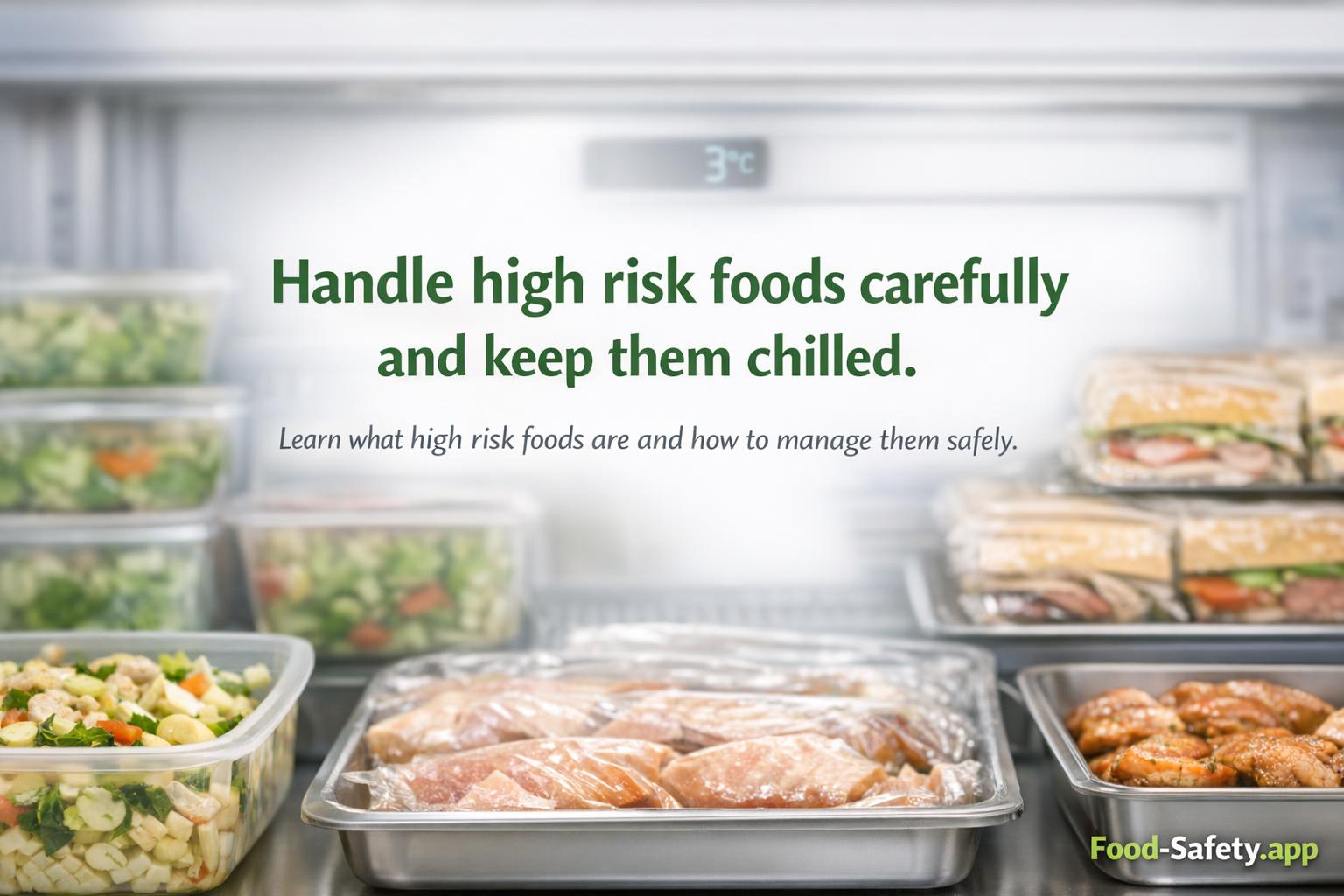
High risk foods are ready-to-eat items that support the growth of pathogenic bacteria and require strict temperature control to remain safe. In a professional kitchen, these foods are the primary cause of foodborne illness because they do not undergo a further “kill step” (cooking) before reaching the customer.
What makes a food high risk?
Bacteria require specific conditions to multiply rapidly. High risk foods typically share three characteristics:
- High protein content: Provides the nutrients bacteria need to grow.
- High moisture content (Water Activity): Bacteria cannot grow in bone-dry environments.
- Neutral pH: Bacteria struggle in highly acidic (lemon juice/vinegar) or highly alkaline environments.
Because these foods are “ready-to-eat” (RTE), any contamination introduced during preparation stays with the food until consumption. Understanding this is the foundation of HACCP principles explained.
The high risk food list
In a commercial kitchen, you must categorise your inventory to ensure appropriate storage and handling. Common high risk foods include:
- Cooked meats and poultry: Including sliced deli meats, pâtés, and terrines.
- Dairy and egg products: Soft cheeses, cream, custards, and dishes containing raw or lightly cooked eggs (e.g., mousse or hollandaise).
- Prepared seafood: Cooked prawns, smoked salmon, and sushi-grade raw fish once processed.
- Cooked starches: Rice, pasta, couscous, and quinoa. These are often overlooked but are high risk due to Bacillus cereus spores.
- Prepared produce: Pre-cut melons, bagged salads, sprouted seeds, and coleslaws.
- Sauces and stocks: Gravies, meat-based stocks, and vegetable purees.
Managing the temperature danger zone
The “danger zone” is between 5°C and 63°C. Within this range, a single bacterium can multiply into millions in just a few hours. To manage this in a busy service, follow these strict limits:
Chilled storage
While the legal limit for chilled food in the UK is 8°C, professional kitchens should target 5°C or below. This 3-degree buffer accounts for frequent door opening during service. Use a fridge temperature monitoring log to verify units at least twice daily.
The 2-hour and 4-hour rule
If high risk foods are removed from refrigeration for preparation or display:
- Under 2 hours: The food can be used or returned to the fridge.
- Between 2 and 4 hours: The food must be consumed immediately; it cannot be returned to the fridge.
- Over 4 hours: The food must be discarded.
Operational controls: Delivery to service
Safety is maintained through a series of “critical control points” during the food’s journey through the kitchen.
1. Delivery and intake
Never accept high risk foods if the delivery vehicle is not chilled or if the food arrives above 8°C. Check for “blown” packaging (a sign of gas production from bacterial growth) and move items to cold storage within 15 minutes of arrival.
2. Fast cooling (The 90-minute rule)
Large batches of high risk food, such as stocks or roasted meats, must be cooled from 60°C to 5°C as quickly as possible. In a professional kitchen, do not simply put a hot pot in the walk-in fridge; this raises the ambient temperature and risks other food. Instead:
- Use a blast chiller.
- Divide food into shallow GN pans (max 50mm deep).
- Use ice baths or “ice paddles” to stir liquids.
- Portion large joints of meat immediately after cooking.
3. Thorough reheating
If reheating high risk foods, they must reach a core temperature of 75°C for 30 seconds (or equivalent, e.g., 70°C for 2 minutes). Only reheat once. Use a calibrated probe and sanitise it before and after every use.
Preventing cross-contamination
Cross-contamination is the physical movement of bacteria from raw sources (like raw chicken or soil on vegetables) to high risk RTE foods.
- Colour coding: Use dedicated equipment for high risk foods. For example, use yellow boards for cooked meats and white boards for dairy/bakery. See colour-coded chopping boards in use for a full breakdown.
- Zoning: If space allows, designate a “High Risk Prep Area” away from the raw meat station and the pot wash.
- Decanting: Never bring external cardboard delivery boxes into high risk prep areas; they carry “outer-packaging” contamination from warehouses and delivery vans.
Shelf life and listeria control
Listeria monocytogenes is a unique hazard because it can grow at refrigeration temperatures. To control it, you must manage “Life of Product”:
- Day of prep + 2: A standard rule for most high risk foods prepared on-site (3 days total).
- Opening dates: When opening a vacuum-packed deli meat, the manufacturer’s “use-by” no longer applies. Apply a new “open life” label based on your food safety management system (usually 48–72 hours).
- FIFO: Strict “First-In, First-Out” rotation is non-negotiable. If a container lacks a date label, discard it immediately.
Corrective actions: What to do when things go wrong
Food safety isn’t just about following rules; it’s about knowing how to react when a limit is breached. Use this framework for common scenarios:
| Scenario | Immediate action | Preventative measure |
|---|---|---|
| Fridge found at 10°C | Probe the food. If above 8°C for unknown time, discard. If below 8°C, move to a working unit. | Service the compressor; check door seals. |
| Rice cooled for 4 hours on bench | Discard immediately. B. cereus toxins are heat-stable and won’t be killed by reheating. | Update cooling log; train staff on blast chiller use. |
| Raw meat juices dripped on cooked ham | Discard the contaminated ham. Sanitise the shelf and all surrounding containers. | Re-organise fridge: Raw on bottom, RTE on top. |
| Soup in bain-marie at 55°C | If under 2 hours, reheat to 75°C and reset. If over 2 hours, discard. | Pre-heat bain-marie before adding hot food. |
Training and record keeping
A “set and forget” approach does not work for high risk foods. Ensure all staff understand the “why” behind the rules. Digital tools can help manage this by sending alerts when fridge temperatures drift or when checks are missed. For managing your team’s compliance, see training records and induction checklists.
By treating high risk foods with the necessary respect—keeping them cold, keeping them covered, and keeping their life short—you protect your customers and ensure your business remains compliant with food safety legislation.