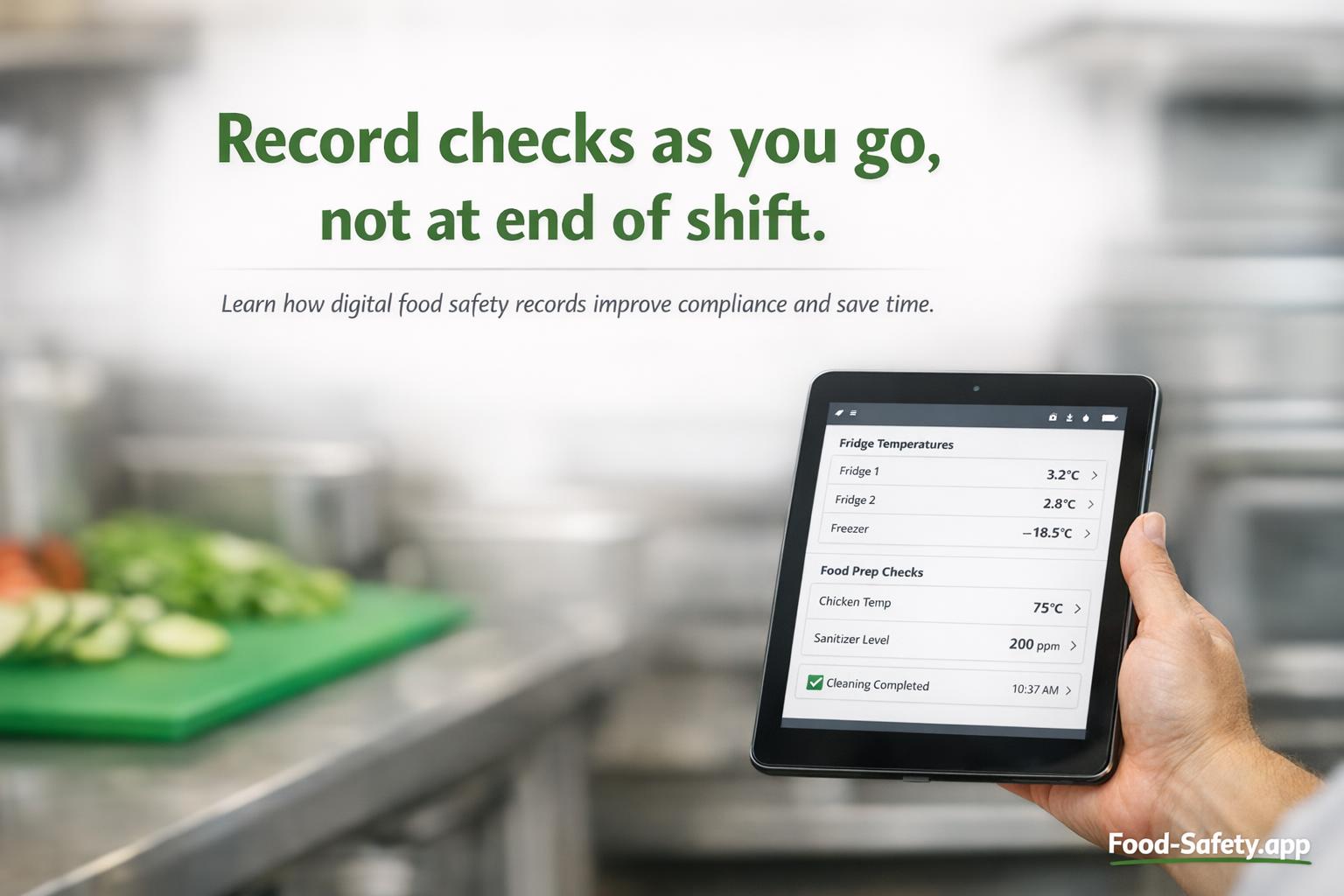
Digital Food Safety Records in Catering and Hospitality
Digital food safety records are becoming a practical way for catering and hospitality businesses to stay organised, reduce paperwork, and keep daily checks visible across busy shifts.
Used properly, digital systems can help teams complete checks faster, improve visibility across operations, and reduce the risk of missing important food safety tasks.
This matters whether you run a restaurant, café, hotel kitchen, school canteen, takeaway, or catering operation. In the UK, records should help demonstrate that food safety controls are working during day-to-day service, not simply stored after the event.
What Are Digital Food Safety Records?
Digital food safety records are electronic versions of the checks and logs used to manage food hygiene and operational safety.
Instead of using paper sheets, staff complete checks on tablets, phones, computers, or dedicated food safety apps.
Typical digital records include:
- Fridge and freezer temperature checks
- Hot holding and cooked food records
- Cleaning schedules and sign-offs
- Delivery inspections for chilled and frozen goods
- Allergen verification and label checks
- Equipment maintenance reports
- Pest sighting logs
- Staff training and competency records
The records themselves are familiar to most kitchens. The main difference is that the information becomes easier to enter, monitor, review, and share across teams or multiple locations.
What Are They Used for in a Commercial Kitchen?
Food safety records exist to prove that controls are being carried out consistently throughout service.
In a busy kitchen, it is easy to lose track of whether a fridge check was completed, whether a cleaning task was signed off, or whether a delivery issue was followed up correctly.
Digital systems help make those tasks visible and traceable.
Example of a practical use case
If a fridge temperature is recorded above safe limits during morning checks, a manager can immediately:
- Move high-risk food to another unit
- Arrange maintenance
- Assess whether food should be discarded
- Record corrective action taken
The important part is not just recording the problem, but also documenting the response.
How Digital Food Safety Records Help
They save time on routine checks
Paper records require printing, filing, checking, and manual review. Digital systems reduce administration so staff can complete checks quickly during service.
They improve consistency
Digital forms can use required fields, dropdowns, and prompts to improve accuracy and reduce incomplete entries.
They make missed checks easier to identify
Managers can quickly spot missing records or failed checks instead of discovering issues later in a paper folder.
They support faster corrective action
Problems can be reviewed in real time, helping teams act quickly before issues escalate.
They improve oversight across multiple sites
For businesses operating across several locations, digital systems make it easier to compare standards, identify repeat issues, and support remote management.
What Should Be Recorded Digitally?
Not every record needs to be digitised immediately, but the most frequent and high-risk checks are usually the best place to start.
Useful records to digitise first
- Opening and closing checks
- Fridge and freezer monitoring
- Cleaning schedules
- Delivery inspections
- Cook, cool, and reheat checks
- Allergen controls and verification
- Maintenance and defect reporting
What every good record should include
- Date and time
- Name of the staff member completing the check
- Equipment or area inspected
- Recorded result
- Issues identified
- Corrective action taken
- Escalation details if needed
A temperature reading alone is rarely enough. Effective records also explain what action was taken when limits were exceeded.
How to Make Digital Records Work During Busy Service
Keep forms short and practical
Checks should take seconds to complete, not minutes. Long forms often lead to poor completion rates.
Place devices where checks happen
If fridge checks happen at prep stations, devices should be accessible there rather than stored elsewhere.
Build checks into normal routines
Opening checks, delivery inspections, mid-shift monitoring, and close-down tasks should all form part of the standard shift flow.
Train staff on corrective action
Teams must understand what to do when checks fail, not just how to enter data into the system.
- Move unsafe food when necessary
- Escalate equipment failures quickly
- Document decisions clearly
- Follow reporting procedures consistently
Common Mistakes to Avoid
Only recording numbers
Without corrective actions, records may fail to show how risks were managed.
Using too many forms
Too many separate forms can slow staff down and reduce compliance during busy periods.
Failing to review records regularly
Managers should review trends, repeated faults, and missed checks frequently.
Assuming digital systems guarantee compliance
Technology supports food safety management, but it does not replace supervision, training, or good hygiene practices.
What to Look for in a Digital System
The best food safety systems are designed around the reality of working kitchens and busy service periods.
Useful features include:
- Simple mobile or tablet access
- Automatic timestamps
- Required fields for critical checks
- Alerts for missed tasks
- Manager reporting dashboards
- Photo uploads for defects and deliveries
- Clear audit trails
Ease of use matters. Systems should fit around kitchen operations rather than interrupt them.
UK guidance and compliance expectations
In the UK, food businesses are expected to maintain suitable food safety records as part of their management procedures.
For official guidance, visit the Food Standards Agency.
Moving from Paper to Digital Records
Most kitchens benefit from introducing digital systems gradually rather than changing everything at once.
A practical rollout approach
- Start with one high-priority process
- Digitise temperature logs or cleaning schedules first
- Keep forms simple and relevant
- Train staff on failed-check procedures
- Test systems during live service
- Review records after the first week
- Adjust workflows where needed
Digital systems should simplify existing processes rather than add unnecessary administration.
Final Thoughts
Digital food safety records are most effective when they help teams complete checks quickly, identify issues early, and clearly document corrective actions.
For restaurants, cafés, hotels, schools, and catering businesses, this can lead to:
- Less paperwork
- Better operational visibility
- Faster corrective action
- Improved consistency across shifts
- Stronger food safety management
Digital tools do not replace good management practices, but they can make food safety systems easier to manage consistently during real-world service conditions.
Upgrade Your Food Safety Records
Replace paper logs with faster, more reliable digital food safety management built for busy catering and hospitality teams.
Track checks, improve compliance visibility, and simplify daily kitchen operations with Food-Safety.app.