Find out how often temperature records should be completed in a small food business so checks stay sensible consistent and strong enough for due diligence.
Table of contents
What needs monitoring
Goods in checks on chilled deliveries
Record temperature readings on delivery in goods-in areas to confirm items arrive within acceptable ranges. Check for temperature integrity before items go into storage, and document any deviations with clear corrective actions. Consistent goods-in checks help prevent unsafe stock from entering the kitchen workflow.
Fridge and freezer temperatures
Regular readings from primary cold storage are essential. Check at opening, during service, and at closing to capture trends and catch drift early. Use a consistent format for notes so that supervisors can review quickly during shifts and for audits.
Cooking probes for high-risk foods
High-risk items should be probed to verify they reach safe internal temperatures during cooking. Use calibrated probes, document the result, and record the time and operator. When cooking results fail, follow your corrective action plan immediately to prevent unsafe service.
Cooling checks
After cooking, record cooling progress for foods destined for chilling or practical use later. Document starting temperatures, cooling duration, and final holding temperatures or stages. Clear cooling records support traceability and reduce the risk of late service issues.
Hot holding checks
During lunch service or buffet periods, monitor hot holding to ensure foods remain in a safe temperature range during display or service. Record checks at key intervals and after equipment adjustments or high traffic periods to confirm stability.
Extra checks after alarms, power cuts or heavy door-opening
Follow emergencies with immediate checks to confirm equipment state and temperatures. Document the incident, actions taken, and any temperatures observed after recovery. Quick rechecks protect against unseen risks when normal routines are disrupted.
How often to check based on risk, volume and the type of food handled
Frequency should reflect actual risk, service volume, and the food type in play. Too-frequent checks for low-risk items waste time; too infrequent checks for high-risk items invite breaches. Use practical patterns aligned to service rhythms to keep records reliable without overburdening staff.
High-risk or high-volume operations
In kitchens handling raw poultry, minced meat, or complex reheating, increase the frequency of temperature checks at critical points: before portioning, during cooking, and after handling high-risk items. Maintain immediate corrective actions and log every exception clearly.
Moderate-risk operations
For items such as ready meals with mixed ingredients or stored but not heavily processed foods, monitor around service windows and after any equipment adjustments. Maintain a consistent record format for easy review by managers and inspectors.
Low-risk or passive storage operations
Where foods are stored in stable conditions and service is lower volume, daily checks may suffice, with added checks after any door openings or alarm events. The aim is to retain a traceable history without unnecessary repetition.
Practical table: frequency by risk
| Risk level | Typical scenario | Suggested frequency |
|---|---|---|
| High | Raw poultry, heavily handled ingredients, high-volume cook-chill | Before service, during service at intervals, after processing |
| Medium | Ready meals with mixed components, semi-prepared foods | Before service and mid-service checks |
| Low | Stable storage of non-high-risk items | Daily checks, plus after equipment events |
When over-recording adds paperwork without improving control
Monitoring becomes counter-productive when checks are duplicative or rarely used for action. Avoid setting rigid, excessive targets that do not improve traceability or response times. Instead, align checks with real control points and ensure each entry supports a clear corrective action if limits are missed.
Signs over-recording harms workflow
- Frequent minor deviations with no documented action
- Checks performed without a clear owner or time reference
- Records that do not feed into a corrective action plan or training updates
How to simplify without losing control
- Use a consistent template and field order for every check
- Log time, item, location, and result succinctly
- Attach corrective actions to any exception and assign ownership
Why timing and format matter for traceability
Consistent timing and a uniform format create a reliable history that inspectors can review quickly. A clear timeline helps identify recurring equipment issues, patterns around service, and opportunities to adjust procedures. Formatting choices matter, too: legible handwriting or a consistent digital template reduces misinterpretation during audits.
Building a simple daily temperature plan for busy shifts
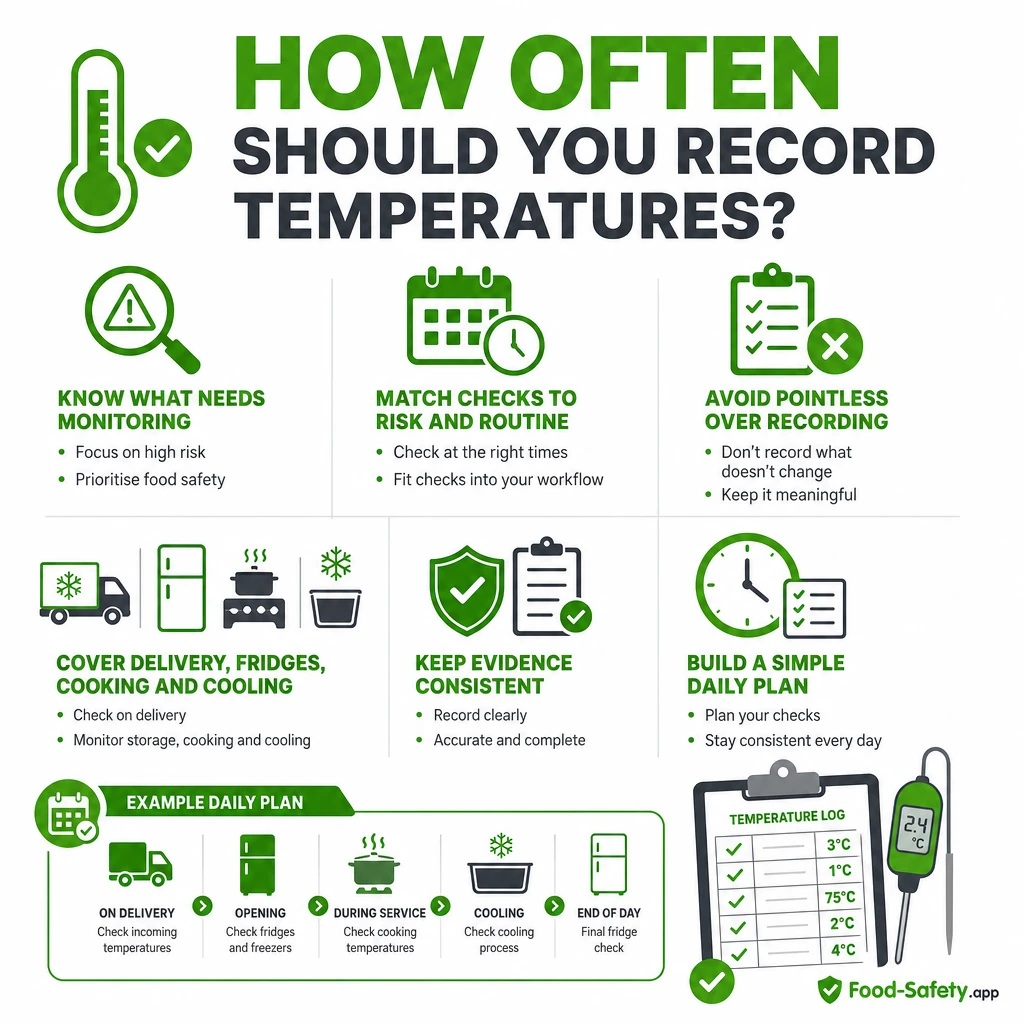
Create a plan that fits your service pattern and staff capacity. Use a standard form or app template for every check, starting with key control points and mapping them to the day’s routine. The aim is a lightweight, repeatable process that delivers trustworthy records for inspections and internal review.
- Define service patterns and storage points that require checks (receiving, fridges, freezers, cooking, cooling, hot holding).
- Assign clear responsibilities to shifts or team members to avoid gaps.
- Use a standard form or app template for every check, capturing time, location, item, and result.
- Set simple corrective actions for out-of-range results and ensure they are followed immediately.
- Review the daily log at shift handover to catch issues early.
- Archive records for audit readiness and trend analysis.
Compliance and operational focus
Keep records automatic, time-stamped, and easy to review. Align checks with HACCP controls and site routines. Record exceptions clearly, including corrective actions when limits are missed. Use a full history view to spot repeat issues with specific equipment and ensure evidence is clear enough for inspections.
Operational habits that support readiness
- Automate where possible to reduce manual entry without sacrificing accuracy
- Ensure staff understand how to log quickly and consistently
- Review logs regularly to identify equipment that needs maintenance or replacement
For official guidance on safe storage and temperatures, see the Food Standards Agency guidance Food Standards Agency.
Food-Safety.app is a food safety management system for catering businesses.
Practical scenarios
Goods in checks on chilled deliveries
Record temperature readings on arrival for perishable items and flag any deviations before loading into storage. Keep a simple log of supplier, item, and condition.
Fridge temperature checks at opening, during service, and at closing
Capture a morning check to establish baseline, mid-service checks for drift, and a closing check to confirm readiness for the next day. Use concise notes and a quick pass/fail result.
Cooking probes for high-risk foods
Probe core temperatures for high-risk foods such as poultry, minced products, and reheated dishes. Document the probe reading, time, and operator. If a target is missed, initiate corrective action and record it.
Cooling checks for cooked foods
Track initial and final cooling steps for meals destined for chilling or reuse. Record temperatures at starts and ends and any duration milestones relevant to your plan.
Hot holding checks during peak service
Monitor a representative sample of hot-held items at intervals during service. Note any temperature drops and adjust service pace or equipment settings as needed.
Extra checks after alarms, power cuts, or heavy door opening
Immediately verify current temperatures and equipment status after disruptions. Document the incident, actions taken, and the updated holding conditions.
Compliance and operational focus
Keep records automatic, time-stamped, and easy to review. Align checks with HACCP controls and site routines. Record exceptions clearly, including corrective actions when limits are missed. Use a full history view to spot repeat issues with specific equipment and ensure evidence is clear enough for inspections.
Operational habits that support readiness
- Automate where possible to reduce manual entry without sacrificing accuracy
- Ensure staff understand how to log quickly and consistently
- Review logs regularly to identify equipment that needs maintenance or replacement
For official guidance on safe storage and temperatures, see the Food Standards Agency guidance Food Standards Agency.
Food-Safety.app is a food safety management system for catering businesses.
Conclusion
Choosing how often to record temperatures is about balancing risk with practical workflow. By focusing on critical control points, keeping records clear and actionable, and aligning with service rhythms, a catering team can protect customers and simplify audits. Start with a simple daily plan, scale as needed, and keep the process as lightweight as possible while remaining robust.
Learn more
Explore how Food-Safety.app can help you automate temperature logging, improve traceability, and simplify audits across small and busy kitchen operations.