Introduction
Colour coding only works when staff use it properly. This guide covers the mistakes that lead to confusion and cross contamination in kitchens
Why colour systems fail in small kitchens
Limited space and shared kit
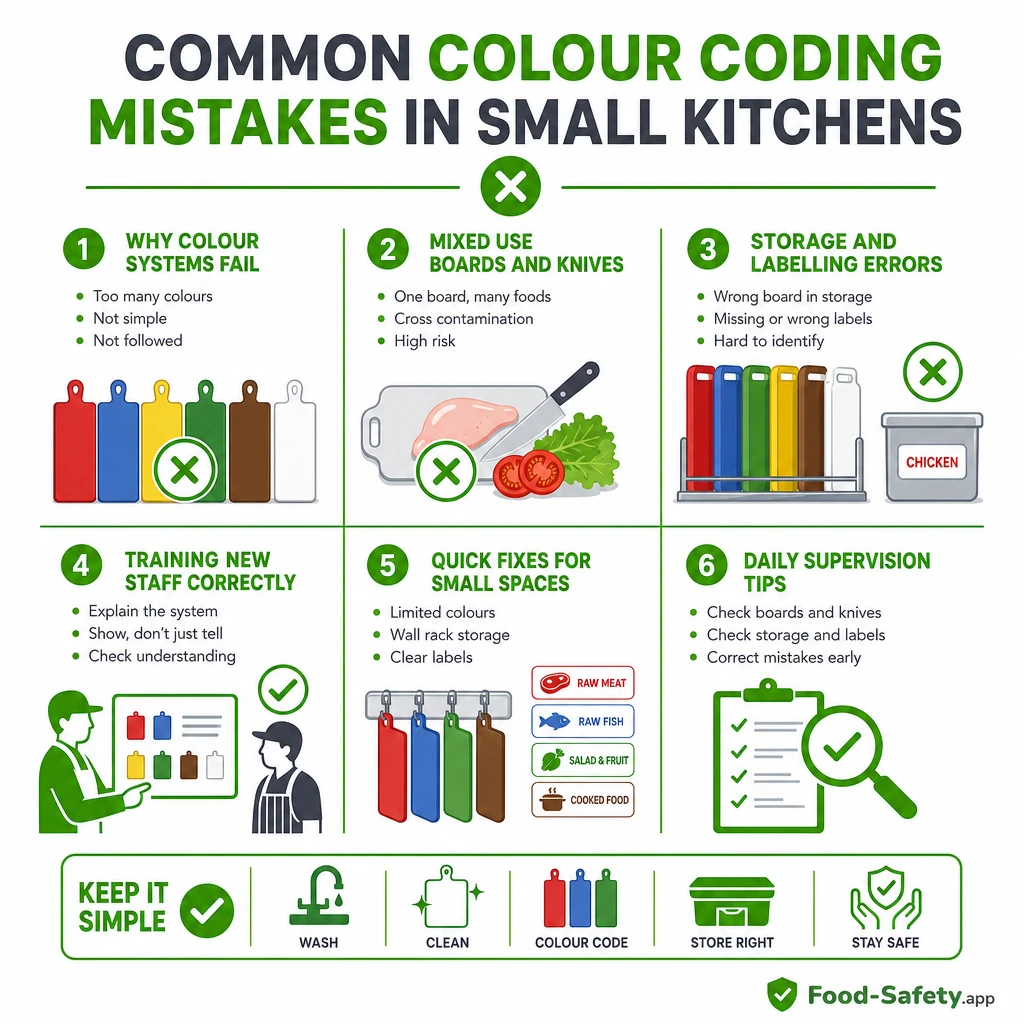
In compact commercial kitchens, there isn’t enough physical separation between boards, knives, and prep surfaces. Colour systems can collapse when boards stack, utensils share a drawer, or storage racks become congested. The result is misused boards, cross-over of raw and ready-to-eat items, and increased risk of cross-contamination during peak service. Clear, simple storage rules are essential so that colour coding remains visible even in tight spaces.
Rushed prep and poor labelling
During busy periods, staff may grab the nearest colour-coded item without checking the task. If labels are flimsy, faded, or only on one side, or if labelling isn’t consistent across shifts, colour coding loses effectiveness. When colour cues aren’t reinforced during prep, the system becomes a reminder rather than a rule, and errors multiply as service demands rise.
Practical steps include: Assign a fixed colour for each task and display a one-page reminder near prep areas; Use separate transport containers for each colour during service; Inspect boards and knives at start and end of each shift.
Mixed use boards and knives: how tools drift between tasks
Examples of drift
In a small pass, staff may grab the nearest board or knife without verifying its colour or purpose. Mixed use boards can end up carrying both raw poultry and salad garnish if storage is unclear. Over time, this drift creates accidental cross-contamination, particularly when quick turnarounds dominate service. cross-contamination explained.
Practical fixes
Install clearly labelled, colour-separated knife blocks and board racks. Create a simple “what colour for what” guide near prep zones and ensure every item is easy to identify at a glance. Encourage staff to pause and confirm colour before use, especially during shift changes or after training refreshers.
Practical steps include: Assign a fixed colour for each task and display a one-page reminder near prep areas; Use separate transport containers for each colour during service; Inspect boards and knives at start and end of each shift.
Storage and labeling errors
Missing colour labels and unmarked drawers
Missing labels are a common fault. If boards or drawers are unmarked, staff will default to memory rather than policy, increasing errors. Unmarked drawers can lead to boards being stacked by size rather than by colour, which defeats the purpose of the system.
Stacked boards and shared knife blocks
When boards are stacked by size or placed on top of one another, labels can become hidden. Shared knife blocks without clear colour separation invite cross-use of blades, exposing ready-to-eat foods to contamination risks. Clear, easy-to-see colour tagging and dedicated spaces help keep colour coding reliable.
Approach and example
Adopt a simple storage rule: colour-coded racks on wall hooks for boards, colour-tinted bins for utensils, and a labelled storage drawer for each colour. A small table can help teams confirm what belongs where during busy periods.
| Colour | Typical use | Notes |
|---|---|---|
| Green | Vegetables | Keep separate from raw products |
| Red | Raw meat | Do not place near cooked items |
| White | Cooked / ready to eat products | Store away from greens |
| Blue | Fish | Keep away from raw meat |
For guidance on cross-contamination controls, see reputable guidance from the Food Standards Agency. This helps keep practices aligned with recognised best practices.
Training new staff correctly
Short inductions
Induction should cover the colour coding policy in plain language, the reasons behind it, and how to apply it during a normal shift. For additional allergen training, see allergen training. Keep sessions short, practical, and repeatable so new staff quickly internalise the routine rather than memorising a list.
Visual prompts
Use clear wall posters, colour-coded tape on prep surfaces, and simple cue cards at points of use. Visual prompts help new starters recall which colour to use and reduce reliance on verbal reminders in a busy service.
What colour for what checks
Introduce quick checks before service starts. A 60-second checklist with three questions—“What colour is the board for poultry?,” “Where does the green board go?” and “Is the knife block colour-coded?”—sets a reliable tone for the shift.
Refresher reminders
Schedule brief, recurring refresher prompts. A 5-minute weekly discussion or a daily huddle focused on colour coding helps maintain discipline and reduces drift over time.
Daily supervision tips
Shift checks
At shift change, verify that every board and knife is correctly colour-coded and stored. Use a simple sign-off sheet to capture completion, reducing reliance on memory in the heat of service. records.
Sign-off routines
Implement a visible sign-off routine for tasks linked to colour coding. Each supervisor can confirm that colour controls were applied on a quick visual audit and that any deviations have a documented corrective action.
Quick corrections before service starts
Spot-checks before opening can prevent issues escalating during service. If a piece of equipment is faded or damaged, reassign or replace it and record the corrective action.
Quick fixes for tight spaces
Wall hooks
Install wall hooks for boards so they don’t crowd benches or drawers. Hooks keep items visible and accessible without cluttering work surfaces.
Labelled bins
Use labelled bins for clean and dirty items, ensuring clear separation by colour. This makes it easier for staff to transport items without confusion during rush periods.
Separate prep zones
Where possible, create small, clearly defined zones for each colour. Even a tiny delineation helps staff maintain discipline during high-pressure service.
Colour-coded tape
Apply colour-coded tape to edges of worktops or benches to reinforce the correct zone for each colour. Visual cues aid memory and reduce errors when space is tight.
Simple storage rules
Keep rules minimal: one colour per zone, one storage location per colour, and routine checks at the start of every shift. Simplicity is the key to compliance in a busy environment.
When to replace or reassign worn equipment
Faded colours
If colour marks fade, replacement is warranted. Faded colour cues reduce recognisability and create risk of mis-handling of foods.
Damaged handles
Cracked boards or damaged handles can compromise safe handling. Replace worn boards promptly to maintain clean separation and ease of handling.
Cracked boards
Cracks can harbour bacteria and obscure markings. Replace cracked boards to ensure clear visibility of colour coding and reduce contamination risk.
Unclear markings
If colour markings are unclear or inconsistent across shifts, reassign or refresh the equipment and retrain staff before reuse. Clear, consistent markings are essential for auditable control.
Practical examples or scenarios
Consider these real-world snapshots to illustrate common pitfalls and fixes: Breakfast prep using the same board for raw bacon and salad garnish, leading to cross-contact risk unless the board is clearly colour-coded and reserved for one purpose; Knife blocks in a small pass where staff grab the nearest knife, not the correct colour for the task; Delivery rush leading to boards being stored together without labels, creating confusion about intended use; New starter assuming “green means veg” but using the wrong board for ready-to-eat food during a busy service.
Closing thoughts
Effective colour coding in a small kitchen hinges on discipline, visible storage, and consistent checking. By keeping rules simple, reinforcing training, and applying practical fixes for tight spaces, you can reduce cross-contamination risk and demonstrate clear controls during inspections. Food-Safety.app, a food safety management system for catering businesses, can help log checks, training records, and corrective actions, making colour coding easier to monitor and prove when needed. For free HACCP plans, see free HACCP plans.
Learn more
Access practical guides, training modules, and checklists to strengthen colour coding, improve everyday hygiene, and reduce cross contamination in busy kitchen services.