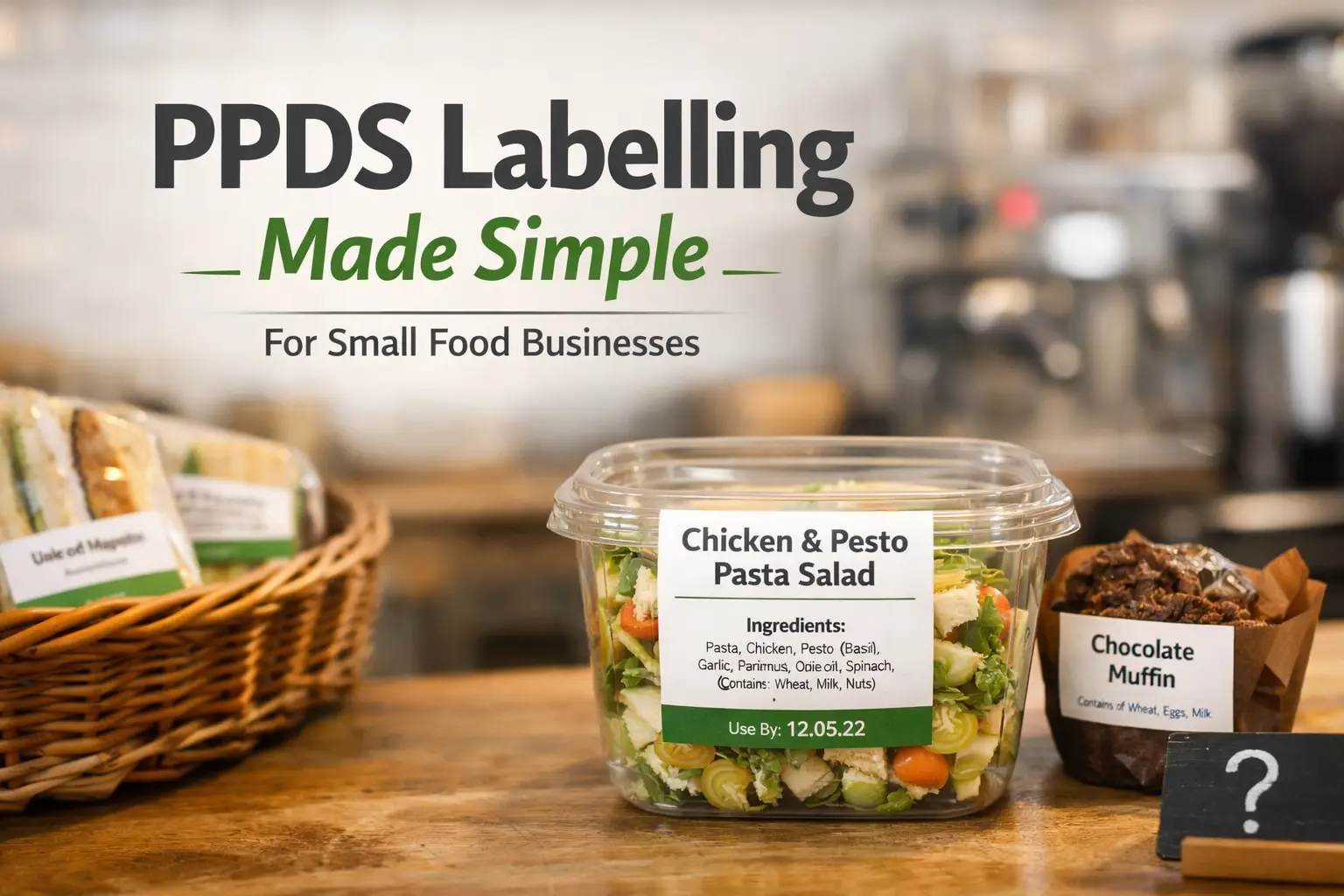
PPDS labelling can catch small businesses out. This guide explains what counts what labels must show and how to avoid dangerous mistakes.
What counts as PPDS
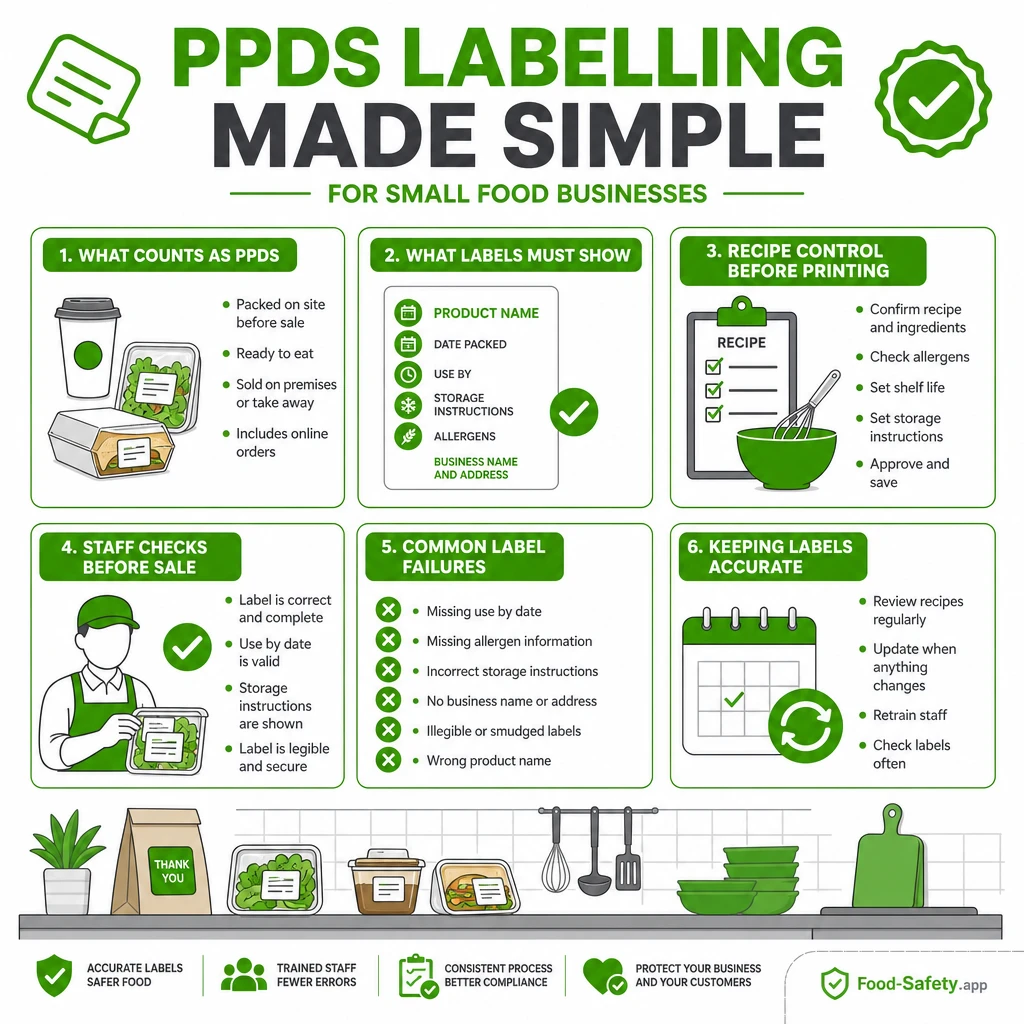
PPDS applies when food is packed on the same premises where it will be offered or sold, before a customer orders it, and packaged for direct sale. This means deli counters wrapping sandwiches, cafes pre-packing cakes for grab-and-go, or hotel kitchens preparing ready-to-eat items for room service are all within PPDS scope. The key is that the product is packed for direct sale and presented to customers without further preparation at the point of sale.
Understanding this boundary helps prevent mislabelling and ensures the right information follows each pack. If a product is prepared to order or not packed for direct sale, it may fall outside PPDS and require a different approach to allergen and ingredient disclosure. For definitive guidance, see the Food Standards Agency guidance on pre-packed for direct sale (PPDS).
Consider how this applies in your operation: a sandwich packed in advance for a counter display, a ready-to-eat salad in a pre-portioned container, or a cake slice boxed for takeaway. In all cases, the label must reflect the product as sold and be accurate at the point of sale.
Recipe control before printing
Before any label is printed, ensure the recipe and ingredient data are current. A single supplier change can alter allergen information or the ingredient list, and labels printed from outdated data create a safety risk and a potential compliance issue.
- Review current recipes – monthly or whenever a supplier changes a formulation.
- Verify allergen information against the latest supplier data and updated ingredient lists.
- Update the label data file in your core system or label design file before printing any batches.
- Approve changes with a sign-off from a supervisor or manager before any labels are produced.
Operationally, treat recipe control as part of your daily routine. A quick verification step saves time during peak service and reduces the likelihood of mislabelling during busy periods. Learn more in cross-contamination training.
Staff checks before sale
Daily checks help catch issues before products leave the kitchen or reach the customer. Build a simple, repeatable routine that staff can perform during opening, mid-service, and closing checks.
- Daily label review – confirm the label matches the actual product and that allergen information is current.
- Batch checks – verify that the correct label accompanies each batch or pack; avoid swapping labels between similar items.
- Fridge display checks – ensure chilled products on display carry readable, up-to-date labels.
- Right pack, right label – ensure the packaging and label are aligned in the same batch and that no cross-packing has occurred.
Potential issues in operation include misreads and cross-packing that blur product identity. See cross-contamination basics.
To support ongoing accuracy, implement regular checks and clear accountability for labeling decisions. cross-contamination basics.
Common label failures
Recognising common failures helps teams prevent them. Typical issues include:
- Missing or incomplete allergen information
- Old recipe versions used for new packs
- Handwritten edits on printed labels
- Unreadable print due to poor quality labels or worn printers
- Wrong date marks or missing date marks
- Labels applied to the wrong product or batch
These failures can lead to customer harm, regulatory action, or costly waste. Establishing a robust verification process and maintaining accurate records mitigate these risks.
For fridge-related pitfalls, see fridge mistakes that let bacteria grow.
Keeping labels accurate
Consistency and traceability are the foundations of accurate PPDS labelling. Put simple systems in place to manage changes and records.
- Version control for recipes – track changes and ensure all linked labels reference the current version.
- Sign-off before printing – require a supervisor to approve label data before any print run.
- Regular reviews after changes – promptly re-check allergens and ingredients whenever menu or supplier adjustments occur.
Practical examples and scenarios
Deli counter packs sandwiches and salads for same-day sale
In a busy deli, items are packed early in the day for same-day sale. Ensure the label reflects the product name, full ingredient list with allergens bolded, and a clear date mark if the item has a limited shelf life. Staff should verify a match between each pack and its label during packing and before stocking displays. Keep a quick reference sheet for common allergen declarations used in the kitchen to speed up daily checks.
Café pre-packs cakes and snacks for grab-and-go display
Grab-and-go items require accuracy at a glance. Implement a pre-print label check: batch-number the packs, attach labels in a consistent orientation, and verify allergen emphasis aligns with the ingredient list. If a supplier swaps a component (for example, a nut-free cake containing traces of tree nuts), trigger an immediate label update and reprint the affected packs.
Hotel kitchen labels chilled ready-to-eat items for room service or staff sales
Room service trays and staff sales need reliable labeling because items move quickly between kitchen, storage, and guest-facing points. Use a controlled printing window tied to the production sheet, and run a short daily reconciliation to ensure the right label is on each tray. Include storage guidance on the label to prevent temperature abuse in service areas.
Caterer changes a recipe because a supplier swaps an ingredient, triggering label update checks
When a supplier substitution occurs, trigger the label control process immediately. Update the recipe in your system, confirm allergen declarations, and reprint affected labels. Communicate changes to front-of-house staff so they recognise the updated items and avoid serving older versions by mistake.
UK food-handling responsibilities
Recommended operational focus
Adopt a practical, low-friction approach to PPDS labelling that suits small food businesses. Focus on reliable routines, traceable records, and staff empowerment.
- Use a simple pre-print label check process
- Keep allergen and recipe records aligned
- Train supervisors to verify labels against production sheets
- Review high-risk items such as chilled ready-to-eat foods and items with multiple ingredients
To streamline these practices, consider adopting a dedicated system that stores recipes, links allergen information, and tracks checks with timestamps. Food-Safety.app is a food safety management system for catering businesses.
External reference: For definitive guidance on PPDS, consult the Food Standards Agency guidance here: Pre-packed for direct sale (PPDS) guidance.
Learn more about PPDS management
Discover how Food-Safety.app can help small food businesses manage PPDS with clear records, simple checks, and reliable labeling processes to protect customers.