Controlling Listeria in chilled foods
Controlling Listeria in chilled foods is one of those jobs that never really goes away in a professional kitchen.
Ready-to-eat sandwiches, cooked meats, soft cheeses, pâté, smoked fish, deli salads and desserts all need tight handling because
Listeria can grow even in the fridge if control slips.
The good news is that how to control Listeria in chilled foods comes down to consistent habits: strong fridge control,
smart shelf life management, good cleaning, and records that actually mean something on a busy service. Get those right and you
massively reduce the risk without turning the kitchen into a clipboard museum.
Listeria control in food-safety-management.
What Listeria is and why chilled foods matter
Listeria monocytogenes is a bacteria that can cause serious illness, especially in pregnant people, older adults, babies, and
anyone with a weakened immune system. In food businesses, the main concern is ready-to-eat chilled food, because there is no
further kill step before service.
If contamination happens after cooking, or if the food has a long enough shelf life for the bacteria to grow, the risk increases.
That is why chilled food control is not just about “keep it cold and hope for the best”. In a busy kitchen, Listeria can get a
lift from sliced equipment, drains, fridges, prep surfaces, packaging, and staff hands. It is a proper opportunist. Give it a
damp patch and a bit of time, and it will happily make itself at home.
How to control Listeria in chilled foods with fridge control
Fridge control is the first line of defence. In UK food businesses, chilled food should be kept under effective temperature
control, with fridges working properly and not overloaded. The aim is simple: keep ready-to-eat foods cold, stable, and protected
from temperature swings.
For practical guidance on maintaining consistent temperatures, see
fridge temperature monitoring.
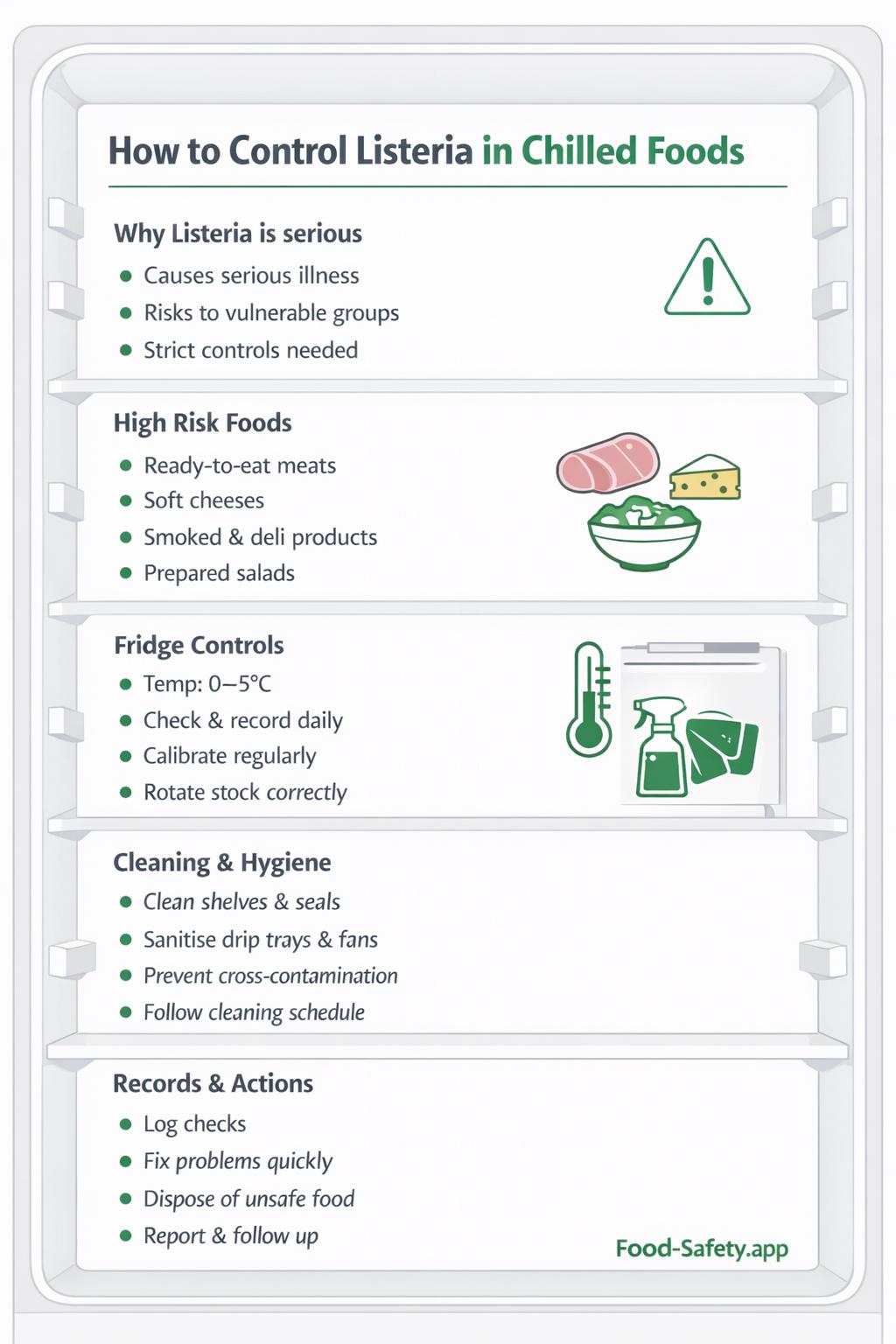
Practical fridge checks
- Check fridge temperatures at the start of service and during the day if the unit is heavily used.
- Use a reliable probe or built-in display, and make sure staff know which one is the control point.
- Do not cram warm deliveries straight into a full fridge and expect miracles.
- Keep doors shut as much as possible during service.
- Move high-risk chilled foods away from the door area and near back shelves where temperatures are usually more stable.
Smart storage layout
Store ready-to-eat foods above raw foods to prevent drips and cross-contamination. Use sealed containers with clear labels. Keep
food off the floor and away from fridge walls where condensation may gather. Separate allergens and strong-smelling foods where
possible to keep the fridge organised and easier to clean.
For professional kitchens, fridge crowding is a common hidden problem. A fridge can look “fine” from the outside while the top
shelf is warm, the back panel is iced up, and the staff are playing Tetris with tubs of coleslaw. If the unit cannot hold food
safely, reduce the load, service it, or replace it before it becomes a recurring headache.
Shelf life control for ready-to-eat chilled food
One of the biggest controls for Listeria is shelf life. The longer a chilled ready-to-eat food sits around, the more chance there
is for bacteria to grow if something has gone wrong in the process.
That is why date marking, batch control and sensible production planning matter so much.
Good shelf life habits
- Label every prepared chilled item with a clear use-by or discard date, as appropriate to your procedure.
- Use the shortest practical shelf life for high-risk foods made in-house.
- Review whether you are making too much in advance for actual demand.
- Do not “reset” dates because a product looks or smells fine.
- Keep batch records so you can trace what was made, when, and by whom.
In a café or hotel kitchen, the temptation is often to make a bit extra because tomorrow might be busy. Fair enough. But if
chilled chicken salad, pasta salad or filled sandwiches are staying in the fridge for longer than planned, shelf life control
needs tightening.
Better to run a smaller, fresher production cycle than to turn the fridge into a cold storage museum.
Receiving, storage and stock rotation
Control starts when the delivery arrives. If chilled products are warm on receipt, damaged, out of date, or poorly packed, do not
just “make do”. Reject or separate them according to your procedures. A rushed intake is how problems get hidden behind the
dessert trolley.
Use a first in, first out system, but keep an eye on actual expiry dates rather than trusting the pile on the shelf. Rotate stock
daily and check that opened packs are managed properly.
Once a pack is opened, the clock may change, so staff need to know the business rules rather than guessing.
Cleaning and cross-contamination control
Listeria loves wet, neglected areas, especially in places that are hard to see or reach. That means cleaning has to go beyond the
visible counter and include fridge seals, shelf runners, handles, drain areas, slicers, chopping boards, and any surface that
touches ready-to-eat food.
Where to focus cleaning effort
Fridge door seals, handles and temperature probes. Slicers, knives, processors and sandwich prep equipment. Under counters,
behind fridges and around drains. Reusable crates, trays and delivery containers. Any surface where condensation or spills collect.
Cross-contamination control is just as important.
Learn how cross-contamination happens and how to stop it
.
Raw and ready-to-eat foods must stay properly separated from delivery to service. Use colour-coded equipment where it helps, but
do not rely on colours alone if staff are not trained. A red board does not magically stop a careless hand from using it for the
wrong job.
Allergen management is a key part of cross-contamination control; see
clear allergen labelling on packaged food
.
Cleaning routines that actually work
Clean and disinfect food contact surfaces after each task, especially between raw and ready-to-eat prep. Use a written cleaning
schedule for fridges and high-risk equipment.
Check that cleaning chemicals are used at the correct strength and contact time. Dry equipment properly where possible, because
persistent moisture helps bacteria survive.
For practical steps on cleaning schedules, see
Cleaning schedules for better food safety management
.
Training, checks and records
How to control Listeria in chilled foods is really about routine. If the team does the same safe steps every day, the risk drops.
If every shift “does it a bit differently”, the bacteria gets more chances than it deserves.
Train staff to spot the warning signs
Staff should be trained to identify fridge temperature issues and overloading, damaged packaging, poor delivery condition,
dirty seals, blocked drains, condensation, cross-contamination risks during slicing or plating, and incorrect date labels or
missing batch identification.
Records should be simple enough to complete during busy service. Fridge temperature logs, cleaning checks, delivery checks and
corrective action notes are all useful if they are accurate and actually reviewed.
If nobody looks at them, they become very expensive stationery.
For a broader framework on how these checks fit into your overall food safety plan, see
HACCP principles explained.
For general guidance on food hygiene in the UK, the
Food Standards Agency
is a trusted starting point.
What to do when something goes wrong
If a fridge has been running warm, a ready-to-eat product has been stored too long, or contamination is suspected, act quickly.
Isolate the food, record what happened, and decide whether it can safely be used or must be discarded based on your procedures and
risk assessment.
Do not keep doubtful products “just in case”.
Corrective action should include checking the cause, not just binning the food and moving on. Was the fridge overloaded? Was a
door left open? Did a cleaner miss a seal or drain?
Fixing the root cause prevents the same problem appearing again next week with a different label on it.
Conclusion
To control Listeria in chilled foods, focus on the basics done well: stable fridge temperatures, short and sensible shelf life,
strong separation of raw and ready-to-eat foods, detailed cleaning of high-risk areas, and records that help the team spot
patterns early.
In catering, hotel, school and takeaway kitchens, the safest chilled food systems are the ones that are simple, repeatable and
understood by everyone on shift.
If your business wants tighter day-to-day oversight, a food safety management system for catering businesses such as
Food-Safety.app can help keep checks, actions and accountability in one place.
Get the routine right, and Listeria has a much harder time getting a free ride.
Strengthen chilled food safety today
Manage checks and corrective actions with Food-Safety.app.