Know when to review HACCP and safe methods after changes in menu suppliers equipment or complaints. Regular review keeps the system current practical and defensible.
HACCP reviews support practical service
Why regular HACCP reviews matter
Regular HACCP reviews matter because operational reality in a busy service environment can outpace static documents. A timely update improves control over temperature logs, corrective actions, and delivery checks, which in turn boosts inspection confidence and reduces the risk of non-compliance. By keeping the HACCP plan aligned with current menus, equipment and staff capability, a catering business strengthens daily decision making and accountability across shifts. Allergen management protocol.
Review triggers in practice
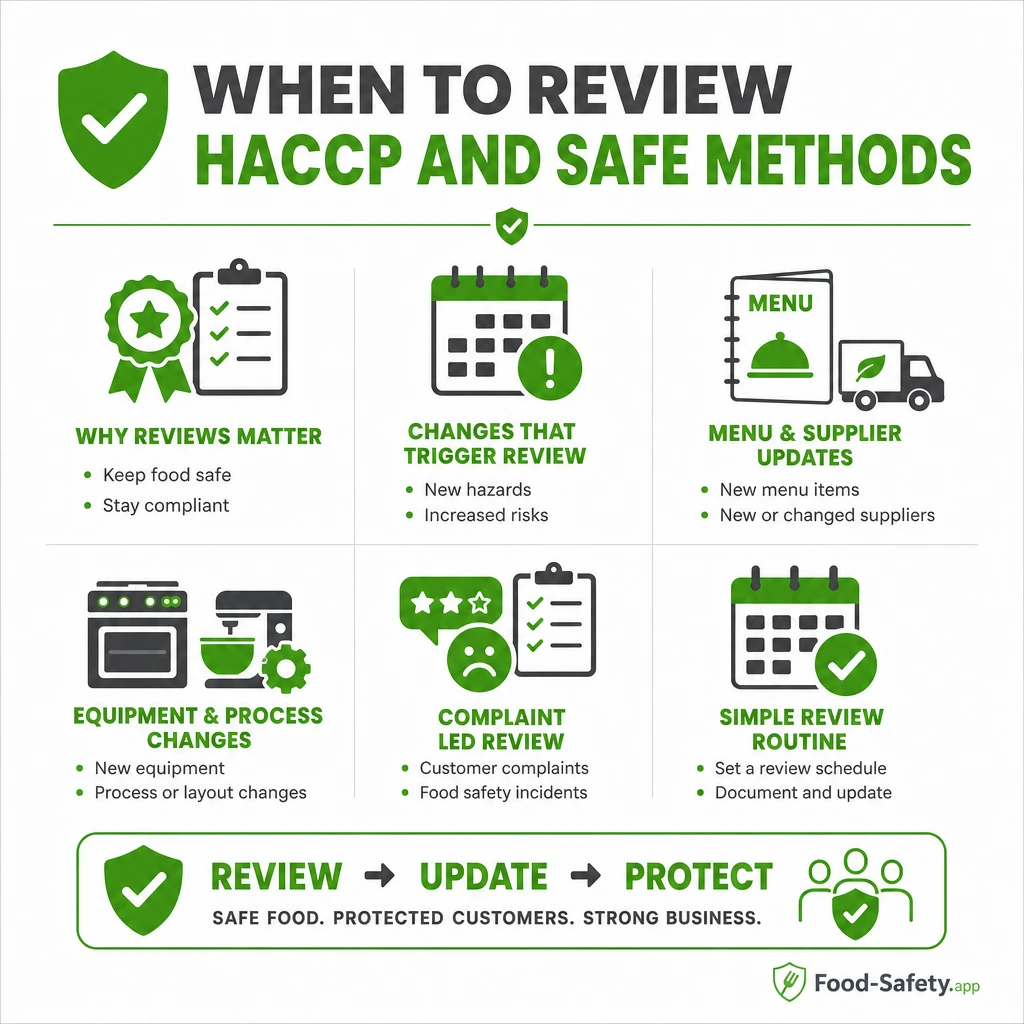
What triggers a review in practice
New menu items or recipe changes
Any addition or modification to a dish can alter critical control points, allergen handling, and cooking temperatures. A trigger here is a formal sign-off to update critical limits, monitoring records, and supplier checks before service starts.
Supplier changes or delivery issues
Changes in packaging, delivery windows or storage requirements affect receipt checks and cold chain verification. Review should update supplier approval, delivery checks, and defect reporting criteria.
New equipment, repairs, or equipment failures
Installing a new fridge, oven or blast chiller, or performing significant repairs, can shift holding temperatures and time controls. Trigger actions include updating calibration procedures, probe accuracy checks, and maintenance logs. Cleaning to prevent cross-contact.
Changes to cooking, cooling, reheating, or hot holding processes
Revising cooking times, cooling rates, or hot holding methods requires re-validating critical limits, monitoring frequencies, and record templates so practice stays within the HACCP plan.
Customer complaints, allergen concerns, or food safety incidents
Any incident or complaint should prompt a rapid review of procedures, ingredient handling and traceability. The aim is to close gaps, reinforce training, and adjust records to reflect what happened in practice.
Staffing changes, training gaps, or poor record trends
New team members or inconsistent record entries can erode control. A trigger is a documented rise in missed checks, incomplete logs, or patterns of corrective actions that signal the need for retraining or document simplification.
Spotting records that no longer reflect practice
Spotting when records no longer reflect practice
Regular checks help highlight when records no longer reflect actual practice. See essential record-keeping requirements for guidance.
- Temperature logs missing entries during peak periods
- Recipes or procedures that diverge from what staff execute in service
- New equipment in use without updated calibration or maintenance records
- Allergen handling steps not matching current supplier data
- Audit findings consistently highlighting similar gaps
- Frequent corrective actions without root-cause analysis
Keep methods simple and current
Keeping methods simple and current
Keep HACCP and safe methods practical for a frontline team. Use plain language, clear responsibilities, and concise record templates. If a document is rarely consulted or frequently mismatched with how service runs, it’s a sign to simplify or rewrite. The goal is to support safe practice, not to create bureaucratic overhead that staff ignore during busy service. For practical basics, see small-business food safety basics.
Routines and task lists for daily practice
Practical routines and task lists
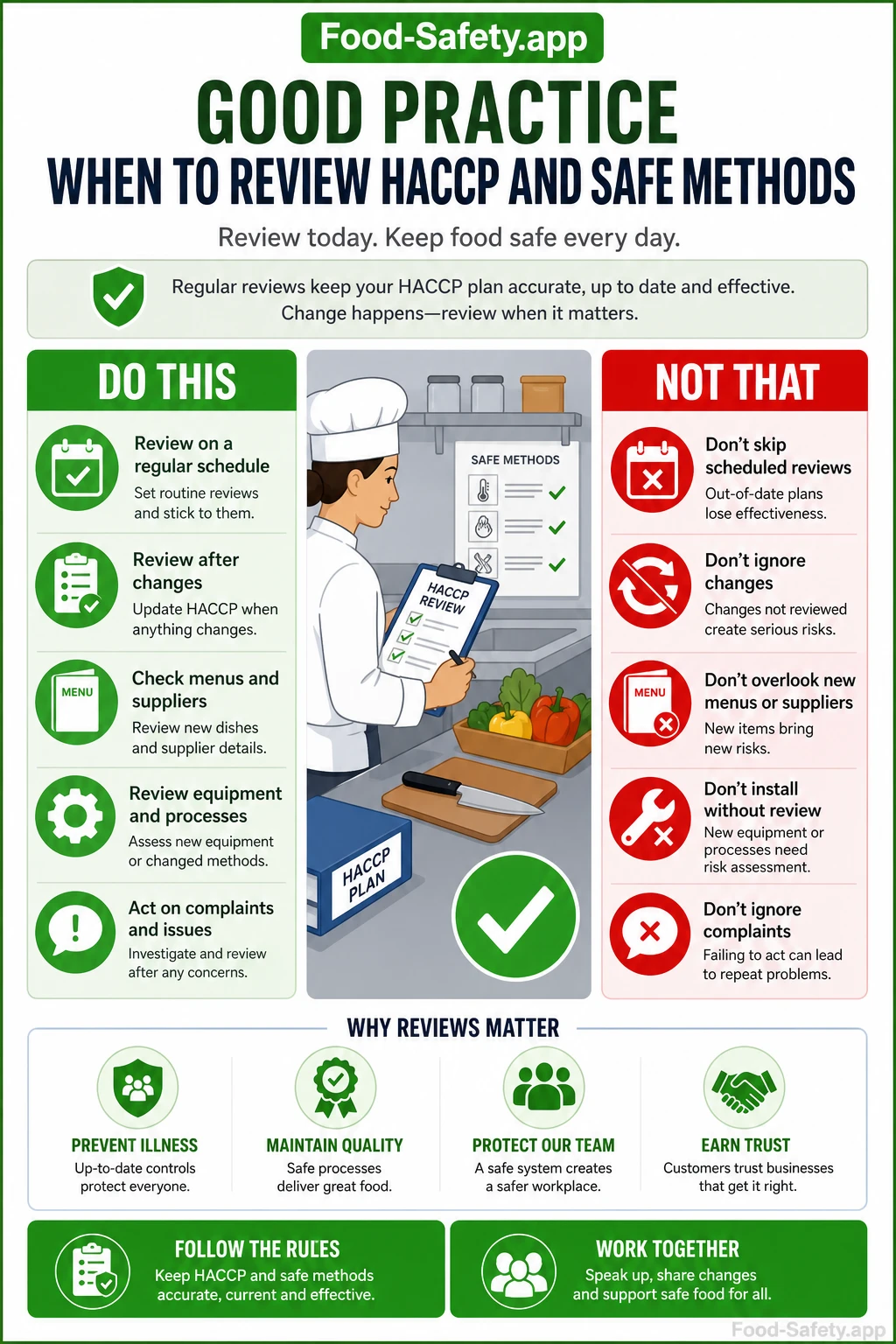
Establish a simple review rhythm that fits a catering operation:
- Monthly check: review all core HACCP plans, allergen matrices, and cleaning schedules for relevance.
- Immediate review after change: update records within 48 hours of any recipe, supplier, equipment, or process change.
- Quarterly brief with the team: run through key controls and verify understanding during shift handovers.
- Incident-driven review: after any food safety incident or consumer complaint, perform a rapid root-cause analysis and revise procedures accordingly.
Establish a simple review rhythm that fits a catering operation. Opening check routine.
Examples and scenarios for HACCP reviews
Examples and scenarios
- A new chilled dessert added to the menu needs allergen and temperature control checks
- A fridge replacement means cold holding limits and probe checks should be reviewed
- A supplier changes delivery conditions, so goods in checks and acceptance criteria need updating
- A complaint about undercooked chicken triggers a review of cooking records and safe methods
- Repeated cleaning misses show a need to update the cleaning schedule or task list
Documentation and guidance for inspection readiness
Documentation and inspection readiness
Link reviews to records that demonstrate control: temperature logs, corrective actions, delivery checks, cleaning records, and defect reports. Maintain a simple, consistent filing system so inspectors can verify decisions and actions quickly. A routine practice of updating records after changes creates a transparent trail that supports inspection readiness and compliance confidence. Inspection readiness guidance.
External guidance and practical support
For official guidance on HACCP and safe food handling, see the Food Standards Agency: HACCP guidance.
In practice, a light, well-used system that records what matters most is more valuable than a heavyweight manual that staff seldom consult. Encourage teams to treat records as live instruments of control, not as paperwork to complete. Food-Safety.app is a food safety management system for catering businesses.
Explore Food-Safety.app for ongoing support
Access practical guidance, templates, and ongoing support to keep your HACCP plan current and compliant across changes and busy service, so staff can rely on simple, effective controls.