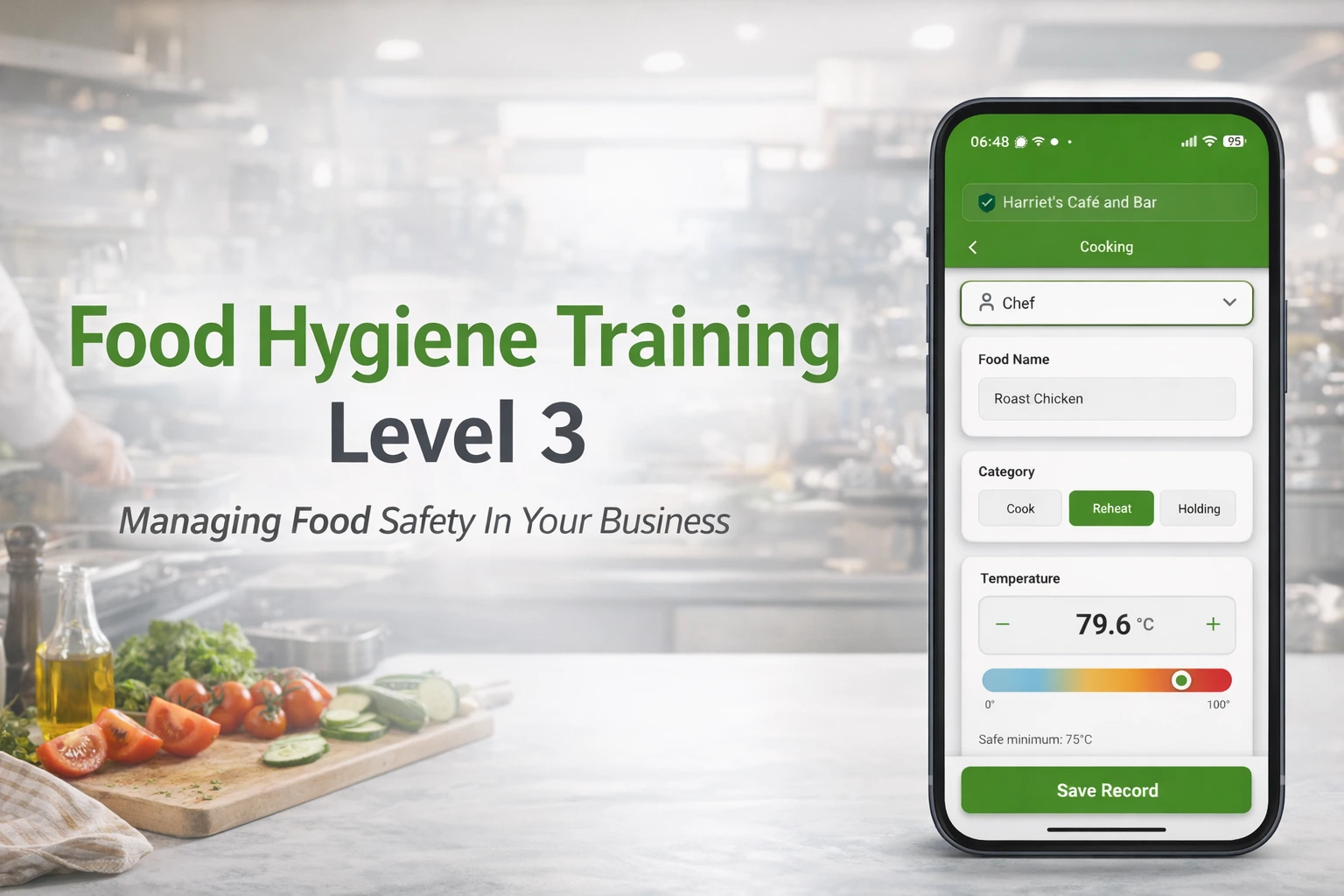
Level 3 food hygiene training is for the people who do more than handle food. It is for the people who supervise others, spot problems early, and make sure food safety standards are followed when service gets busy. If you run a café, takeaway, pub kitchen, care home, catering unit, or restaurant, this is the level of training most often associated with day-to-day food safety management.
This guide explains what Level 3 food hygiene training actually covers, who needs it, how it connects to HACCP, and what good supervision looks like in a real kitchen. It also shows where digital systems can support training by turning knowledge into consistent daily practice.
Table of Contents
- What is Level 3 food hygiene training?
- Who needs Level 3 training?
- What does Level 3 training cover?
- How does HACCP fit into training?
- Is Level 3 a legal requirement?
- Why does Level 3 training matter in practice?
- Common mistakes businesses make
- How to choose the right training
- How digital systems support Level 3 training
What is Level 3 food hygiene training?
Level 3 food hygiene training is aimed at supervisors, team leaders, managers, and business owners who are responsible for overseeing food safety standards rather than simply following instructions.
At Level 2, the focus is usually on safe personal practice: handwashing, contamination control, cleaning, temperature awareness, and safe handling. Level 3 goes further. It is about managing risk, supervising staff, checking that systems are actually working, and stepping in when they are not.
In plain terms, Level 3 is the difference between knowing that raw chicken must be kept away from ready-to-eat food, and being the person responsible for making sure that rule is followed properly on every shift, by every member of staff, even when the kitchen is under pressure.
UK law does not say every supervisor must hold a specific Level 3 certificate. What the law does require is that food handlers are supervised and instructed or trained in food hygiene matters appropriate to their work, and that those responsible for developing and maintaining food safety procedures have adequate training in HACCP principles. Level 3 is widely seen as the right standard for people in operational charge of food safety.
If you are still comparing staff training levels, see Level 2 food safety training for UK catering for the baseline expected of food handlers.
Who needs Level 3 training?
Level 3 food hygiene training is most relevant for anyone who supervises food handling or is expected to maintain standards across a shift, site, or team.
- Kitchen supervisors and shift leaders
- Head chefs, sous chefs, and kitchen managers
- Café, pub, and takeaway owners who run daily operations
- Care home and school catering leads
- Anyone responsible for HACCP-based checks, corrective actions, or staff supervision
For example, imagine a busy brunch café in Manchester. The owner has three junior staff, one new starter, and a rush of orders between 10am and 1pm. A Level 3 trained supervisor should be able to notice that chilled storage temperatures have not been checked, see that a colour-coded chopping board has been used incorrectly, and fix both issues before they turn into bigger problems.
Or take a care home kitchen. The risk is not just speed or volume. It is vulnerable residents, allergen control, reheating, and consistency across every meal service. In that setting, supervisory food safety knowledge matters much more than a basic certificate alone.
What does Level 3 training cover?
Good Level 3 training should prepare a supervisor to manage real food safety risks, not just pass a multiple-choice test. That means understanding the hazards, the controls, the records, and the human side of running a kitchen properly.
Supervising staff and maintaining standards
Supervisors are responsible for turning food safety rules into routine behaviour. That includes:
- Making sure staff follow safe methods every shift
- Monitoring hygiene standards during prep and service
- Correcting unsafe behaviour immediately
- Supporting new staff and temporary workers properly
- Escalating problems instead of ignoring them
A practical example: during a Friday night service, a line cook handles raw chicken, wipes their hands on a cloth, and reaches for a tub of salad garnish. A Level 3 trained supervisor should not just say “be careful.” They should stop the task, isolate any at-risk food, make sure proper handwashing happens, check whether utensils or surfaces were contaminated, and reinforce the rule with the team there and then.
Understanding hazards in real kitchens
Level 3 training covers the main categories of food safety hazards and how they show up in real operations:
- Biological hazards such as bacterial growth caused by poor chilling, undercooking, or cross-contamination
- Chemical hazards such as cleaning chemical residue on food contact surfaces
- Physical hazards such as broken plastic, packaging fragments, or damaged probe covers getting into food
In a takeaway, that might mean checking a hot holding unit that has drifted below temperature. In a bakery, it might mean controlling allergen cross-contact between products. In an events catering unit, it might mean managing transport temperatures and service delays.
The 4Cs of food hygiene
Strong supervisors manage the basics consistently. The 4Cs still sit at the heart of good food hygiene practice:
- Cleaning
- Cooking
- Chilling
- Cross-contamination
What changes at Level 3 is accountability. You are not just expected to know the 4Cs. You are expected to make sure the system, staff behaviour, and records all support them. For a practical refresher, read utensil control and cross-contamination risks.
Allergen management responsibilities
Handling allergens correctly is a legal and operational responsibility. Level 3 supervisors need to make sure allergen controls are reliable, not improvised.
That includes making sure:
- Allergen information is accurate and kept up to date
- Recipe changes are reflected before service starts
- Front-of-house staff know when to check instead of guessing
- Cross-contact risks are controlled during prep and service
Real world example: a soup on the specials board is usually made without cream, but on one shift the chef adds cream to balance the texture. If the allergen sheet is not updated and a customer asks whether it contains milk, the risk is obvious. That is not a paperwork failure. It is a supervision failure.
For more on this area, see allergen management and Natasha’s Law for UK food businesses.
Records, checks, and corrective actions
Level 3 training explains why records matter and how supervisors should use them. Typical examples include:
- Fridge, freezer, cooking, cooling, and hot holding temperature logs
- Cleaning schedules and sign-off checks
- Delivery inspections and rejection records
- Probe calibration checks
- Corrective action notes when something goes wrong
These records are not there to fill a folder. They are there to prove control, reveal patterns, and show what action was taken when standards slipped. If you want a practical example, read deliveries and receipt of food to see how checks at the door support the whole system.
How does HACCP fit into training?
HACCP is the backbone of food safety management. It is the system used to identify hazards, decide where control matters most, set safe limits, monitor them, and take action when something goes wrong.
Level 3 training helps supervisors apply HACCP in practical terms, including:
- Identifying critical control points such as cooking, chilling, reheating, or hot holding
- Checking that safe limits are being met consistently
- Knowing what corrective action to take when checks fail
- Making sure records reflect what actually happened
- Reviewing whether the control measure is still suitable when the menu, team, or process changes
For example, if a cooked batch of rice is left out too long before chilling, the right response is not to guess and carry on. It is to assess the risk, follow your procedure, record the issue, and prevent a repeat. HACCP is useful because it forces those decisions to be made properly, not casually.
If you are building or reviewing your system, see what systems help run a safe food business and the food business internal audit tool for practical support.
For official guidance, the Food Standards Agency Safer Food, Better Business guidance explains what a food safety management system should achieve in practice.
Is Level 3 a legal requirement?
Not in the sense of a named qualification written directly into law for every supervisor. But food businesses do have legal duties that make appropriate supervisory training essential.
Food businesses must:
- Sell food that is safe to eat
- Ensure staff are supervised and trained appropriately for their job
- Put HACCP-based food safety procedures in place
- Control allergen risks and provide accurate information
- Keep records and show that food safety is being managed properly
That is why Level 3 matters. If a business has supervisors making decisions about hygiene, training, corrective actions, temperature control, allergens, or daily checks, those supervisors need knowledge that goes beyond basic food handling.
It also affects inspections. Environmental Health Officers are interested in what your team actually understands and does, not just what certificates you can produce. This is one reason why management and food safety systems have such a big impact on outcomes. See what affects your food hygiene rating for a clearer breakdown.
Why does Level 3 training matter in practice?
Good training changes what happens on an ordinary Tuesday, not just what appears in a training file. Businesses without competent supervision often have the same recurring problems:
- Fridges running above safe temperatures with no action taken
- Raw and ready-to-eat foods stored or handled too closely together
- Staff guessing allergen information instead of checking it
- Cleaning checks being signed off without being done properly
- Temporary staff being left to copy others without proper instruction
Consider a small takeaway on a Saturday night. Orders are stacking up, one fridge is overloaded, and a delivery arrives during peak service. A weak supervisor sees only workload. A strong supervisor sees food safety risks: warm stock waiting to be checked, cramped storage raising cross-contamination risk, and staff cutting corners to save time.
That is where Level 3 training earns its value. It helps supervisors recognise risk quickly, act confidently, and keep standards stable even when the kitchen is under pressure.
Common mistakes businesses make
Many food businesses undermine their own system in the same predictable ways:
- Treating training as a one-off purchase instead of an ongoing management process
- Relying on certificates while ignoring weak day-to-day supervision
- Using records that look tidy but do not reflect reality
- Failing to retrain staff when menus, equipment, or procedures change
- Leaving new starters to learn by watching whoever happens to be on shift
- Not reviewing repeated issues such as missed checks or recurring temperature failures
One common example is the “paper-perfect kitchen.” Every box is ticked, but staff cannot explain critical limits, allergen controls, or what to do when a fridge fails. That is exactly the kind of gap an inspection can expose.
How to choose the right training
Not all Level 3 food hygiene training is equally useful. The best option is the one that helps a supervisor manage real responsibilities, not just collect a certificate.
Look for training that:
- Is relevant to catering and hospitality, not generic food production only
- Explains supervision, monitoring, and corrective action clearly
- Includes allergens, HACCP, and record keeping in realistic detail
- Uses examples that match the working environment
- Can be reinforced through toolbox talks, refreshers, or on-shift coaching
Formal training works best when it is backed up by practical reinforcement. Short refreshers can often prevent more mistakes than a certificate filed away and forgotten. For ideas, see video training in food safety management.
How digital systems support Level 3 training
Training is only useful if it changes daily practice. That is where digital systems can help. They do not replace supervision or competence, but they make it easier to apply both consistently.
For example, a supervisor who has completed Level 3 training still needs to make sure checks are done, records are accurate, and follow-up actions are not forgotten. A good digital system can support that by helping teams:
- Complete daily food safety checks on time
- Keep temperature, cleaning, and delivery records in one place
- Track staff training and refreshers more consistently
- Record corrective actions when issues happen
- Stay more inspection-ready without relying on paper folders
Food-Safety.app is designed to support that side of the job. It helps UK catering businesses manage food safety records, checks, and supervision tasks in one place so the standards taught in training are easier to maintain in real service conditions.
Conclusion
Level 3 food hygiene training is not about collecting a more impressive certificate. It is about giving the people in charge of food safety the judgment, confidence, and structure to manage real risk properly.
For supervisors, managers, and owners, that means understanding hazards, controlling allergens, applying HACCP, supervising staff well, and taking action when standards slip. Businesses that do this well are usually safer, calmer, and better prepared for inspection.
And when that training is backed up by simple systems, accurate records, and clear daily routines, food safety management becomes far easier to maintain. That is where tools like Food-Safety.app can help turn knowledge into consistent practice.