Find out why confidence in management drops during inspection and what causes it. Strong HACCP habits better records and trained staff help protect your rating.
What inspectors notice first
Missing logs and incomplete checks
Incomplete or missing logs are among the first things an inspector will spot. If opening checks, closing checks, or task sign-offs are absent or inconsistent, it signals that daily discipline isn’t being followed. The lack of a clear trail makes it difficult to confirm that routine controls were applied before service.
Practical approach:
Make sign-off a non-negotiable part of every shift handover. Use a single, simple daily log for temperature checks, cleaning tasks, and equipment status. Ensure logs are stored in an accessible place and time-stamped.
See what food-safety records small businesses should keep.
Inconsistent temperatures
Temperatures that drift outside safe ranges or are not recorded with a capable measuring tool send a clear message to inspectors. Regular checks should match readings on the actual equipment, and anomalies must trigger a documented corrective action.
What good practice looks like:
Keep refrigerators at or below 5°C and freezers at or below -18°C where possible. Calibrate thermometers routinely and use calibrated probes for different compartments. Record readings with date, time, and initials; note what corrective action was taken if a reading is out of range.
Learn how cleaning stops allergen cross-contact.
No clear corrective actions
Every issue found in records should be linked to a concrete corrective action with ownership and deadlines. Without a defined follow-up, the same faults repeatedly surface during inspections, eroding confidence in the system.
What to implement:
For each fault, specify who is responsible, what needs to be done, and by when. Close the loop by updating the record after action is completed and verifying the result.
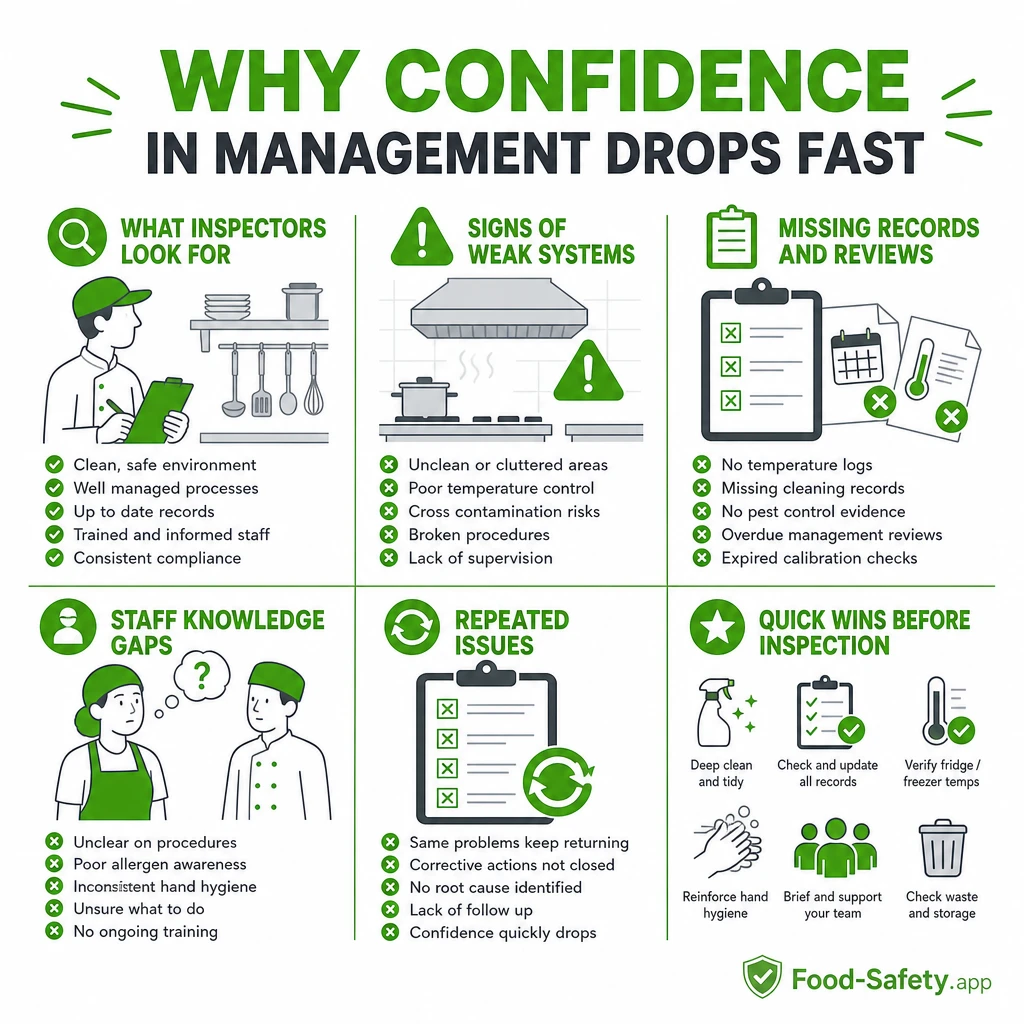
Signs of weak systems in a busy kitchen
Paperwork done late
When records are completed after the event or only during downtime, it creates a disconnect between reality on the shop floor and the paper trail. This delay undermines inspection readiness and hides when issues started.
Strengthen with a shift-end routine that requires immediate entry into the system after each task, not at the end of the day.
No review trail
A system without a clear review trail—no updates, no sign-offs, no notes of who approved changes—appears unreliable. Inspectors look for evidence that management actively supervises and updates controls.
Make review routine visible: weekly supervisor checks, sign-off on all action items, and a visible log of changes.
See how FHR scores are broken down and what affects your rating.
Tasks not signed off
When tasks are completed but not signed off, you cannot prove who performed them or when. This creates ambiguity in accountability during an inspection.
Fix: require sign-off for every critical task, with date and initials, and integrate it into the daily log.
Staff unsure who is responsible
Unclear ownership leads to gaps in coverage and slow responses to problems. If staff cannot identify who handles allergen information, equipment faults, or cleaning tasks, the system loses credibility.
Resolve with clear role assignments posted in staff areas and embedded in the daily routines.
Missing records and reviews
Key records and timely reviews form the backbone of an auditable HACCP system. When these are missing or not routinely reviewed, confidence in management declines fast.
See what food-safety records small businesses should keep.
Opening and closing checks; Cleaning schedules; Probe calibration records; Delivery checks; Temperature monitoring logs; Pest sightings and action trails
Practical scenarios
Fridge running warm but no defect log or follow-up action; Delivery accepted with no temperature or condition recorded; Cleaning task ticked off, but no detail on what was actually done; New starter handling allergens without recorded training; Probe calibration missing, making temperature records hard to trust; Repeated pest sighting logged with no monitoring or action trail
Staff knowledge gaps
Allergy awareness
Allergen handling often separates good practice from serious risk. Staff must recognise allergen-containing ingredients, cross-contact risks, and the importance of accurate allergy records.
Learn about the allergen management protocol for food businesses.
Temperature limits
Understanding safe temperature ranges for all critical control points is essential. Gaps here let unsafe food slip through unnoticed and undermine the integrity of records.
Cleaning routines
Cleaning tasks demand consistent execution and documented results. If staff rely on memory rather than defined routines, the records will miss what was actually done.
Learn how cleaning stops allergen cross-contact.
What to do when equipment fails
Equipment failure requires immediate escalation, not improvisation. Clear steps for containment, reallocation of duties, and communication with suppliers and maintenance are essential.
Repeated issues undermine confidence
When the same problems recur, it signals deeper systemic weaknesses rather than isolated mistakes. Repeated fridge faults, recurring cleaning misses, or ongoing delivery problems create a pattern that inspectors will question.
Impact in practice:
Fridge faults repeated without long-term action; Cleaning misses that reappear across shifts; Delivery issues with no root-cause analysis or supplier follow-up; Unresolved complaints or defects lingering in the system
Explore what small food businesses need for food safety.
Quick wins before inspection
Update records daily with time-stamped entries and immediate sign-offs; Review corrective actions weekly and close completed items with evidence; Check allergen details are up to date and easily accessible to all staff; Confirm staff training status and record dates of recent training; Close gaps in equipment checks, including probe calibration and maintenance logs
External resources
Food Standards Agency guidance on food safety management
For teams seeking a practical, offline-compatible record-keeping solution, Food-Safety.app, a food safety management system for catering businesses, helps keep temperature checks, cleaning, allergens, delivery records, defects, corrective actions, and training in one place with automatic timestamps and full history for inspections.
Improve food safety management today
Streamline your temperature checks, logs, and training in one place with automatic timestamps and a clear audit trail. Learn how Food-Safety.app can simplify compliance and boost confidence.