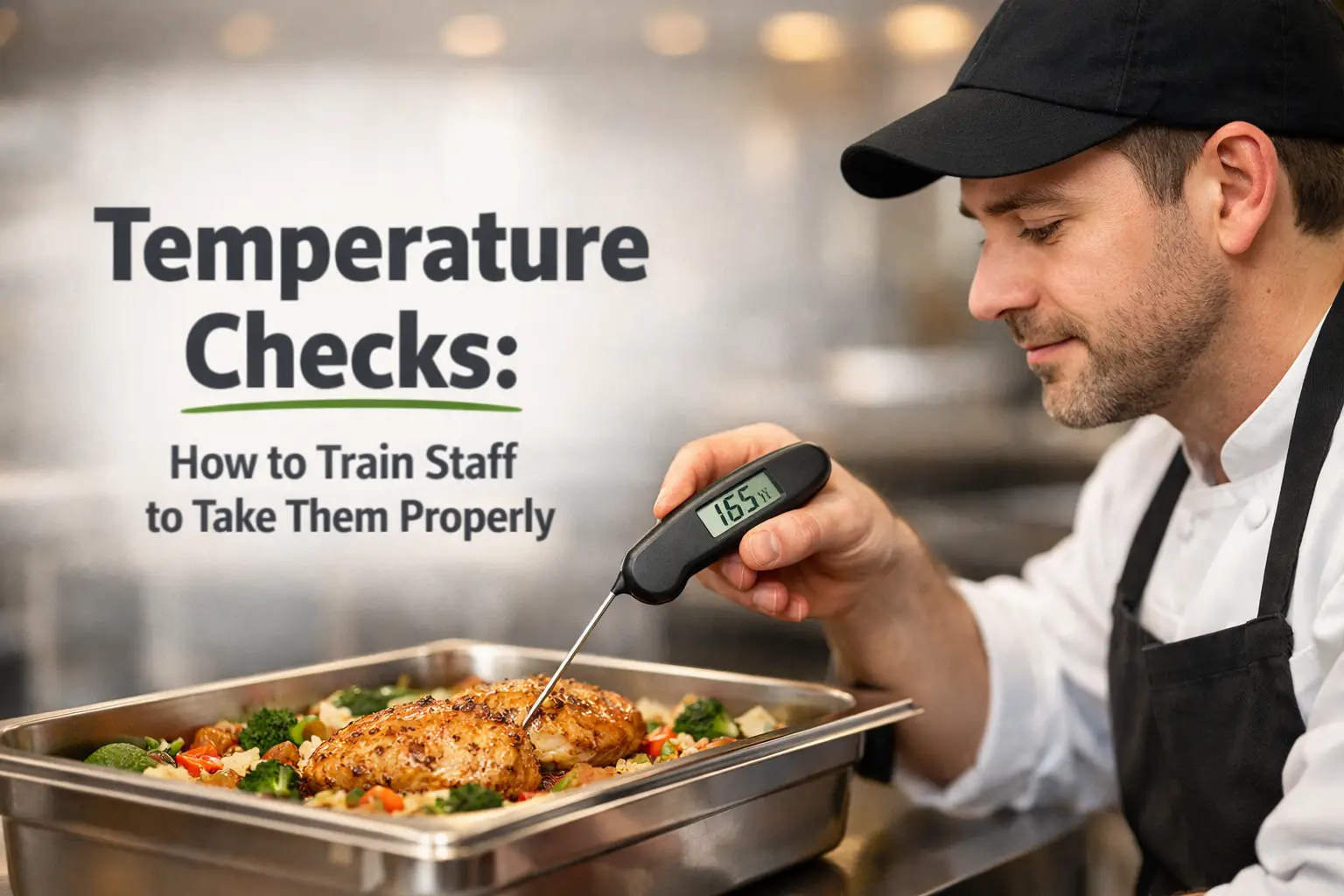
Temperature checks only help when staff do them properly. Learn how to train the team to use probes record results and act on failures.
Table of contents
- Why temperature checks fail in a busy kitchen
- Probe technique and cleaning basics
- Target foods and safe limits
- Recording practices and common mistakes
- Corrective actions when readings fail
- Coaching staff to stay consistent
- How Food-Safety.app supports this
- Practical scenarios you can use today
- Implementation checklist and how to start today
Why temperature checks fail in a busy kitchen
In a high‑pressure service, temperature checks can slip if processes aren’t concrete. Inconsistent probe use leads to unreliable readings. Rushed service leaves little time for proper wait times after insertions, so readings are taken too soon. Missed cleanings between uses create contamination risk. Poor documentation makes traceability difficult, which can undermine HACCP compliance and internal audits.
Inconsistent probe use
Staff may use different probes, or insert them at varying depths. Consistency matters because even small differences in insertion depth or angle can affect readings. Standardise probe models, calibrate before each shift if possible, and rehearse a single technique across the team. Cross-contamination training helps staff remember safe handling.
Rushed service
During peak service, there’s pressure to finish quickly. Temptations to cut corners on wait times or skip calibrations creep in. Emphasise that accuracy saves waste and protects customers, even if it takes a few extra seconds per item. This supports meeting legal responsibilities to keep people safe.
Missed cleanings
A dirty probe or squeeze of contaminated tongs can transfer bacteria between samples. Clean probes between uses with approved sanitising practices and keep a visible routine so staff perform it automatically, not periodically. Proper cleaning protocols help reinforce this.
Poor documentation
Incomplete readings, missing timestamps or wrong measurement sites undermine traceability. A simple, consistent form helps managers verify that checks happened, when they happened, and what actions followed. Record-keeping requirements ensure consistency.
Probe technique and cleaning basics
Mastering the mechanics of a temperature check reduces errors and strengthens your HACCP plan. Train staff to use the same technique every time, and build it into shift routines so it becomes second nature.
Insertion depth and location
Insert the probe into the thickest part of the item, avoiding fat, bone, or gristle. For thick cuts, test at multiple sites and use the average or the core thermometer reading where appropriate. Document the site used if your process requires it. Staff training helps ensure consistent technique.
Wait times and reading accuracy
Allow the probe to stabilise before recording the temperature. A typical hold time is 5 to 15 seconds, depending on the product and probe. Rushed readings are often falsely high or low, leading to unnecessary rework or unsafe serving.
Cleaning between uses
Clean probes between samples with approved sanitiser and dry thoroughly before the next use. Visibly clean probes signal to the team that the process is being followed and helps prevent cross‑contamination.
Avoiding cross‑contamination
Use dedicated probes for raw and ready‑to‑eat items when possible. Store probes in clean sanitiser solution or a clean, dry holder between tasks. Label probes if you rotate between sites or products to prevent mix‑ups.
Target foods and safe limits
Understanding target core temperatures helps you determine when a dish is safe to serve and when to rework it. Use practical targets that align with your HACCP plan and local regulations. The examples below are typical targets used in many catering environments, but always align with your approved procedures and official guidance.
| Food type | Core temperature target | Hot holding minimum | Rest or cooling guidance |
|---|---|---|---|
| Poultry (whole cuts) | 75°C or higher | Above 63°C | Test in the thickest part; rest briefly if needed |
| Beef, pork, lamb (whole cuts) | 70°C or higher | Above 63°C | Test at the center; avoid overcooking outside of target |
| Reheated foods | 75°C core | — | Reheat uniformly; retest after reheating |
| Cooked vegetables and grains | Generally safe when cooled and stored properly | — | Cool from 63°C to 8°C within 90 minutes where possible |
For official guidance on temperatures, consult the appropriate authority such as the Food Standards Agency. Food Standards Agency
Recording practices and common mistakes
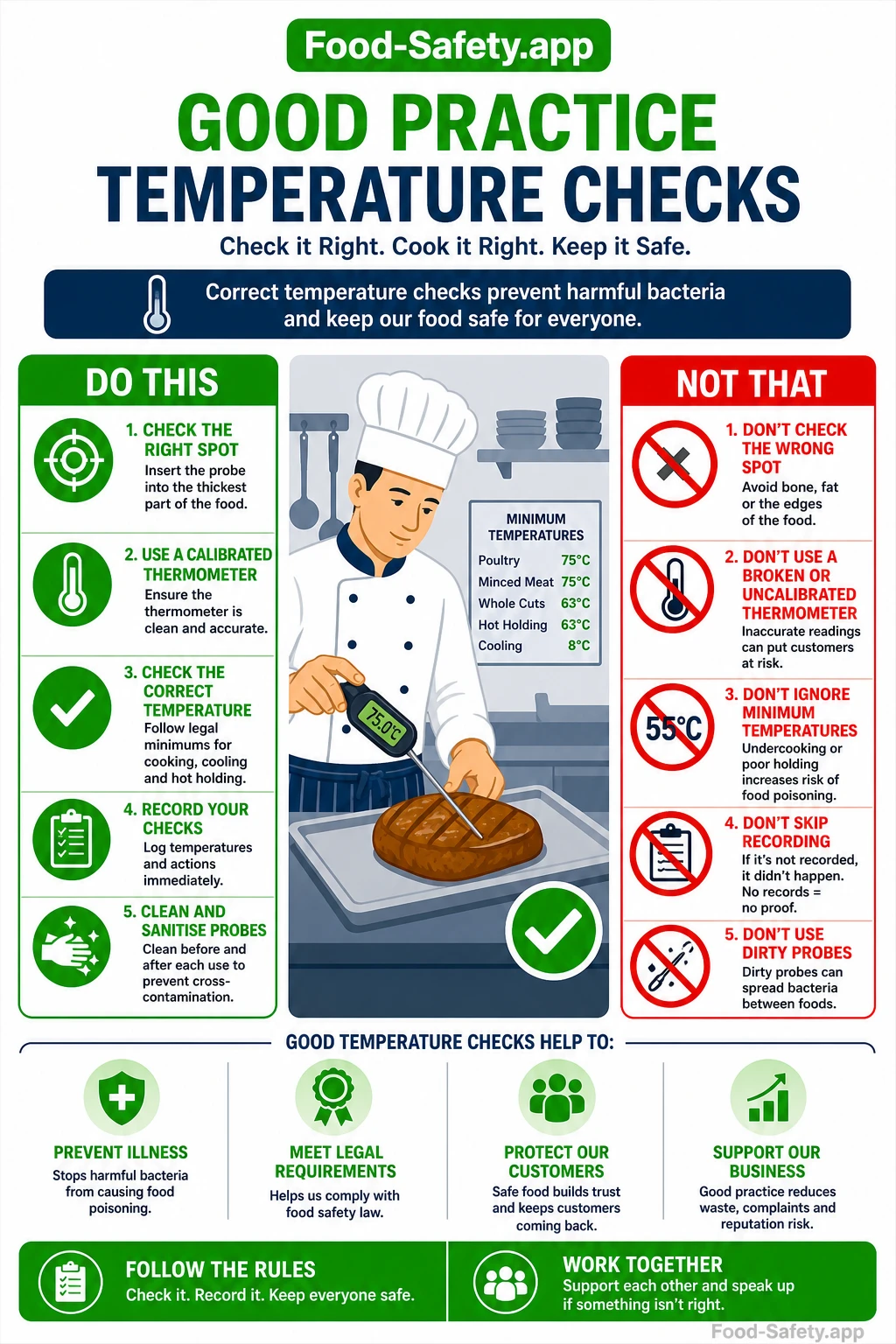
Accurate recording is the backbone of traceability. When a reading is out of spec, a timely, documented action helps protect guests and supports audits. Be explicit about what was measured, where, and when, and keep records that are easy to review during inspections.
Common recording mistakes
- Missing timestamps or dates
- Recording the wrong site or product
- Using inconsistent units (°C vs %)
- Incomplete sections or missing actions taken
Best practices for records
- Use a clear, universal form for all temperature checks
- Log the time, product, site of measurement, and reading
- Note the action taken if the reading is out of spec (reheat, recheck, discard)
- Escalate persistent issues to a supervisor promptly
During this process, consider adherence to broader governance and documentation standards. Record-keeping requirements help ensure consistency across the team.
Corrective actions when readings fail
When a reading fails, take a defined, repeatable set of actions to protect safety and service quality. A quick, documented response reduces waste and prevents recurrence.
- Recheck with a clean probe on a fresh sample
- If still out of spec, reheat to the core target and retest
- If the retest fails again, discard or escalate per SOP
- Document the action taken and notify the supervisor or HACCP lead
Coaching staff to stay consistent
Consistency comes from simple routines. Implement short, practical coaching that fits into busy service without slowing pace.
Daily routines and reminders
Daily routines and reminders sentence case text to preserve readability. Daily huddles focus on temperature checks, visible pass checklists remind staff of steps, and bite sized coaching prompts support performance during service.
Staff training is a continuous priority to keep consistency across shifts.
How Food-Safety.app supports this
Food-Safety.app provides practical tools to make temperature checks reliable and auditable even when the kitchen is at full tilt. Features include timestamped entries, probe calibration logs, cleaning task reminders, offline access, and exportable PDFs for audits. The platform also offers HACCP tools and training resources to keep your team aligned on definitions, targets, and actions.
Practical scenarios you can use today
Use the scenarios below to train staff with real-life prompts that reflect daily operations.
Scenario 1: Lunch service — reheating curry to core 75°C
During lunch service, reheat curry to a safe core of 75°C. If the reading shows 72°C, reheat again to the core target, retest, log the action, and notify a supervisor. Document the temperature trajectory and time to completion.
Scenario 2: Cooling phase — record initial cooling temp and time
When cooling hot servings, record the initial temperature and time, then verify the rate of cooling meets safe requirements before moving to storage. If cooling is slower than target, adjust portion size or start the cooling process earlier in service.
Scenario 3: Probe calibration — weekly check against a standard
Perform a weekly probe calibration against a known standard. Log the calibration result, and replace the probe if drift is detected. Include the date, standard temperature, and any corrective actions taken.
Implementation checklist and how to start today
- Draft or review your standard operating procedures for temperature checks
- Define target safe limits for your key foods and reheats
- Install a simple, consistent recording method and train all staff
- Schedule daily huddles and visible reminders on the pass
- Set calibration and cleaning tasks with clear ownership
- Adopt a temperature-check workflow that works offline and exports for audits
Learn more about using Food-Safety.app for temperature checks
Start building reliable temperature checks today with Food-Safety.app offline support, clear audits, and built in training resources for catering teams.