Introduction
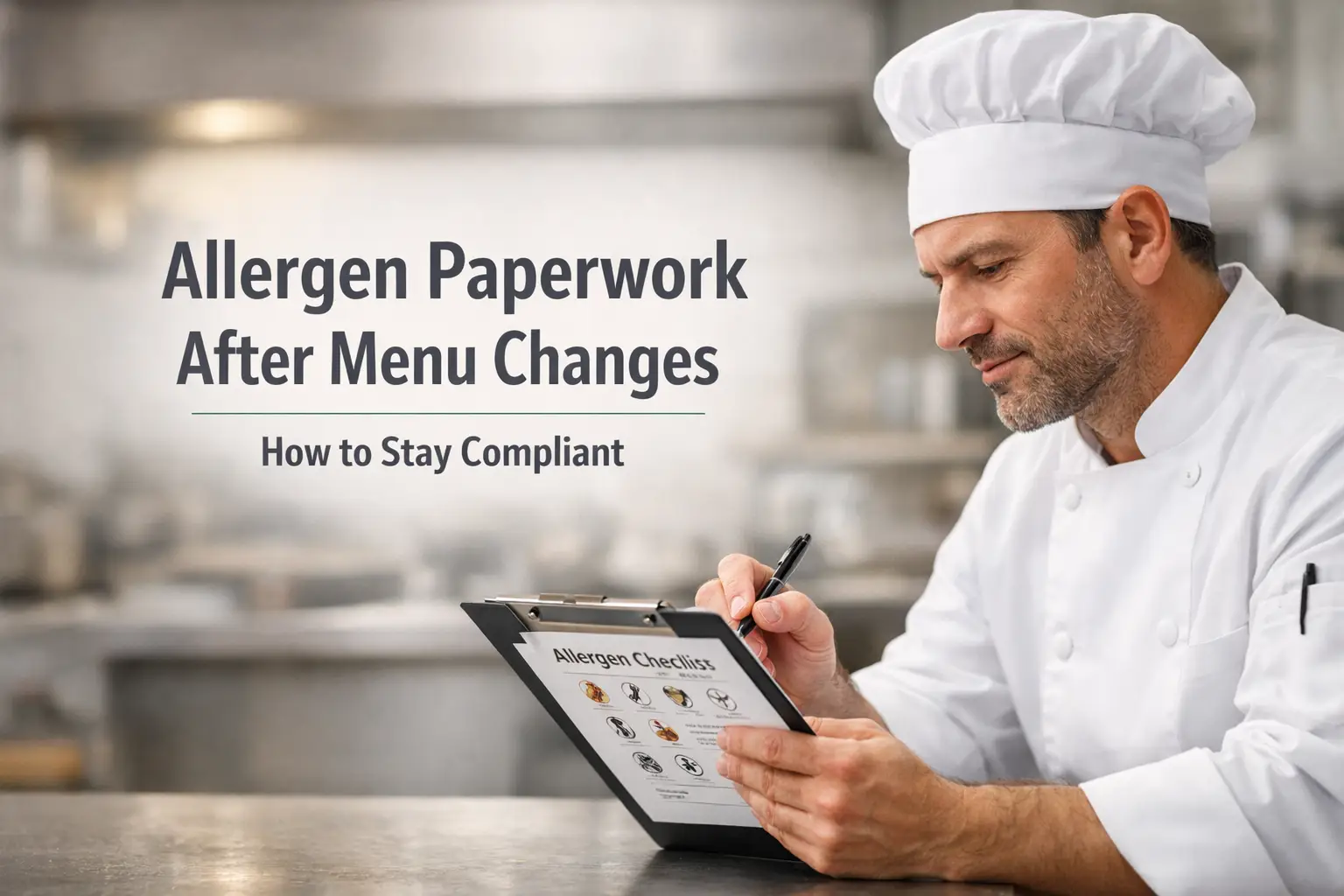
Menu changes often break allergen paperwork. Learn how to keep records labels and staff information aligned so a quick recipe change does not become a serious risk.
Table of contents
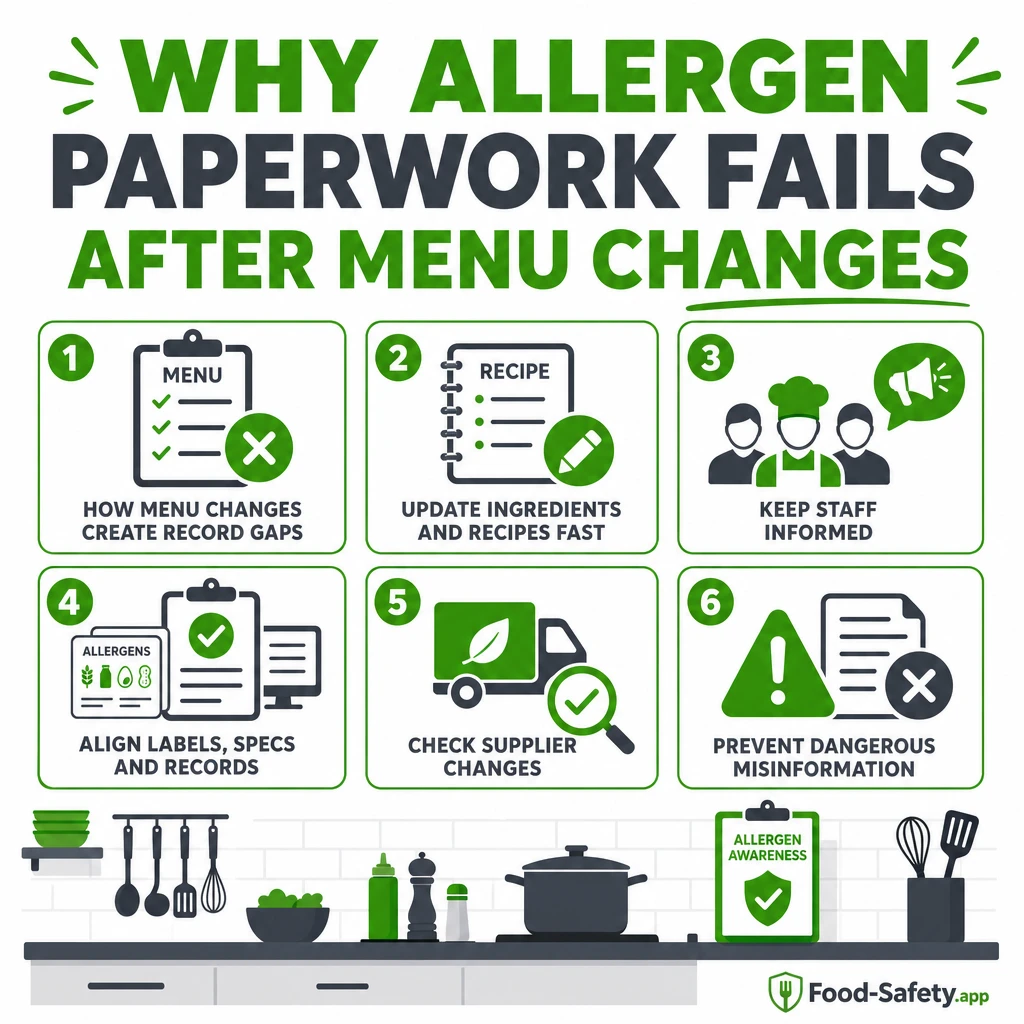
Why menu changes disrupt allergen paperwork
Menu evolution happens through new dishes, substitutions, seasonal items, and specials. If the paperwork isn’t updated the same day, the kitchen and front-of-house teams may default to the old allergen status. A sauce replaced by a mustard-containing version, a bun swapped for a sesame-topped alternative, or a garnish reconfigured can all alter allergen contents without a corresponding update to specs or allergen sheets. In a busy service, these small changes become major risk factors.
Practical consequences in real service
- A supplier replaces a sauce with a newer version that includes celery — staff assume the previous label remains accurate.
- A burger bun is changed to a gluten-free option without amending the allergen sheet, confusing servers on daily checks.
- A lunchtime special is added verbally but never written into the allergen record, leading to inconsistent answers during customer questions.
- A dessert recipe is tweaked; the printed menu still cites the old ingredients and allergens.
- Staff answer questions using yesterday’s sheet, not today’s recipe, creating conflicting guidance at the counter.
These scenarios show how quickly a single undocumented change can undermine a customer’s safety and a business’s due diligence during inspections.
Common gaps that create risk
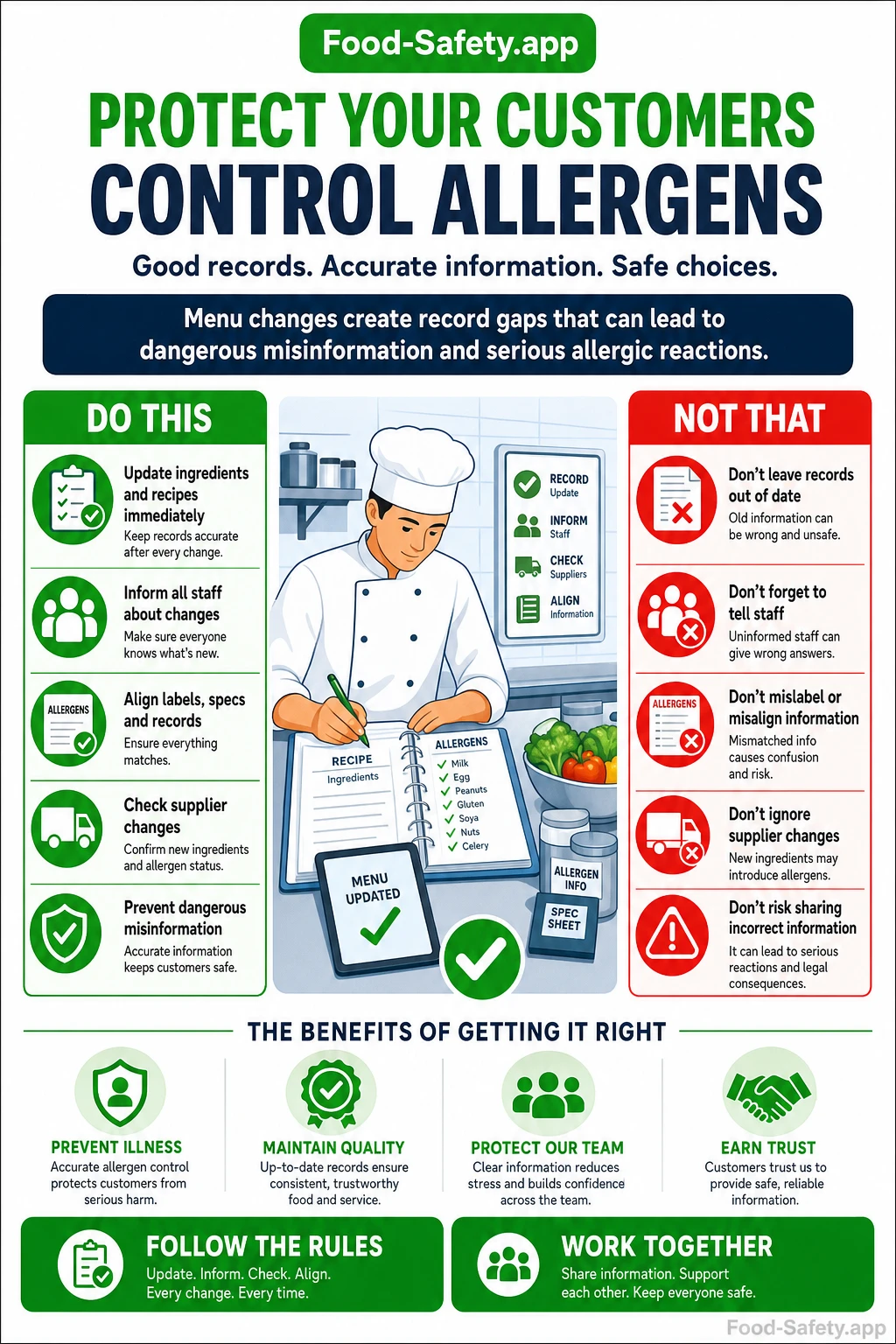
Across front-of-house, kitchen, and management, several recurring gaps open the door to incorrect allergen information. These gaps are often procedural, not technical, and can be addressed with disciplined routines and clear ownership.
- Verbal updates that are not captured in a written record or version-controlled file.
- Printed menus or spec sheets that lag behind current recipes.
- Disparate storage locations for specs, making it hard to find the latest version during service.
- No single source of truth for allergen data shared across teams.
- Suppliers changing ingredients without timely change notices being acted upon.
- Inadequate staff training on where to find the latest allergen information.
Without closing these gaps, even well-meaning teams can give inconsistent or incorrect allergen guidance to customers.
For example, cross-contamination concerns can arise if staff rely on outdated processes or incomplete records. Cross-contamination explained helps frame what needs to be controlled in daily routines.
Practical actions to stay compliant
Apply a structured, day-one approach to changes so allergen information remains current. The following actions are practical and work in a commercial kitchen.
- Establish a single source of truth for all allergen data and keep it in a shared, searchable folder.
- Require supplier change notices to be reviewed before stock is used and logged in the change record.
- Update menus and allergen information on the same day as any recipe change.
- Ensure staff know where the latest version is kept and have access to it during service.
- Use version control so old paperwork is not in circulation.
- Keep checks and audits that managers can reference during inspections.
Coordinate documentation with training to ensure everyone understands where to access the latest information. For more on building a robust allergen strategy, see Allergen management protocol for food businesses.
Practical actions to stay compliant (checklist)
| Action | Owner | Timing | Notes |
|---|---|---|---|
| Review any supplier change notices | Kitchen Manager | Before new stock is used | Record approval and update |
| Update specs, allergen sheets & menu copies | Ops Supervisor | Same day as change | Print and digital copy |
| Distribute latest version to front-of-house | Front-of-house Lead | Before service | Brief staff on changes |
| Close-out check to archive旧 versions | Quality Controller | End of day | Archive old versions |
Implementing an effective update routine
Put a documented, repeatable process in place so every change is captured and communicated. A practical routine could look like this:
- Trigger a change notice as soon as a recipe, ingredient, or menu item is altered.
- Prepare updated ingredient specs, allergen sheets, and any required label changes within the same day.
- Push a confirmed version to the single source of truth and notify all teams.
- Provide a quick training touchpoint for front-of-house staff at shift handover.
- Log completion, including date, version number, and responsible person, for audit trail.
- Review monthly to confirm no stale versions remain in circulation.
For deeper guidance on how HACCP records support due diligence, see How HACCP records support due diligence.
Staff engagement and accountability
Get staff involved by making updates visible and routine. Clear ownership matters: who signs off changes, who distributes documentation, and who monitors for stale information. Use short handovers, written handover notes, and a quick visuals board in the staff room to highlight the latest allergen information. Encourage feedback from servers who interact with customers daily — their insights help catch gaps before service peaks.
Practical shift scenarios
- A server notices yesterday’s allergen sheet while answering a customer; the shift has a new dish today — update flow catches this before service starts.
- A cook receives a supplier notice about a sauce change; the change is documented, approved, and reflected across all materials immediately.
For further guidance on training and staff development, see Allergen training for new and agency staff.
Tools, training and records
Maintaining an effective system requires practical tools and ongoing training. Records should be accessible, auditable, and searchable, with clear version numbers and timestamps. Staff should be trained on where to find the latest information and how to report discrepancies quickly.
For teams seeking a practical way to coordinate updates, Food-Safety.app, a food safety management system for catering businesses.
Regulatory guidance can support your programme. For example, the Food Standards Agency provides allergen labelling guidance that can help shape your update routines and staff training. See Allergen labelling guidance for reference.
Additional resources include internal materials on Allergen management and cleaning practices to prevent cross-contact. For example, learning how to create an allergen matrix for your menu can be beneficial. See how to create an allergen matrix for your menu.
Internal training can also be supported by targeted sessions on cross-contamination prevention. See Cross-contamination training.
Additional practical guidance is available in the following internal resources: Allergen training for new and agency staff, Cleaning and cross-contact, and what records small businesses should keep.
See also /fhrs-scores-broken-down-what-affects-your-food-hygiene-rating/ for guidance on inspections and ratings. FHRs scores.
Strengthen allergen controls in your kitchen
Strengthen allergen controls by aligning records with every change and equipping staff with fast access to the latest information during service.