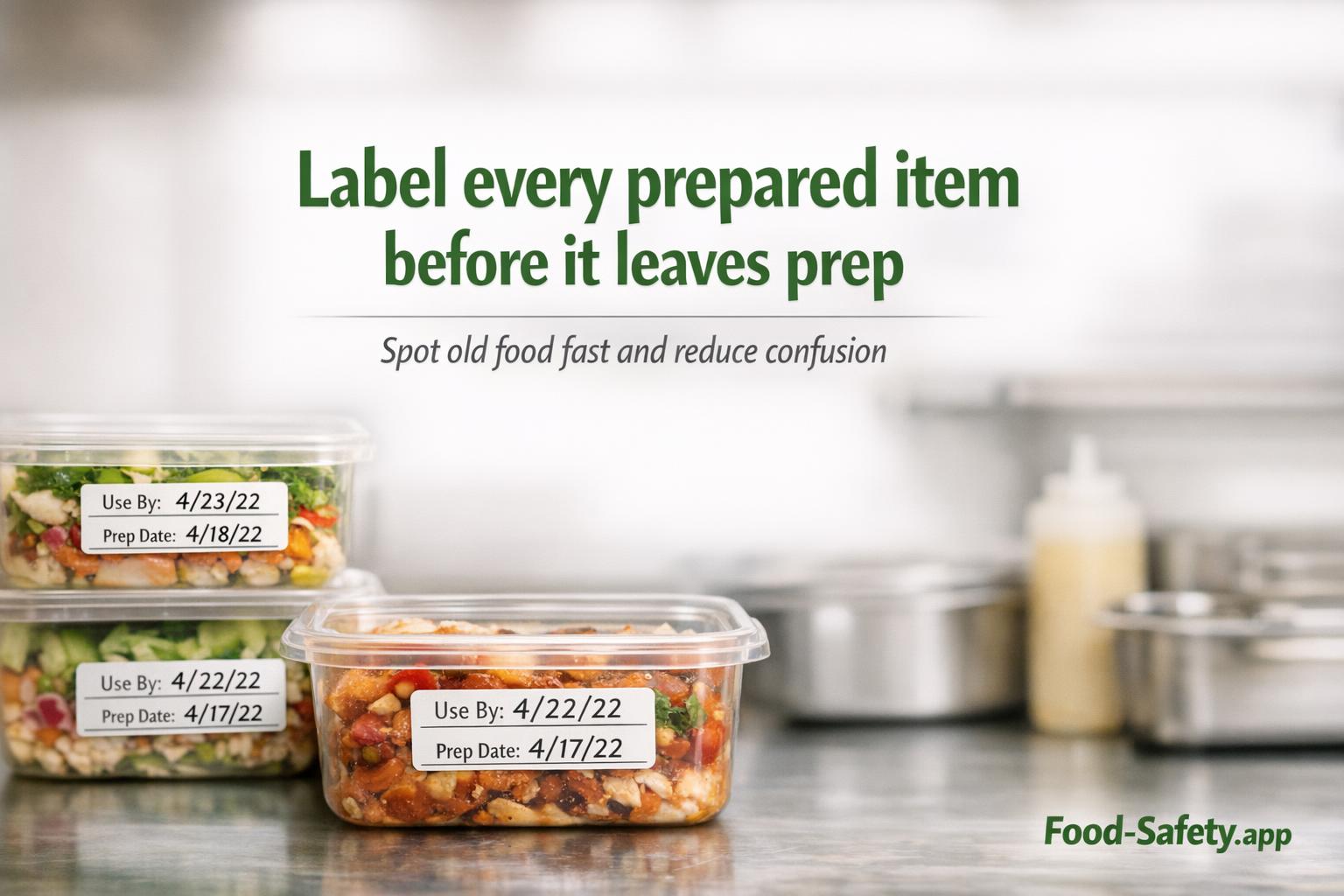
Date labels that stop food being served too late are one of the simplest ways to keep a busy commercial kitchen under control. When everything is moving fast, it only takes one vague tub of sauce, one unlabeled tray of cooked rice, or one “I’m sure that was made yesterday” moment to create waste, confusion, and a food safety headache. A good date labelling system helps your team spot old food quickly, keep turnover tight, and stop unsafe leftovers from being served in error.
This guide is written for UK catering and hospitality businesses, and food safety expectations can vary in other countries, so always check local rules if you work elsewhere. The aim here is practical: make date labels easy to use in a professional kitchen, fit them into busy service, and reduce the sort of confusion that happens when everyone is moving at full speed and someone says, “Whose box is this then?”
Why date labels matter in a busy kitchen
The main job of date labels is to stop food being served too late. That sounds obvious, but in a packed restaurant pass, school kitchen, hotel breakfast service, or takeaway prep area, “obvious” can disappear fast. When multiple people are making, chilling, reheating, and portioning food, you need a label that answers three questions at a glance: what is it, when was it made, and when should it be used or discarded.
Without that, staff start making guesses. Guessing is not a food safety control. It is more of a culinary adventure, and not the good kind.
Clear labels also reduce waste. Teams are far less likely to throw out good food early when they can see the dates clearly. At the same time, they are less likely to keep food too long because it looked fine. Food can look perfectly respectable and still be past its safe, planned use period.
A strong date labelling system supports stock rotation, gives supervisors a quick check point, and helps new staff work safely without needing to decode someone else’s handwriting from 6 a.m. on a Monday.
For a broader view of how these practices fit into HACCP, see HACCP principles explained.
Allergen management is another critical layer in a robust kitchen safety system. See clear allergen labelling on packaged food.
The best date labelling system for professional kitchens
The best system is the one your team will actually use every single time. In a commercial kitchen, that usually means a label that is quick to complete, easy to read, and consistent across all prep areas.
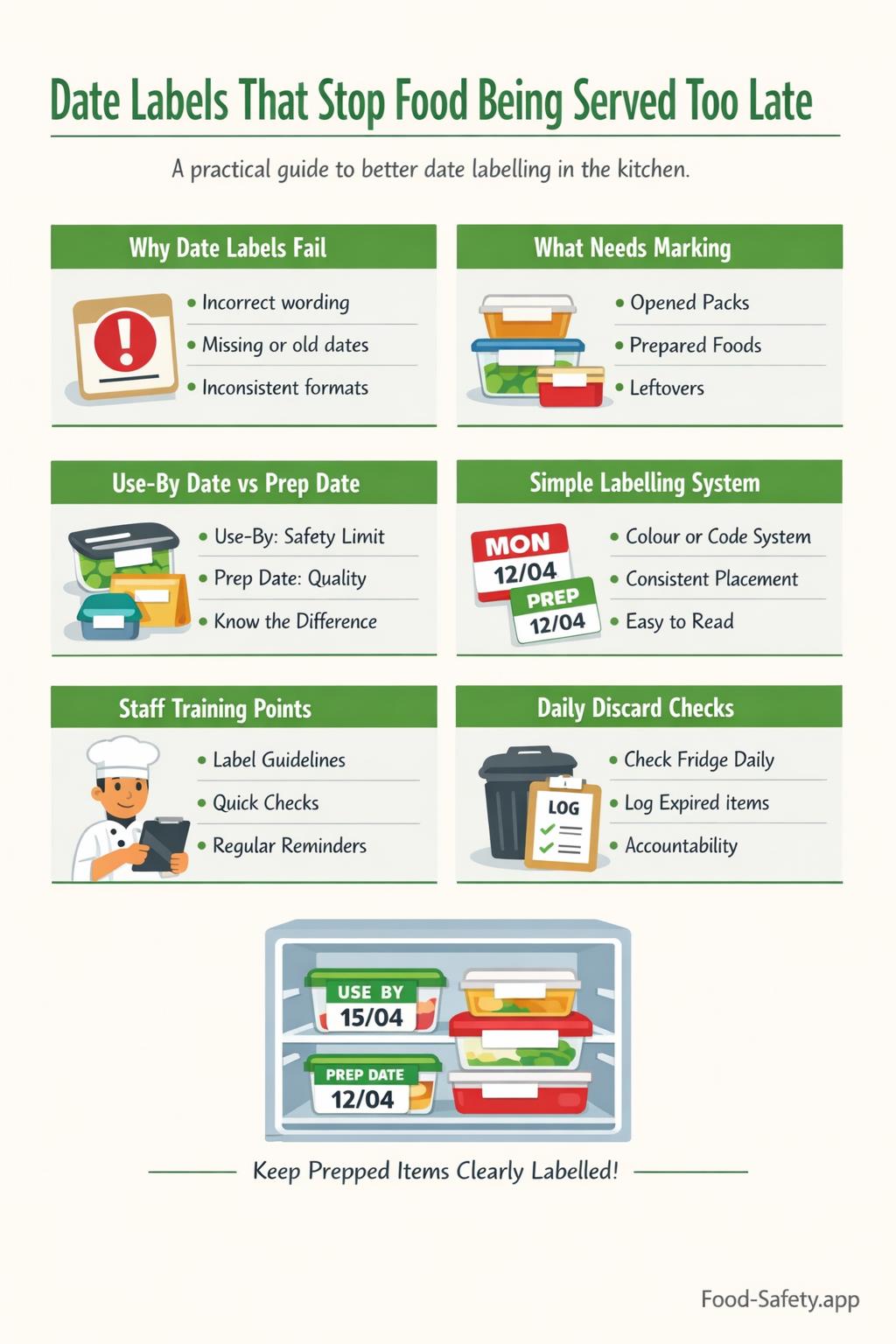
This approach should align with allergen management as well, see managing allergens safely in a busy kitchen.
Use one standard format
Pick one date format and stick to it across the business. For example, use day, month, and year written clearly, or another agreed format that removes confusion. The key is consistency. If one chef writes 03/04 and another means 3 April while someone else thinks it means 4 March, you have already lost the plot.
Separate made-on dates from use-by or discard dates
Many kitchens benefit from having both a prep date and a clear last-use or discard date, where appropriate to your controls. That makes it easier to judge rotation during service and cleaning. If food is transferred into smaller containers, the new container still needs a proper label. The salad in the gastro bin is not magically date-aware just because the original box had a sticker somewhere on the side.
Keep labels visible
Labels should face outward where possible, especially on shelf-stable prep areas, fridges, and walk-in storage. If a team member has to move six tubs to see the date on the seventh, the system is already slowing service down.
Make the system work for different sites
A hotel kitchen, a school canteen, and a small café all have different pressures. A good date labelling system should still work when one team is batch cooking, another is portioning leftovers, and another is handling multiple menu cycles. Keep the core rules the same, but adapt the physical label type to the pace of the site.
This approach should align with allergen management as well, see managing allergens safely in a busy kitchen.
What to put on each label
A practical label should be short, readable, and useful at the point of use. If it takes a paragraph to complete, people will stop doing it properly.
Include the food name
Name the food clearly. “Soup” is not enough if there are three soups. “Tomato and red pepper soup” gives staff confidence when checking stock during a rushed lunch prep.
Include the date prepared
This helps staff work out age quickly, especially for items made in batches. It is particularly useful for cooked meats, sauces, rice, pasta dishes, desserts, and prepared fillings.
Include the discard or use-by instruction
Use your own business rules for shelf life and storage, based on your food safety controls. The important thing is that the label makes the end point obvious. If the food has reached its planned limit, staff should not need to calculate anything while tickets are printing and the fryer is screaming for attention.
Add initials if useful
Initials can help trace who prepared the item or who completed the check. That can be useful during handover or if something looks off later in the day. Keep it optional if it slows the team down too much, but use it where it genuinely helps accountability.
As part of overall hygiene and safety culture, see Good hygiene practices in kitchen.
How to train staff so labels actually get used
Even the best date labelling system fails if the team treats it as “that admin thing we’ll do later”. Training needs to be short, practical, and built into the way the kitchen already works.
Show the reason, not just the rule
Staff are more likely to label properly if they understand that the label protects customers, reduces waste, and prevents awkward last-minute binning of food that was supposed to be served today. Explain that clear labelling also protects service speed because nobody wants a fridge rummage during a full lunch rush.
Teach by station
A prep chef, a dessert team member, and a KP all use labels differently. Show each area what good looks like at their station. For example, prep teams may label every container as it is filled, while front-of-house support teams may need to know how to spot a label that is no longer acceptable.
Make it part of opening and closing checks
Include label checks in opening, shift-over, and close-down routines. That way, date labels become part of normal kitchen control rather than a separate task that keeps getting forgotten until someone finds a suspicious tub at the back of the fridge.
Daily checks that stop old food slipping through
A good date labelling system only works if someone checks it. In a commercial kitchen, the daily check should be quick, visible, and tied to a person or role.
Start with the highest-risk storage areas
Fridges, chilled prep units, and ready-to-eat storage should be checked first. These are the areas where unlabeled or out-of-date food is most likely to cause a problem if it is not caught early.
Daily checks should also include temperature control, such as fridge temperature monitoring.
Use a simple rotation rule
Place older stock in front of newer stock where possible. Train staff to look for the oldest label first, not the nearest tub. In busy service, people naturally grab what is easiest to reach. Your system should make the safest choice the easiest choice too.
Check transferred food
Whenever food is moved into a different container, it should be relabelled straight away. This includes sauce pots, squeeze bottles, trays, ingredient tubs, and buffet-style pans. A container without a label should not be left to “deal with later”, because later tends to arrive right in the middle of service.
Remove anything doubtful
If a label is missing, smudged, peeled off, or unclear, the food should be treated cautiously and dealt with under your business rules. Train staff to ask rather than guess. Guessing is how yesterday’s risotto ends up auditioning as today’s special.
Common mistakes that lead to food being served too late
Most label failures are not dramatic. They are small, repeated habits that build up over time.
Using vague handwriting
If someone can read the date only after turning the tub into the light and squinting, the label is not doing its job. Use printed labels where possible, or insist on clear block capitals if handwriting is the only option.
Relying on memory
Memory is not a control measure. Staff changes, split shifts, and delivery pressure mean people will forget. Labels remove that risk.
Not relabelling mixed or repacked items
Once food is repacked, portioned, or mixed into another container, the original packaging is no longer enough. The new container needs its own label with the key details.
Leaving old labels stuck on containers
Double labels create confusion. A clean container with two different dates is practically begging for a mistake. Remove old labels before reusing tubs and boxes.
What to do when labels fail
Things go wrong. Labels fall off, fridges get overfilled, and in a busy kitchen someone will eventually put a container down “just for a second” and forget about it. What matters is how quickly the team responds.
Set a clear escalation step
If a member of staff finds a missing or unreadable label, they should know exactly who to tell and what to do next. That may mean isolating the food until it can be checked, or disposing of it if it cannot be verified safely under your controls.
Review why it happened
Look at the cause. Was the label printer out of tape? Did the team run out of pens? Was the format too complicated? Correct the system, not just the symptom. Otherwise the same problem will return, usually on a Saturday evening when you are already short-staffed.
Record repeated problems
If labels are repeatedly missing in one prep area, that points to a process issue. The answer might be better stationery, clearer training, or a more sensible fridge layout. Often, the fix is boring rather than dramatic, which is excellent news because boring is usually safe.
Paper labels, colour codes, and digital options
There is no single perfect system. Some kitchens work well with simple paper labels and marker pens. Others prefer pre-printed colour-coded labels or a digital system that prints from a screen. The right choice depends on volume, staff turnover, and how much time is spent in production versus service.
Paper labels
Paper labels are cheap and flexible, but only if the team uses them consistently and the ink stays readable in chilled conditions. Keep pens where labels are used, not in a drawer three rooms away.
Colour coding
Colour coding can make it faster to spot older batches or different production days, especially in larger sites. Just make sure everyone knows what the colours mean. A colour chart on the wall is useful; a colour chart in one supervisor’s head is not.
Digital systems
Digital labelling can help in higher-volume kitchens because it reduces manual errors and improves consistency. If you use a food safety management system for catering businesses, such as Food-Safety.app, make sure it supports the actual flow of your kitchen rather than forcing staff into awkward workarounds.
Keeping it simple in real service
The most effective date labels are the ones that fit naturally into the rhythm of the kitchen. A practical routine might look like this: label when food is packed away, check labels at shift change, rotate stock before each service, and remove anything that cannot be clearly identified. That is far more reliable than trying to rescue a messy system later.
For best results, keep labels close to the point of use, keep the format consistent, and keep the instructions short enough that a tired chef can still follow them without sighing. A strong date labelling system should save time, not create a paperwork marathon.
If you manage a multi-site operation, standardise the basics across all sites so staff can move between venues without relearning the rules. That is especially helpful for hotels, contract caterers, and groups with shared kitchen teams.
Conclusion
Date labels that stop food being served too late do more than tick a compliance box. They help your team see what is safe, what needs using first, and what should be removed before it becomes a problem. In a busy commercial kitchen, that means less waste, fewer mistakes, and smoother service.
Keep the system simple, use one clear format, train staff properly, and build checks into daily routines. If you can glance at a fridge shelf and know what is oldest in seconds, your date labelling system is doing its job. If you need a detective novel to work out what’s in the tub, it is time to tighten things up.
For kitchen teams that want a more joined-up approach, a food safety management system for catering businesses can help keep labelling, checks, and records in one place. You can also refer to the Food Standards Agency for general UK food safety guidance via food.gov.uk.
For an integrated approach, see Food safety systems in place.
Strengthen your kitchen food safety system
Bring date labelling, routine checks, food safety records, and team responsibilities together in one practical system. Food-Safety.app helps catering and hospitality businesses organise essential controls clearly, support consistent staff routines, and reduce the confusion that can lead to missed checks or unsafe food decisions.