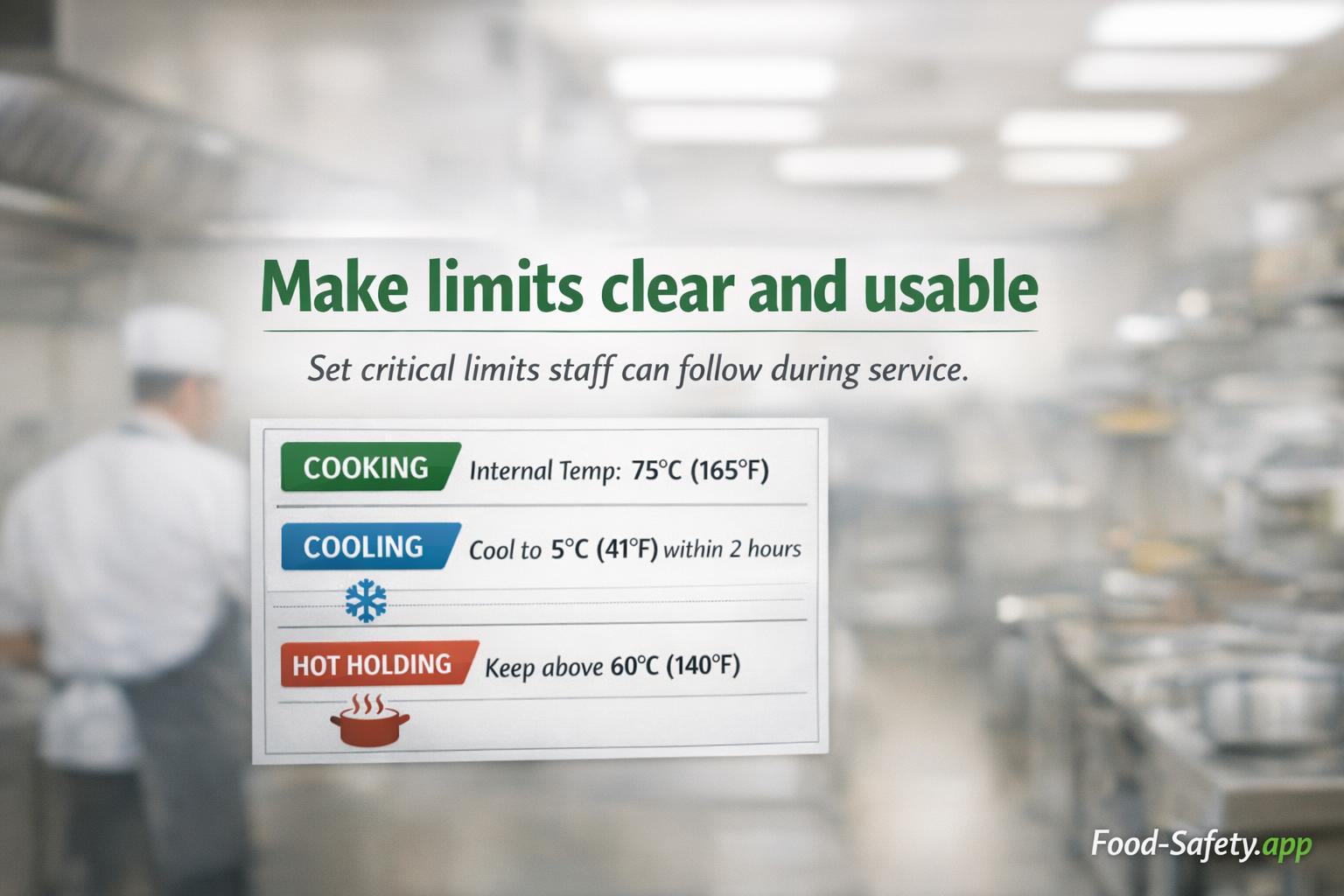
If your team is asking, “How hot is hot enough?” or “How long can that sit there?”, your critical limits are probably too vague. In a busy kitchen, the best critical limits that staff can follow are the ones that leave no room for guesswork, support clear HACCP checks, and make corrective action quicker when service gets hectic.
That matters because clear limits reduce confusion, keep checks consistent, and stop people making up their own rules mid-service. A limit like “cook thoroughly” sounds fine on paper, but in a catering environment it is about as helpful as a chocolate teapot. Staff need numbers, timing, responsibility and a simple way to prove what happened.
This guide shows how to set practical critical limits for a professional kitchen, how to write them so people actually use them, and how to keep them working when the pressure is on.
Table of contents
Why vague limits fail in service
In theory, a vague limit gives flexibility. In practice, it creates drift. One person interprets “keep chilled” as fridge storage, another thinks a prep counter near the pass is fine for a short while, and suddenly nobody is sure who made the call or when the food moved out of control.
That is where service problems start. When a limit is not specific, staff will guess. When staff guess, checks become inconsistent. When checks become inconsistent, corrective action is slow, messy, and often written up after the event with a lot of eyebrow-raising.
The most common weak points are:
- No number or time attached to the limit
- No clear responsibility for checking it
- No agreed action if the limit is missed
- No way to verify the result quickly during service
For example, “reheat properly” does not help a supervisor at 12:30 on a packed lunch shift. “Reheat to 75°C and hold hot at 63°C or above” gives the team something concrete to work with. That is the difference between a rule and a habit.
What good critical limits look like
Good critical limits are specific, measurable, time-bound, accountable and verifiable. That sounds a bit policy-heavy, but it is really just the practical stuff staff need to work safely without second-guessing everything.
Specific
Say exactly what must happen. “Store ready-to-eat food at 5°C or below” is specific. “Keep cold food cold” is not.
Measurable
If you cannot measure it, you cannot manage it. Use temperatures, times, or other clear checks that can be recorded.
Time-bound
Some limits are about a point in time, others about how long something can stay out. Time matters especially in service, where a tray can drift from the fridge to the pass to the bin faster than anyone would like.
Accountable
Every limit should have a named role attached, even if the person changes by shift. For example: “Line chef checks and records every 30 minutes” or “Duty manager signs off the cooling log.”
Verifiable
Staff must be able to check it using the equipment available on site. If your process relies on a probe thermometer, that thermometer needs to be working, clean and calibrated.
Match critical limits to your equipment
Critical limits should fit the equipment you actually use, not the ideal kit you wish you had. If your oven runs hot at one shelf and cooler at another, the limit needs to reflect that. If your fridge struggles at peak service, you need to know before the audit, not during it.
Thermometers should be calibrated regularly, with calibration records kept close to the check records. That makes it easier to trust the numbers and easier to explain them if there is a question later. The same goes for blast chillers, fridges, hot holding units and probe covers; if the equipment is off, the limit is not the problem, the process is.
A useful rule is to write limits around the equipment’s actual operation, then test them during a normal shift. If staff need three extra steps and a diagram just to get the probe in the right place, the process is too clunky.
For UK food safety guidance, the Food Standards Agency is a sensible place to check current advice.
Write critical limits clearly for staff
Clear writing is half the battle. A strong limit should say:
- the exact value
- the unit, such as °C or minutes
- the location or item being checked
- the time when it must be checked
- who is responsible
- what to do if it is out of limit
So instead of “check the fridge regularly”, write “check the ready-to-eat fridge at start of shift and every 2 hours during service; action required if above 5°C”. That is easier to follow, easier to train, and easier to audit.
Keep wording short enough to fit on a one-page reference card at each station. If you need a paragraph to explain one limit, it probably needs tightening up.
Good wording examples
- “Reheat poultry dish to 75°C, then hold at 63°C or above.”
- “Cool cooked sauce from 60°C to 5°C or below within 90 minutes.”
- “Store ready-to-eat foods at 5°C or below.”
Poor wording examples
- “Reheat thoroughly.”
- “Cool quickly.”
- “Keep chilled as much as possible.”
Train staff to use critical limits on shift
Even the best limit fails if staff do not know how to use it under pressure. Training needs to be short, practical and based on the actual kit in the kitchen, not a classroom version of the shift that never really happens.
Start with a pre-service briefing. Keep it to a few minutes and focus on the limits that matter that day: hot holding, chilling, reheating, and storage temperatures. Then follow up with a one-page reference card at the station, ideally where the probe, logs and sanitiser live.
Good training includes:
- a quick explanation of why the limit matters
- a live demo using the real thermometer and equipment
- a practice check by the person who will use it
- a reminder of the corrective action if the limit is missed
Short drills help too. Ask a new starter to show how they would probe a cooling dish, or have a supervisor spot-check a fridge reading at the start of service. A two-minute practice can prevent a two-hour headache later.
Examples of critical limits staff can follow
Here are three practical scenarios that work well in catering and hospitality operations. They are simple enough for service, but specific enough to support reliable records.
Reheat and hot hold a poultry dish
A cooked poultry dish should be reheated to 75°C and then held at 63°C or above. Staff should use a clean, calibrated probe thermometer to check the centre of the thickest part, then log the result immediately.
If the dish does not reach temperature, stop service, continue reheating, and recheck before it goes out. If it cannot be corrected safely, discard it. That is a much calmer option than trying to “make it work” while customers are waiting and everyone is pretending not to panic.
Cool a cooked sauce
A cooked sauce can be cooled from 60°C to 5°C or below within 90 minutes, using an ice bath, shallow trays or a blast chiller depending on the setup. Record the temperature every 15 minutes so the team can see whether the process is on track.
If cooling stalls, split the batch, move it to a more effective cooling method, or discard it if it cannot be brought back under control. The limit only works if someone is watching the trend, not just the final reading.
Store ready-to-eat food during service
Ready-to-eat foods should be stored at 5°C or below. Check fridge temperatures at the start of service and during service, especially when doors are opening constantly in a busy lunch rush.
If the fridge is above 5°C for more than 2 hours, discard the affected food. If it has only just drifted and you can fix the issue immediately, move the food to a working fridge, log the incident and check the temperature again. Keep the decision simple and document it clearly.
Review critical limits after changes, incidents and routine checks
Critical limits are not set-and-forget. Equipment changes, menu changes, staffing changes and repeated incidents all tell you something about whether the current limits still work in practice.
Set a quarterly review so someone actually looks at the logs, the corrective actions and any repeated weak spots. Also review limits after a breakdown, a failed temperature check, a complaint linked to temperature control, or a major change in service style.
Document the update. That includes what changed, why it changed and who approved it. A tidy record helps managers, supervisors and auditors understand that the system is being managed, not just filed away in a drawer for optimism.
A simple review checklist
- Are the limits still clear to new staff?
- Is the equipment still accurate and calibrated?
- Are the checks happening at the right times?
- Are corrective actions being followed?
- Have any incidents shown a pattern?
Practical takeaway
If you want critical limits staff can actually follow, keep them short, measurable and linked to the way your kitchen really works. Print them, place them at each service station, train people on the actual equipment, and make the corrective action obvious. That combination reduces confusion, improves HACCP checks and helps teams respond faster when something slips.
It also helps to pilot the limits for two weeks with the team, then review what worked, what got ignored and what needs tightening up. A ready-to-fill critical limits template can make that much easier, especially if you want something consistent across different shifts or sites. Food-Safety.app, a food safety management system for catering businesses, can also help keep the process organised without turning it into paperwork for paperwork’s sake.
From there, keep the habit going: brief before service, check during service, review after service. That is usually how good control sticks in a busy kitchen, not by magic, but by making the right thing the easy thing.
Learn more about critical limits
Discover practical templates and checklists to implement reliable critical limits in your kitchen, helping teams act quickly, reduce errors, and strengthen HACCP checks during busy service.