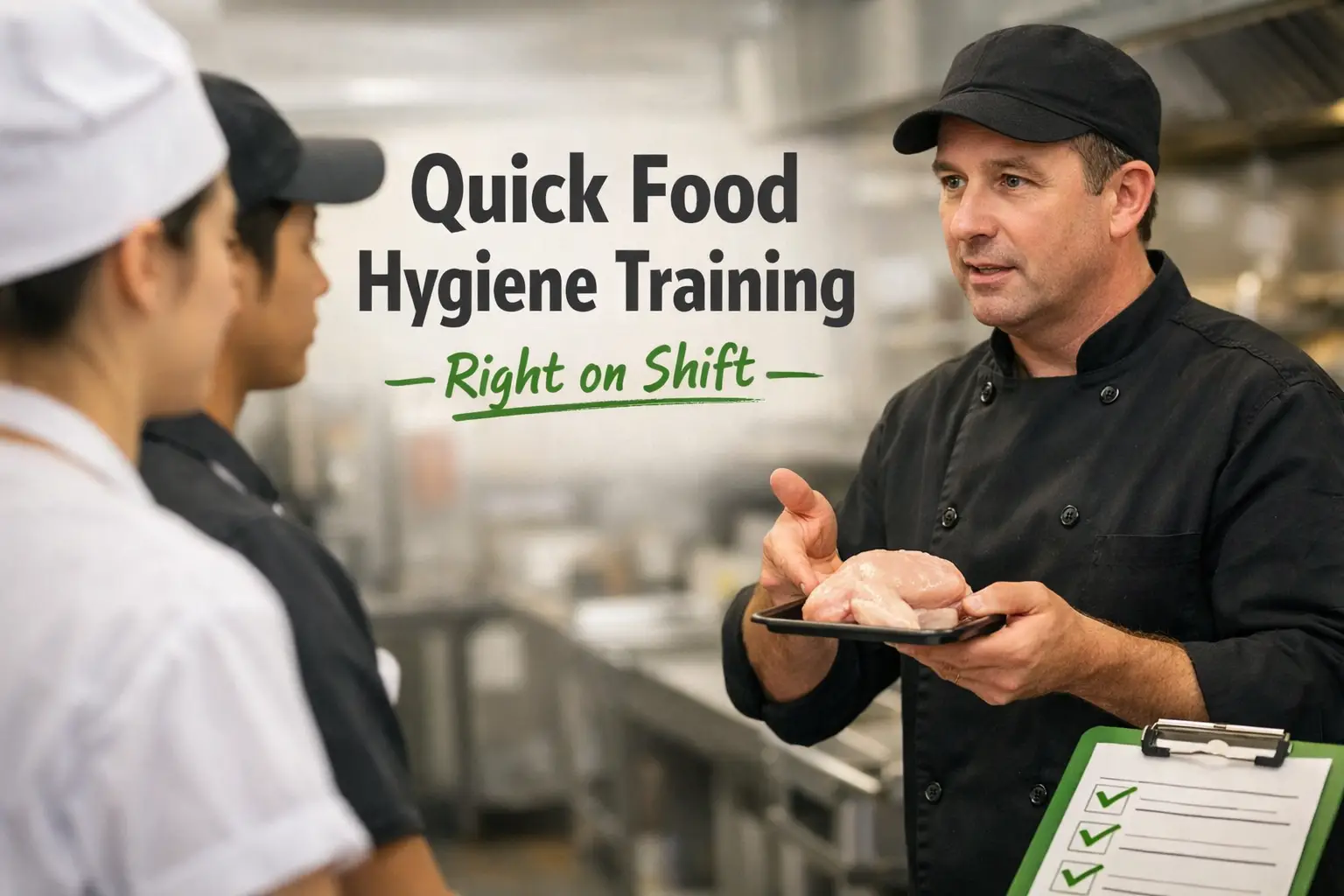
Train staff in food hygiene without long classroom sessions. Use short practical methods that fit busy kitchens and help standards stay consistent.
Why quick training matters in busy catering
Busy service places strong pressure on staff to perform correctly while under time constraints. Slow onboarding often leaves gaps in knowledge that surface as cross-contamination risks, incorrect temperatures, or missed allergen information. Quick, task-based training reduces these gaps by embedding essential habits from day one and tying each task to concrete outcomes such as safe fridge checks, clean preparation surfaces, and accurate logging. See how to stop cross-contamination in service to reinforce these practices.
Day one priorities for new starters
What counts as a CCP in a small kitchen? helps integrate allergen controls into day-one routines.
Hands-on essentials
- Handwashing and personal hygiene
- Cross-contamination prevention
- Temperature control requirements
- Cleaning and sanitising routines
- Allergen awareness and information handling
- Reporting problems and escalation paths
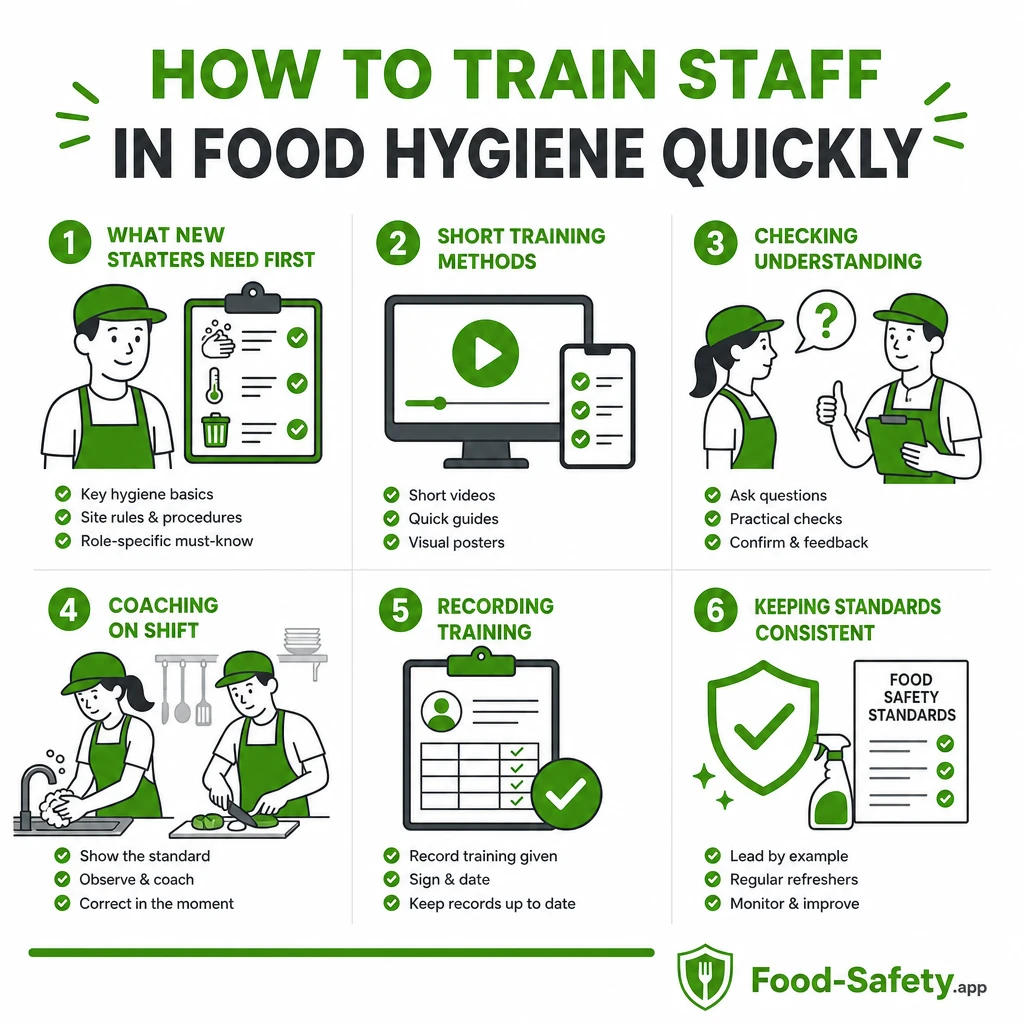
A fast onboarding framework: small checks and coaching
Structure for day one
- Welcome brief: outline expectations and the day’s rapid training plan.
- Shadowing: observe a seasoned colleague performing key tasks.
- Demonstration: the trainer shows the correct method step by step.
- Repeat-back: the trainee explains the steps aloud to confirm understanding.
- Sign-off: supervisor confirms completion of each task and records it.
Coach staff during service: on-the-spot correction
How to correct without breaking momentum
- Address the issue immediately in plain language and show the correct method.
- Ask short questions to confirm understanding, not to trip up the staff member.
- Demonstrate the right method, then have the staff member perform it again.
- Record the correction and plan a quick follow-up check on shift.
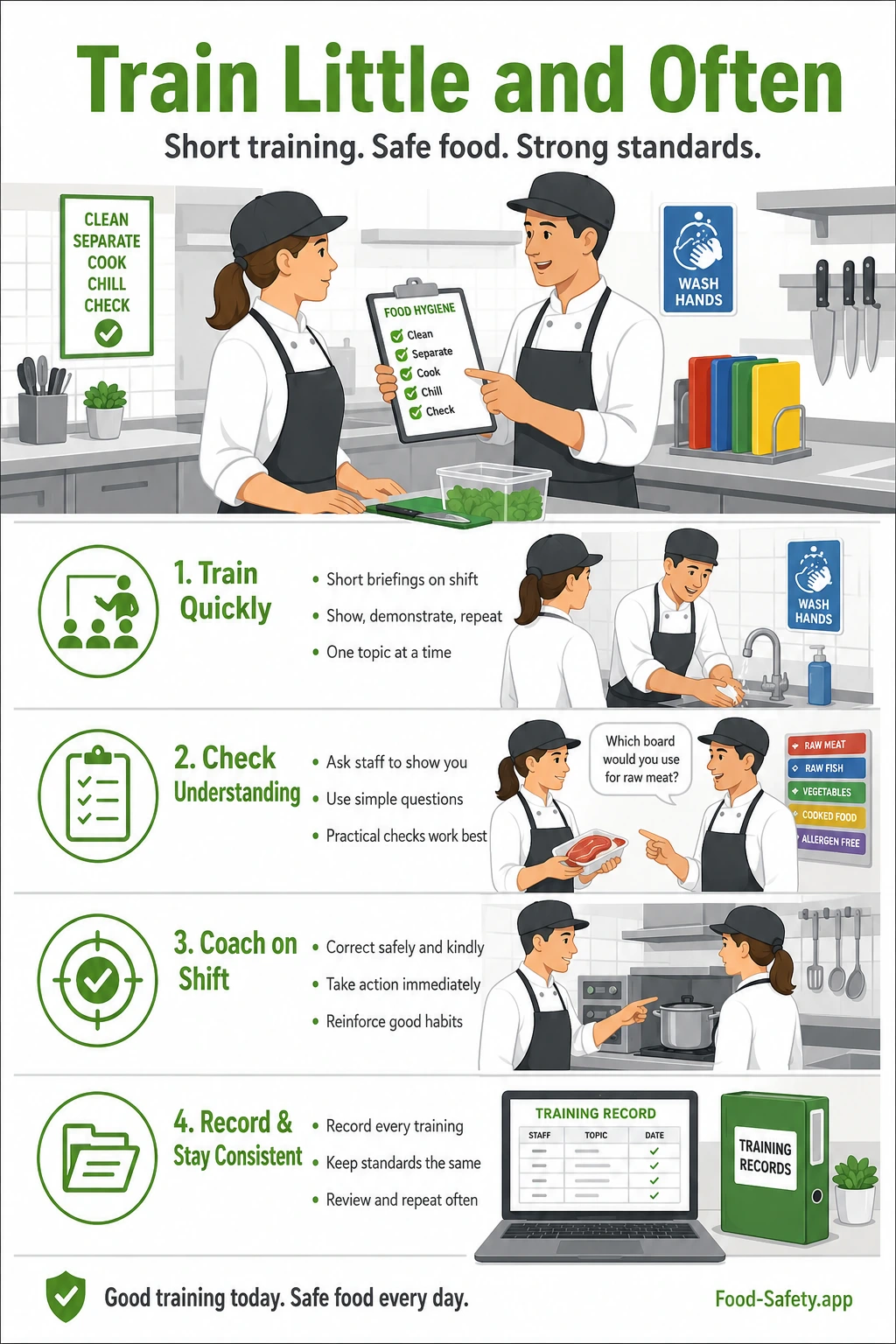
Consistency across shifts: standardised routines
Creating reliable cross-shift routines
- Develop a core set of handwriting-free checklists for opening, mid-service, and closing tasks.
- Train supervisors in the standardized approach so they model the same methods.
- Use simple, repeatable prompts to verify understanding during each shift.
- Record deviations and corrective actions to maintain continuity.
Recording training and competency: evidence for audits
What to capture and how
- Task-by-task signing off with timestamped notes.
- Short refresher sessions and the dates completed.
- Competency checks on critical tasks (handwashing, temperature checks, logging).
- Accessible records for internal reviews and inspections.
Practical scenarios and quick checklists
Use small, task-based scenarios to reinforce learning. For each scenario, run through a quick 5-step checklist. For a quick refresher on fundamentals, see the 4 Cs of food hygiene made practical.
- A new KP staff member learns safe fridge checks, labelled storage, and probe use before service:
- Verify fridge temperatures are recorded twice per shift.
- Check that items are labelled with names and dates.
- Demonstrate probe calibration and proper insertion technique.
- Ask the staff member to perform the checks and log them.
- Sign off with a timestamp and plan a follow-up check.
- A commis chef is shown how to clean a prep area, change cloths, and log the task at the end of shift:
- Show cleaning products and contact times.
- Demonstrate cloth handling to minimise cross-contamination.
- Walkthrough the end-of-shift log and where to record completion.
- Have the staff member perform the tasks and log them.
- Confirm completion and schedule a quick follow-up.
- A waiter is trained on allergen questions, menu checks, and what to do if a customer asks about ingredients:
- Role-play allergen questions using a standard script.
- Explain how to check labels and communicate clearly.
- Practice with a sample customer inquiry.
- Record the interaction as a simple competency check.
- Provide a quick refresher if gaps are found.
- A supervisor spots poor handwashing and gives a same-shift correction, then records follow-up training:
- Pause service briefly to correct posture and technique.
- Explain the correct steps and run through the process together.
- Have the staff member re-wash and engage in a quick recap.
- Document the correction and schedule immediate follow-up.
- Monitor until the behaviour is consistent on the floor.
External resources
For practical guidance on hygiene fundamentals, see trusted public health guidance such as
hand hygiene basics.
Natasha’s Law for small food businesses offers essential allergen management guidance. Learn more.
Food-Safety.app, a food safety management system for catering businesses, can help you record training, track competency, and keep standards consistent.
Onboarding best practices and day-one training insights can also be found in our dedicated guide. How to train new kitchen staff on day one.
To keep staff training records that stand up to audits, see how to keep staff training records that stand up.
Practical onboarding for busy kitchens
Practical onboarding that fits busy kitchens and keeps safety standards consistent through bite sized training and real time coaching every day.