Introduction
Small teams often rely on memory for allergens and that creates risk. Learn the mistakes that lead to unsafe advice and weak compliance.
Table of contents
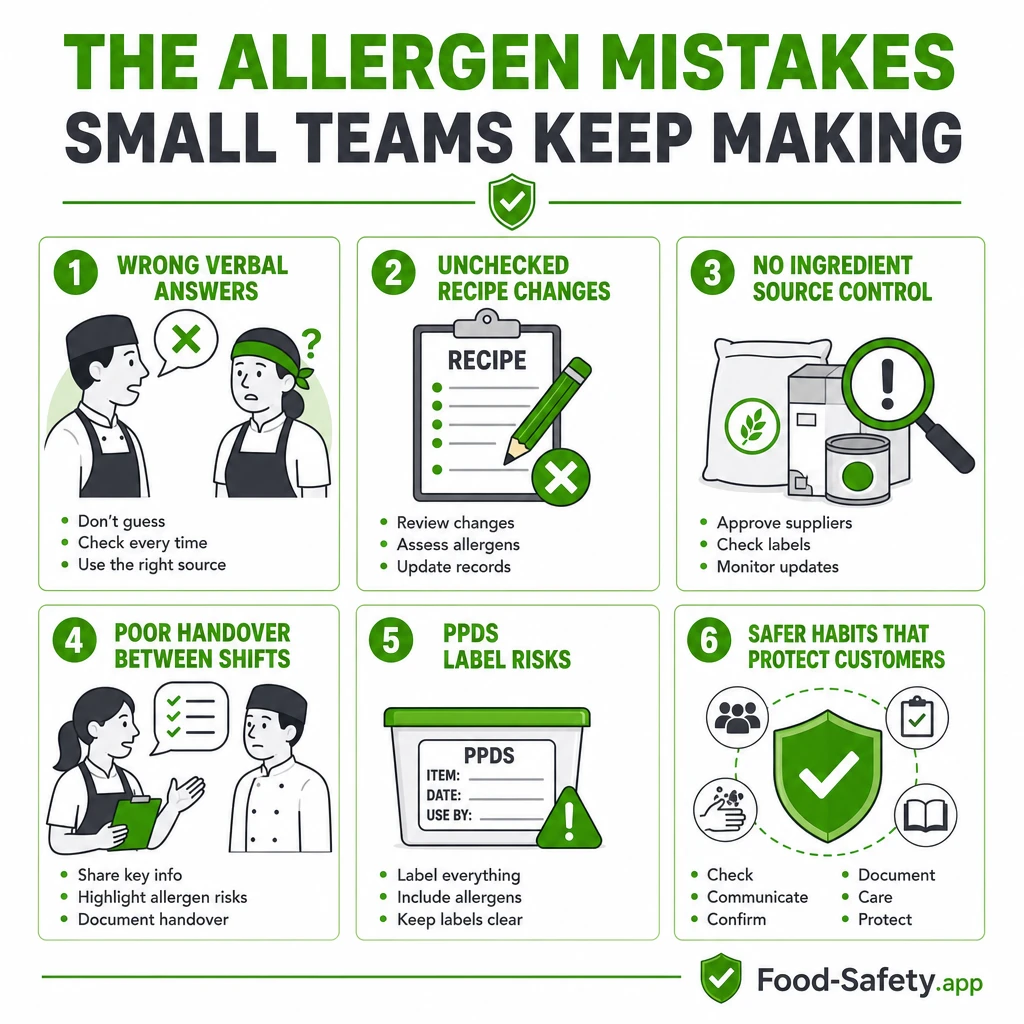
- Wrong verbal answers: why “I think it’s dairy-free” is not enough
- Unchecked recipe changes: keeping allergen status accurate
- No ingredient source control: locking down suppliers and brands
- Poor handover between shifts: preserving allergy notes
- PPDS label risks: staying aligned with the label
- Safer habits that protect customers: practical routines
Wrong verbal answers: why “I think it’s dairy-free” is not enough
In busy service, staff often answer allergy questions from memory or by guessing. This creates risk when customers rely on non-verified statements. Wrong verbal answers can lead to cross-contact or hidden allergens. This section explains how to shift from informal responses to verified information that is traceable in your records. For clearer allergen labeling practices, see clear allergen labeling.
Why words matter
Verbal assurances are easy to misinterpret. If the kitchen team relies on memory or menu versions, customers can be exposed to allergens unintentionally. A single misstatement can lead to a claim or a failed inspection. Clear language that references the current allergen data is essential.
What good practice looks like
- Provide allergen information only from written records or verified digital screens, not from memory.
- Train every front-line staff on the exact allergen status of common items and how to route customers to the information they need.
- Use a standard script: “I’ll check the allergen status and confirm with the kitchen before serving.”
- Record all allergen inquiries and responses in a central log so future staff can verify the answer.
Practical scenarios
- A sandwich filling is substituted by a supplier. The sheet still lists the old filling, and staff answer dairy-free based on memory.
- A customer asks for nut-free, and a chef responds with “no nuts” without consulting the allergen list.
Unchecked recipe changes: keeping allergen status accurate
Small swaps in ingredients, suppliers, or garnishes can change the allergen status without anyone noticing. Without a routine to verify changes, a dish that previously contained nothing problematic can suddenly introduce an allergen. This misalignment often happens when menu updates are slow or procurement is reactive. See how changes can break allergen control.
Why changes matter
Even a minor substitution—such as almond milk replacing dairy milk, a sesame garnish, or a sauce containing peanut oil—can alter the allergen profile. If the change isn’t captured in the allergen records, staff may rely on outdated information.
What good practice looks like
- Require a formal recipe change check before service, with updating the allergen matrix and PPDS as needed.
- Coordinate between the kitchen, procurement and front-of-house to confirm supplier changes and ingredient specs.
- Retain a timestamped record of every alteration, including brand, supplier, lot, and any new allergens.
- Update menus, EPOS item data, and any printed or digital allergen sheets used in service.
Practical scenarios
- A garnish is swapped to a sesame topping mid-service; the allergen sheet is not updated and servers don’t know to avoid sesame.
- A new supplier provides a product with a different nut ingredient; staff assume the old status and continue service.
No ingredient source control: locking down suppliers and brands
Relying on loose ingredients or multiple brands without records creates multiple allergen risks. If the same item arrives from two sources with different ingredients or if a bulk bag is split into smaller portions, allergen data can become unclear. Strong source control reduces variance and simplifies safety checks. See Natasha’s Law for small food businesses for context.
Why source control matters
Different brands may contain different allergen traces or manufacturing processes. Delivery variations can occur without notice, making it harder to assure customers of allergen status.
What good practice looks like
- Maintain a master supplier specification for each item, including allergen ingredients and cross-contamination statements.
- Inspect deliveries on arrival and verify that the item matches the current required brand and lot.
- Record any substitution at delivery in the allergen tracking system and adjust the records accordingly.
- Keep a single source of truth for each ingredient in the kitchen, with a clear chain of custody.
Practical scenarios
- A product is substituted by a supplier, and the team doesn’t log the change; later batches cause cross-contact concerns.
- A bag of loose rice is used without checking for cross-contact warnings on the packaging.
Poor handover between shifts: preserving allergy notes
Allergy notes often fail to survive the handover if teams rely on verbal transfers alone. The next shift starts with missing critical information, and allergens end up unaccounted for during peak service. A reliable handover process is essential for continuous protection. For practical steps, see how to stop cross-contamination in service.
Why handovers fail
In a busy service, last-minute updates can get overlooked. Verbal notes may be forgotten or misinterpreted, leading to inconsistent practice across teams.
What good practice looks like
- Use written handover logs for all allergen-related notes, with clear action items and responsible person.
- Require sign-off on key allergy decisions at the end of each shift.
- Double-check that any post-shift changes are visible to the incoming team before service starts.
- Keep a central allergen update sheet accessible to the entire kitchen and front of house.
Practical scenarios
- A temp team member adds a garnish containing sesame without checking whether it is allowed for a sesame-allergic customer.
- A late shift prep team misses an allergy request because the note was only given verbally.
PPDS label risks: common mistakes with prepacked for direct sale labels
Prepacked for direct sale (PPDS) items need accurate allergen information on the label. Common mistakes include using old ingredient lists after a recipe tweak or failing to update the label when substitutions occur. In busy service, a missing or outdated PPDS label can lead to mis-sold items and enforcement checks. For official guidance on allergen information for prepacked foods, see Food Standards Agency guidance.
Why PPDS labels matter
PPDS rules require allergen information to be present and accurate for foods packaged or labelled in advance of sale. Inaccuracies undermine customer trust and create compliance risk. For practical context, see the 4 Cs of food hygiene made practical.
What good practice looks like
- Review all PPDS items before service and ensure the label matches the current recipe and allergen status.
- Implement a change-record workflow to update PPDS immediately after any recipe modification.
- Archive a copy of the current ingredient list where it is used to label PPDS items for traceability.
- On delivery, re-check PPDS labels against what arrives to avoid mismatches.
For official guidance on allergen information for prepacked foods, see Food Standards Agency guidance.
Practical scenarios
- A PPDS item is relabelled with the old ingredient list after a recipe tweak.
- A chef answers a customer from memory during service, based on an old menu version for a PPDS dish.
Safer habits that protect customers
Putting in place consistent checks, clear records, and a simple system helps teams perform under pressure. The aim is to create reliable habits that staff can follow even during busy service, so allergen information remains accurate and actionable.
Core routines to build
- Opening checks: verify allergen status on all dishes that will be served that shift.
- During service: consult the written allergen data before fulfilling special requests; use a standard response script.
- Closing checks: confirm any changes are finalised, logged, and communicated to the next shift.
- Access to information: keep allergen records visible to cooks, front of house, and managers.
Ongoing training and short drills help staff stay confident. Create a simple handover template, and keep a single source of truth for each item. When the team can access verified data quickly, the risk of allergy mishaps reduces dramatically. For digital records that help maintain this log, see digital food safety records.
Food-Safety.app is a food safety management system for catering businesses.
Learn more
Access practical guides and digital tools to strengthen allergen controls in busy kitchens and protect customers. with consistent routines and clear records.