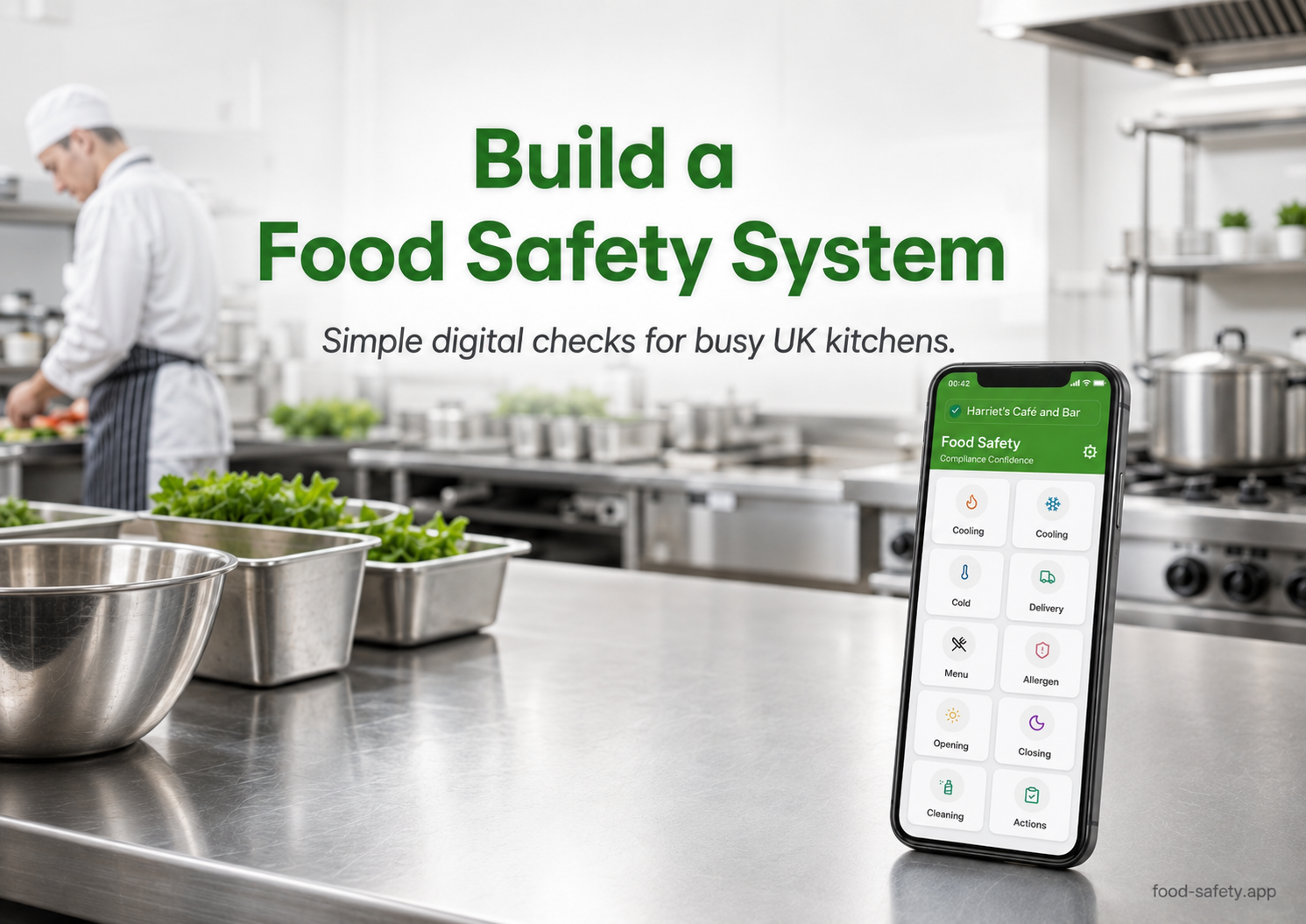
Food safety management is not just about completing temperature sheets. It is the system your business uses to identify risks, control them, train staff, respond to problems and prove that safe procedures are being followed during everyday service.
This guide explains how to build a practical food safety management system for a café, restaurant, takeaway, pub, hotel kitchen or catering operation. It includes real-world examples, suggested records, corrective actions and management review checks.
What is a food safety management system?
A food safety management system is the combination of procedures, responsibilities, checks, records and corrective actions a business uses to keep food safe.
It should explain:
- What food safety risks exist in the business
- How those risks are controlled
- Who is responsible for each control
- How staff check that controls are working
- What happens when something goes wrong
- How managers verify that the wider system remains effective
A temperature record on its own is not a management system. It becomes part of a management system when staff know why the temperature is checked, what limit applies, who reviews the result and what action must be taken if the reading is unacceptable.
Real-world example: a busy café opening for breakfast
At 7:00 am, the opening supervisor checks the display fridge. The reading is outside the café’s documented safe limit. Instead of simply writing down the number, the supervisor checks the temperature with a clean, calibrated probe, moves high-risk food to another suitable fridge, labels the affected stock, reports the fault and records the corrective action.
The manager later reviews the incident and discovers that the fridge door had not closed properly after the previous evening’s clean-down. The closing checklist is updated so staff must confirm that each refrigerator door is fully shut before leaving.
That complete process—checking, responding, recording, investigating and improving—is food safety management.
For a more detailed introduction to the underlying principles, read what HACCP means in food safety management.
What does a UK catering business need?
UK food businesses must put suitable food safety procedures in place based on HACCP principles. In practical terms, this means identifying hazards, deciding how they will be controlled, monitoring important controls, correcting failures and keeping appropriate evidence.
The exact system should reflect what the business actually does. A small coffee shop selling prepacked cakes will not need the same controls as a hotel kitchen that cooks, cools, stores and reheats large batches of food.
The Food Standards Agency provides official guidance on HACCP-based food safety management systems. Smaller catering businesses may also use Safer Food, Better Business for caterers, where appropriate.
Important: A folder of forms does not prove that food is being managed safely. Procedures should match the kitchen’s real activities, and completed records should be supported by safe practice.
Who should be responsible?
Responsibility should be allocated by role, not left as “everyone’s job”. For example:
- The opening supervisor checks refrigeration equipment
- The chef in charge verifies cooking and cooling controls
- The kitchen porter completes assigned cleaning tasks
- The front-of-house supervisor controls allergen enquiries
- The manager reviews missed checks and corrective actions
There should also be cover when the usual responsible person is absent. If only one manager knows how to review records or answer an allergen question, the system is too dependent on one person.
Businesses reviewing their legal responsibilities can also read UK food safety law explained for everyday practice.
What are the seven parts of a practical food safety system?
A useful system can be organised into seven connected areas.
1. Clear responsibilities
Every important task should have an owner, a frequency and a backup person. Staff should know who has authority to reject a delivery, remove food from sale or stop an unsafe process.
2. Hazard controls
The business should identify microbiological, chemical, physical and allergen hazards that could occur during delivery, storage, preparation, cooking, cooling, reheating, holding and service.
3. Daily monitoring
Staff should complete meaningful checks at the right time. A result written down after the shift does not demonstrate that the control was monitored when it mattered.
4. Cleaning and maintenance
Cleaning tasks should state what is cleaned, how it is cleaned, which product is used, who completes it and how completion is checked. Equipment faults should be recorded and followed through to repair.
5. Allergen control
Recipes, supplier specifications, labels and front-of-house information must remain aligned. Staff should never guess whether a dish contains an allergen.
6. Training and supervision
Training should match each person’s duties. Managers should observe staff completing tasks rather than relying only on certificates.
7. Review and improvement
Managers should look for repeated failures, incomplete records and changes to menus, suppliers, equipment or working methods. The system should be updated when the business changes.
Which food safety records does your business need?
Records should be selected because they help control a real risk, not because another business uses the same form. The table below gives common examples for catering operations.
| Business activity | Useful record or evidence | Typical timing | Possible owner |
|---|---|---|---|
| Receiving chilled or frozen food | Delivery condition, temperature and acceptance check | At each relevant delivery | Chef or trained goods-in employee |
| Chilled and frozen storage | Equipment temperature or product check | According to the documented procedure | Opening and closing supervisor |
| Cooking high-risk food | Validated cooking check or core temperature record | By batch, item or documented process | Chef responsible for cooking |
| Cooling cooked food | Cooling time and temperature record | For relevant batches | Chef or production supervisor |
| Cleaning and disinfection | Cleaning schedule and verification check | Per task or area | Assigned team member and supervisor |
| Allergen management | Recipe, ingredient, supplier and allergen matrix review | Whenever a recipe, product or supplier changes | Manager or nominated allergen lead |
| Probe use | Cleaning and calibration evidence | According to the business procedure | Chef or supervisor |
| Staff competence | Induction, task training and supervision record | At induction and during reviews | Manager or team leader |
| Failed checks | Corrective action and follow-up record | Whenever a failure occurs | Person responding and reviewing manager |
For a closer look at practical documentation, read how HACCP records are used in a working kitchen.
Avoid collecting records nobody reviews
A takeaway may have months of completed fridge sheets but no evidence that anyone investigated repeated high readings. In that situation, the business has collected data without managing the risk.
Every record should answer three questions:
- What decision will this record help us make?
- Who will review it?
- What will happen if the result is unacceptable?
How do you create a food safety plan?
Start by following the journey food takes through the business. Do not begin with a generic template and try to force the kitchen into it.
- Map the process. List delivery, storage, preparation, cooking, cooling, reheating, hot holding, transport and service activities that apply.
- Identify hazards. Consider what could make food unsafe at each stage.
- Define controls. State what the business does to prevent, remove or reduce each hazard.
- Set limits or standards. Define what an acceptable result looks like.
- Decide how controls are monitored. Explain what is checked, how, when and by whom.
- Write corrective actions. Tell staff what to do when a check fails.
- Keep suitable evidence. Record results and actions where records add value.
- Verify and review. Confirm that the system works and still reflects the operation.
Worked example: cooking and cooling chicken curry
A pub kitchen prepares chicken curry in batches for service the following day.
| Stage | Possible risk | Control | Monitoring | Example corrective action |
|---|---|---|---|---|
| Raw chicken preparation | Cross-contamination of ready-to-eat food | Separate preparation area, equipment and effective cleaning | Supervisor observation and cleaning checks | Stop preparation, isolate affected food, clean and disinfect the area, then assess whether any food must be discarded |
| Cooking | Harmful bacteria survive | Use the business’s validated cooking method and limit | Check an appropriate part of the batch with a clean probe | Continue cooking and recheck, or discard if safety cannot be demonstrated |
| Cooling | Bacteria multiply while food remains warm | Divide into smaller containers and use a suitable rapid-cooling method | Record time and temperature according to the cooling procedure | Use an alternative safe cooling method, assess the batch and discard it if safe control cannot be confirmed |
| Cold storage | Unsafe storage temperature or excessive storage time | Label, date and refrigerate under controlled conditions | Storage checks and date control | Move food to suitable storage, assess exposure and investigate equipment failure |
| Reheating | Food is not reheated thoroughly | Use the documented reheating method | Check the centre and any likely cold spots | Continue reheating and recheck, or discard if the process cannot be completed safely |
This example should be adapted to the business’s recipes, equipment, batch sizes and documented safe limits.
Businesses that cool food regularly may also find this practical guide to cooling food safely useful.
What should happen when a food safety check fails?
A failed check is not automatically evidence of poor management. Ignoring it, hiding it or recording no response is the bigger problem.
A useful corrective-action process has six steps:
- Make the immediate situation safe
- Identify and isolate affected food
- Assess what happened and for how long
- Report the problem to the responsible person
- Record the decision and action taken
- Investigate the cause and prevent a repeat
Scenario 1: a refrigerator is outside its limit
The opening cook notices an unacceptable display reading. They verify it using the business’s agreed method, move affected food to suitable storage and label it so it is not used until assessed. The manager checks how long the unit may have been outside control and records the decision made about the food.
The engineer later finds that cardboard packaging was blocking the internal airflow. Staff are retrained on loading the fridge, and the maximum fill line is marked clearly.
Scenario 2: a delivery arrives in poor condition
A supplier delivers yoghurt pots with damaged lids and signs of leakage. The employee does not accept them simply because the café is short of stock. The affected items are rejected, the reason is recorded and the manager contacts the supplier.
The menu is adjusted for the day rather than using food whose safety or integrity cannot be confirmed.
Scenario 3: a cooking check is missed
During a busy wedding service, a tray of chicken is moved towards service before the agreed check has been completed. The supervisor stops the tray from leaving the kitchen, completes the check and confirms whether further cooking is needed.
After service, the team changes the workflow so trays cannot enter the service area until the chef has attached a completed batch label.
For more detail, see how to record corrective actions that lead to improvement.
How should allergen management be organised?
Allergen management depends on accurate information moving between suppliers, managers, kitchen staff and front-of-house employees.
The system should cover:
- Current ingredient and supplier information
- Documented recipes and menu items
- The regulated allergens present in each item
- Controls for allergen cross-contact
- How customer questions are handled
- How changes are communicated across shifts
- How prepacked for direct sale food is labelled, where relevant
Real-world example: an emergency supplier substitution
A restaurant’s usual burger bun is unavailable, so the wholesaler sends a different brand. The packaging looks similar, but the substitute contains sesame.
A weak system allows the buns to go straight into service because the product name appears unchanged. A stronger system requires the person receiving the delivery to identify substitutions, check the ingredient information and notify the manager before the product is used.
The allergen matrix is updated, kitchen and front-of-house staff are briefed, and the old information is removed from use. Until those steps are complete, staff do not guess or rely on memory.
Read how to prevent allergen errors after supplier changes and how to build a practical allergen management process.
The Food Standards Agency also provides official allergen guidance for food businesses.
How should staff be trained and supervised?
Training should match the tasks each person performs. A new kitchen assistant may need practical instruction on handwashing, illness reporting, cleaning chemicals and cross-contamination. A chef may need additional instruction on cooking, cooling, reheating and probe use. Front-of-house employees need a clear process for allergen enquiries.
Certificates can support learning, but they do not prove that someone can complete a task correctly in your workplace.
A practical training process
- Explain why the task matters
- Demonstrate the correct method
- Ask the employee to perform the task
- Check their understanding with practical questions
- Record what was covered
- Observe the employee again during normal service
- Provide refresher training when standards slip or procedures change
Real-world example: the completed cleaning sheet
A new employee signs that the meat slicer has been cleaned. The supervisor checks the machine and finds food debris behind the guard.
Rather than treating the signature as proof, the supervisor asks the employee to demonstrate the cleaning method. It becomes clear that nobody showed them how to remove the guard safely.
The manager provides task-specific instruction, updates the cleaning card with photographs and adds a supervisor verification check for the next two weeks.
For a structured onboarding process, see food safety induction training for new staff.
How should managers monitor and improve food safety management?
Monitoring is the completion of individual checks. Verification is the wider process of confirming that the system is suitable and being followed.
A manager should not only ask, “Was the fridge sheet completed?” They should also ask:
- Were readings taken at the correct time?
- Do the results look credible?
- Were unacceptable results acted upon?
- Are the same failures happening repeatedly?
- Do staff understand the required response?
- Does the written procedure still match the kitchen?
Weekly management review
- Review missed or late checks
- Review failed temperature results
- Check that corrective actions were completed
- Follow up outstanding equipment faults
- Confirm allergen or supplier changes were recorded
- Inspect selected cleaning tasks
- Check that new staff received suitable instruction
Monthly management review
- Look for repeated failures or patterns
- Review complaints and food safety incidents
- Check whether procedures need updating
- Review changes to menus, suppliers or equipment
- Identify staff training or supervision gaps
- Confirm that completed records are easy to retrieve
- Assign actions, owners and completion dates
Real-world example: repeated high fridge readings
A manager reviewing one week of records notices that the sandwich fridge is repeatedly outside its normal range at approximately 12:30 pm.
The unit works normally at opening and closing, so the manager observes lunchtime service. Staff are leaving the door open while assembling orders, and warm stock is being placed inside immediately before the rush.
The business changes the preparation routine, limits how long the door remains open and moves newly prepared stock into suitable refrigeration earlier. The manager then reviews the following week’s results to check whether the changes worked.
Inspection preparation is easier when this type of review happens routinely. See how to prepare for an official food safety inspection.
Should you use paper or digital food safety records?
Both paper and digital systems can support food safety when they are suitable for the business and used properly. The best option depends on the complexity of the operation, the number of staff and how easily managers can review completed work.
| Area | Paper records | Digital records |
|---|---|---|
| Ease of use | Familiar and simple for small teams | Can make recurring checks quicker once configured |
| Missed tasks | Depend heavily on memory and manual review | May provide clearer task lists or prompts |
| Record history | Stored across diaries, folders or sheets | Can be organised in one searchable history |
| Corrective actions | May be written separately or overlooked | Can be linked directly to a failed check |
| Management review | Requires managers to inspect physical documents | Can make patterns and incomplete records easier to find |
| Reporting | Usually requires scanning or manual collation | May allow organised PDF exports |
| Equipment | Requires forms, pens and suitable storage | Requires a compatible phone, tablet or computer |
| Suitability | Can work well for a small, simple operation | Can help when several checks, people or locations are involved |
A digital system does not make an unsafe procedure safe. It cannot replace suitable limits, trained staff, clean equipment or good management. Its value is in making an effective system easier to complete, organise and review.
Read what digital food safety records are and how they help or compare the advantages and limitations of SFBB.
When is a food safety app worthwhile?
A food safety app may be worth considering when the problem is no longer the design of the food safety procedure, but completing and reviewing it consistently.
Digital records may be useful when:
- Several employees complete checks across different shifts
- Paper sheets are frequently missed, lost or damaged
- Corrective actions are difficult to follow through
- Managers spend too long reviewing separate folders
- The business has many items of refrigeration equipment
- Allergen, cleaning and training records are stored separately
- Records need to be exported for review or inspection
- Managers want clearer evidence of when checks were completed
Real-world example: the takeaway with three paper folders
A takeaway stores temperatures in one folder, cleaning sheets beside the sink and staff training records in the office. When the manager investigates a complaint, it takes nearly an hour to find the relevant delivery, refrigeration and staff records.
Moving those checks into one organised system does not change the underlying controls, but it makes the evidence faster to review and reduces the chance that an important record is overlooked.
How Food-Safety.app supports daily management
Food-Safety.app is a digital HACCP food safety management system designed for cafés, restaurants, takeaways, pubs and catering businesses.
It can bring together:
- Temperature and equipment records
- Cleaning schedules
- Delivery checks
- Allergen information
- Staff training evidence
- Corrective actions
- Record histories and PDF exports
The system should be configured around the business’s own equipment, procedures and safe limits. It supports management but does not replace the need for competent staff, suitable HACCP-based procedures or appropriate supervision.
Businesses ready to compare options can view Food-Safety.app pricing and plan information.
Food safety management checklist for catering businesses
Use this checklist to identify the most important gaps in your current system.
- A named person has overall responsibility for food safety management
- Important daily tasks have named owners and backup staff
- The food safety plan reflects what the kitchen actually prepares and serves
- Hazards and controls have been identified at each relevant process stage
- Staff know the limits or standards that apply to their checks
- Corrective actions explain what staff must do when a check fails
- Refrigeration, cooking, cooling and reheating controls are suitable for the operation
- Cleaning schedules describe the correct method, frequency and responsibility
- Allergen information is updated when recipes, ingredients or suppliers change
- New staff receive practical induction before working without supervision
- Managers observe staff completing important tasks
- Failed checks and equipment faults are followed through to completion
- Records are reviewed rather than simply stored
- Repeated problems are investigated for an underlying cause
- The system is reviewed after menu, supplier, equipment or process changes
- Relevant records can be found quickly when needed
If several items are missing, improve the underlying procedures before adding more forms. A smaller system that staff understand and managers review is more useful than a large system that exists only on paper.